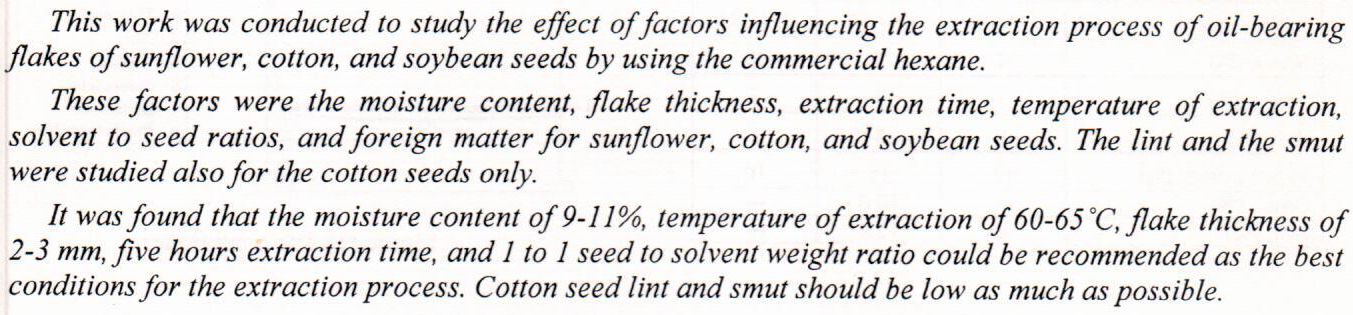
Factors Affecting the Extraction Process

Reconstruction project management in the cities of Mosul, Anbar, and Tikrit, in Iraq still faces major obstacles that impede the comprehensive performance of these projects. It is thus necessary to improve the arising challenge estimation in the implementation of reconstruction projects and evaluate their components: time, cost, quality, and scope. This study used the Analytical Hierarchy Process (AHP) to prioritize major and minor criteria in the influential causes of challenges and formulate a mathematical model to help decision-makers estimate them. Using the Super Decisions software, the final results indicated that changes in scope reached 40.8%, which is the greatest difficulty, followed by changes in cost at 27.6%, changes in
... Show More (1)
(1)
 (3)
(3)


This research is Interested in how the performance and implementation of factory production engine coolants of the General Company for Electrical Industries of its work, and to facilitate the flow of the decisions of senior management and access to all configurations, to ensure differentiation desired and reduce lost sales, resulting from poor scheduling of operations through the application of certain rules of scheduling operations in the production plant Engines Air-cooler, the objectives of research in identifying the best base and working to reduce the time and cost of Same Rules of Process which are considered the most influential of any organization and thr
... Show More
Due to the developments taking place in the field of communications, informatics systems and knowledge management in the current century, and the obligations and burdens imposed on the business organization to keep pace with these developments, the traditional methods of administrative decision-making are no longer feasible, as recent trends have emerged in management that focus on the need to rely on quantitative methods such as operations research.. The latter is one of the results of World War II, which appeared for the first time in Britain to manage war operations. The first method used in this field is the linear programming method. The use of operations research has developed greatly in the past years, and the methods of analysis in
... Show MoreStereo lithography (SLA) three-dimensional (3D) printing process is a type of additive manufacturing techniques that uses digital models from computer-aided design to automatically produce customized 3D objects. Around 30 years, it has been widely utilized in the manufacturing, design, engineering, industrial sectors and its applications in dentistry for manufacturing prosthodontics are very important. The stereo lithography technology is highly regarded because it can produce items with excellent precision especially when selecting the best process parameters. This review article offers a useful and scientific summary of SLA three-dimensional printing technology and its brief history. The specific type of 3D printers which is SLA t
... Show More
(32)
(30)
Stereo lithography (SLA) three-dimensional (3D) printing process is a type of additive manufacturing techniques that uses digital models from computer-aided design to automatically produce customized 3D objects. Around 30 years, it has been widely utilized in the manufacturing, design, engineering, industrial sectors and its applications in dentistry for manufacturing prosthodontics are very important. The stereo lithography technology is highly regarded because it can produce items with excellent precision especially when selecting the best process parameters. This review article offers a useful and scientific summary of SLA three-dimensional printing technology and its brief history. The specific type of 3D printers which is SLA type b
... Show More
(32)
(30)
An expression for the transition charge density is investigated where the deformation in nuclear collective modes is taken into consideration besides the shell model transition density. The inelastic longitudinal form factors C2 calculated using this transition charge density with excitation of the levels for Cr54,52,50 nuclei. In this work, the core polarization transition density is evaluated by adopting the shape of Tassie model together with the derived form of the ground state two-body charge density distributions (2BCDD's). It is noticed that the core polarization effects which represent the collective modes are essential in obtaining a remarkable agreement between the calculated inelastic longitudinal F(q)'s and those of experimen
... Show More
(1)
The research was performed in order to investigate the prevalence of Eimeria spp in buffalo. Coccidiosis, is a common livestock disease include water buffaloes and nothing is known about the most pathogenic species of Eimeria. Since the highest prevalence of oocyst shedding and incidence of disease occurs in buffalo calves less than one year of age. The omnipresent occurrence and negative effects of the infection on health and buffalo growth output are taken into account. Therefore, both farmers and veterinarians should pay greater attention to infections with Eimeria spp. And there is little analysis of data reported in Iraq and the world regarding Eimeria infection in river buffalo spp.
The effect of short range correlations on the inelastic longitudinal
Coulomb form factors for different states of J 4 , T 1with
excitation energies 3.553,7.114, 8.960 and 10.310 MeV in 18O is
analyzed. This effect (which depends on the correlation parameter )
is inserted into the ground state charge density distribution through
the Jastrow type correlation function. The single particle harmonic
oscillator wave function is used with an oscillator size parameter b.
The parameters and b are considered as free parameters, adjusted
for each excited state separately so as to reproduce the experimental
root mean square charge radius of 18O. The model space of 18O does
not contribute to the tra
In this research, the influence of the fermentation treatments and baking in Iraqi’s flour type (Ibaa 99, Al-rashed, Tamus, Abu-grabe) and Turkish flour type (Muaamel) on phytic acid was investigated. In whole wheat flour, the phytic acid was (1500, 1290, 1450, 1230, 1440 ( mg/ 100 g flour respectively, and the inorganic phosphorous was (29.18, 25.15, 23.89, 20.85, 22.83) mg/100 g flour respectively. The dough prepared from flour with a higher phytic acid content also contained higher amount of phytic acid. During fermentation, degradation of phytic acid occurred. The cumulative loss of phytic acid after fermentation in all type of dough was ~ 23, 22, 34, 26 and 27% respectively،While increased of inorganic phosphorous occurred. The c
... Show MoreBackground: Autism is a complex developmental disability that typically appears during the first three years of life. Autism affects the normal development of the brain in the areas of social interaction and communication skills.Objectives: To identify risk factors for Autism among a sample of autistic children in Baghdad city. Type of the study: this is a case – control, study. Methods: This study was conducted during the period of data collection extended from first of November 2010 until the first of April 2011,The total number of children involved was 100children with diagnosis of autism. Handred children who are free from autism were taken as the control sample. Results: there was a significant association between paternal age and
... Show More