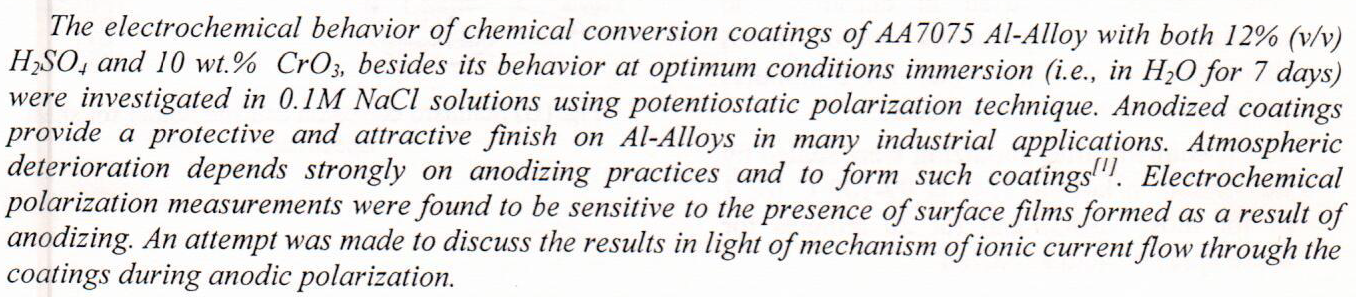
Electrochemical behavior of Anodized AA7075 Aluminum Alloy in 0.1M NaCl Solution as Investigated by Potentiostatic Polarization Ttechnique

Solar collectors, in general, are utilized to convert the solar energy into heat energy, where it is employed to generate electricity. The non-concentrating solar collector with a circular shape was adopted in the present study. Ambient air is heated under a translucent roof where buoyant air is drawn from outside periphery towards the collector center (tower base). The present study is aimed to predict and visualize the thermal-hydrodynamic behavior for airflow under inclined roof of the solar air collector, SAC. Three-dimensional of the SAC model using the re-normalization group, RNG, k−ε turbulence viscus model is simulated. The simulation was carried out by using ANSYS-FLUENT 14.5. The simulation
... Show More (5)
(5)

Electrochemical Grinding (ECG) process is a mechanically assisted electrochemical process for material processing. The process is able to successfully machine electrically conducting harder materials at faster rate with improved surface finish and dimensional control. This research studies the effect of applied current, electrolyte concentration, spindle speed and the gap between workpiece and tool on hardness and material removal rate during electrochemical grinding for stainless steel 316. The characteristic features of the electrochemical grinding process are explored through Taguchi-design-based experimental studies. The better hardness can be obtained at 10 A of the current, 150 g/l of the electrolyte concentration, 0.3 mm of gap an
... Show More (8)
(9)
(8)
(9)


Ionic liquids (ILs) and deep eutectic solvents (DESs) have been found to be highly effective as electrolytes in TiO2 NTAs-graphite cells when combined with additives that enhance conductivity by reducing the viscosity of these liquids. The presence of CaCl2.6H2O: Acetamide DES with DI water as an additive resulted in a cell voltage of 1.31V and an internal resistance of 19 ohm. This can be attributed to the concentration and quality of the ionic species. The cells exhibited an interesting response to the AlCl3-chloroacetamide IL with dichloromethane DCM as an additive, with a cell voltage of 1.81V and an internal resistance of 5.0 ohm. Once again, this is influenced by the quality and concentration of the ionic species. Furthermore,
... Show More
(2)
In this study, copper was removed from an aqueous solution through electromembrane extraction (EME), a new approach that utilises a two-chamber electrochemical cell. It consists of two electrodes (stainless steel cathode and graphite anode) and a solid liquid membrane (SLM). SLM is composed of supporting polypropylene membrane impregnated with1-octanol as an organic solvent and bis(2-ethylhexyl) phosphate (DEHP) as a carrier. The effects of process parameters such as applied voltage, pH and copper concentration on the removal of copper were investigated. Response surface methodology (RSM) was applied to optimise these parameters and their interactions. Results indicated that pH has the major effect on the removal of copper, followed
... Show More
(2)
(3)
Emotional exhaustion considered one of the critical factors in the formation and composition of organizational behavior of individuals within organizations, as well as social behavior and psychological, and emotional exhaustion is one of the three components of burnout, as well as depersonalization (cynicism) and low achievement, the emergence of research relevant to this concept began at the beginning of the seventies of the twentieth century, then started to become clear features in the eighties it. This research aims to build intellectual framework for draining emotional exhaustion through highlight on most important philosophical contents, as well as review and analysis of some models associated with this concept, and then a
... Show More
Abstract
The present research paper provides an analysis of Thomas Dekker’s
exaltation of the figure of the Babylonian woman as a tragic heroine in his dramatic
art. The paper falls into two sections. The first section outlines the deliberate
mispresentation of the figure of the Babylonian woman in the Bible and the
misreading of that figure. The second section reveals Dekker’s rectification of the
distorted image of the Babylonian woman, whom he defends and glorifies as a
heroine and a victim of misinterpretation and conspiracy.
In this study, nickel cobaltite (NC) nanoparticles were created using the sol-gel process and used as an adsorbent to adsorb methyl green dye (MG) from aqueous solutions. The adequate preparation of nickel cobaltite nanoparticles was verified using FT-IR, SEM, and X-ray diffraction (XRD) studies. The crystalline particle size of NC nanoparticles was 10.53 nm. The effects of a number of experimental variables, such as temperature, adsorbent dosage, and contact time, were examined. The optimal contact time and adsorbent dosage were 120 minutes and 4.5 mg/L, respectively. Four kinetic models—an intraparticle diffusion, a pseudo-first-order equation, a pseudo-second-order equation, and the Boyd equation—were employed to monitor the adsorpti
... Show MoreThis study present, the density of alum chrom in water and in aqueous solution of poly (ethylene glycol) (1500) at different temperature (288.15, 293.15, 298.15) k. Experimental values of density was used to calculate the apparent molar volume (Vθ), limiting apparent molar volume Vθ˚, experimental slope (Sv) and the partial molar volume at infinite dilution of transfer of solute Δνθ˚. These results have been interpreted the molecular interaction in term of ion- solvent, ion– ion interaction. The structure making /breaking capacities have been inferred from the sign of the second derivative of limiting partial molar volume with respect temperature at constant pressure. Alum has been formed to act as structure breaker in water and aq
... Show MoreIn Incremental sheet metal forming process, one important step is to produce tool path, an
accurate tool path is one of the main challenge of incremental sheet metal forming
process. Various factors should be considered prior to generation of the tool path i.e.
mechanical properties of sheet metal, the holding mechanism, tool speed, feed rate and
tool size. In this work investigation studies have been carried out to find the different tool
path strategies to control the twist effect in the final product manufactured by single point
incremental sheet metal forming (SPIF), an adaptive tool path strategy was proposed and
examined for several Aluminum conical models. The comparison of the proposed tool path with t
(2)