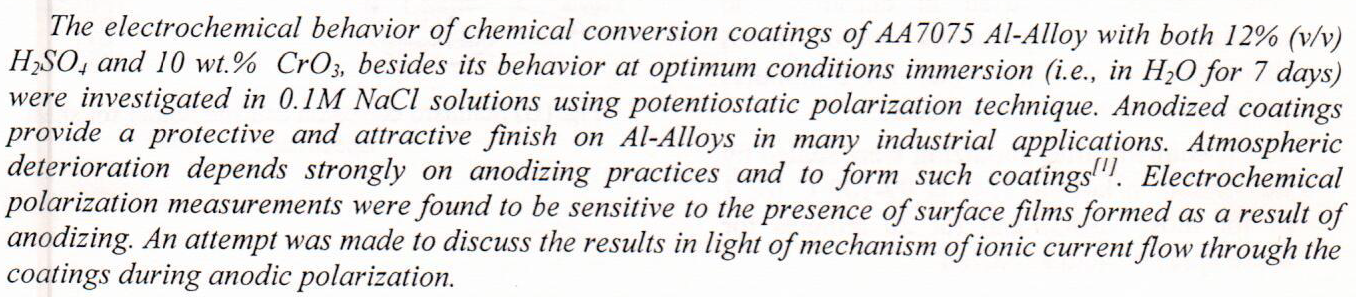
Electrochemical behavior of Anodized AA7075 Aluminum Alloy in 0.1M NaCl Solution as Investigated by Potentiostatic Polarization Ttechnique

Granular Pile Anchor (GPA) is one of the innovative foundation techniques, devised for mitigating heave of footing resulting from the expansive soils. This research attempts to study the heave behavior of (GPA-Foundation System) in expansive soil. Laboratory tests have been conducted on an experimental model in addition to a series of numerical modeling and analysis using the finite element package PLAXIS software. The effects of different parameters, such as (GPA) length (L) and diameter (D), footing diameter (B), expansive clay layer thickness (H) and presence of non-expansive clay are studied. The results proved the efficiency of (GPA) in reducing the heave of exp
... Show More (8)
(8)

The research shows the importance of orientation towards the formulation of the green strategy and its effect in determining the behavior of the green municipal institution in Babel governorate. The research highlighted the formulation of the green strategy as an important variable, especially today, the trend towards protecting the environment and minimizing the damage resulting from the delivery of services, and through it also the type of green behavior or performance adopted by the municipal institution and the emergence of the need for a strategy that is not harmful to the environment. The research took the sample intentionally comprehensive size of 222 personnel of municipal institutions and some formations concerned with t
... Show More
Density data of alum chrom in water and in aqueous solution of poly (ethylene glycol) (1500) at different temperatures (288.15, 293.15, 298.15) k have been used to estimate the apparent molar volume (Vθ), limiting apparent molar volume (Vθ˚) experimental slope (Sv) and the second derivative of limiting partial molar volume [δ2 θ v° /δ T2] p .The viscosity data have been analyzed by means of Jones –Dole equation to obtain coefficient A, and Jones –Dole coefficient B, Free activation energy of activation per mole of solvent, Δμ10* solute, Δμ20* the activation enthalpy ΔH*,and entropy, ΔS*of activation of viscous flow. These results have been discussed in terms of solute –solvent interaction and making/breaking ability of so
... Show More (30)
(28)
(30)
(28)

 (12)
(8)
(12)
(8)
Gel polymer electrolytes (GPEs) have drawn a lot of interest due to their special qualities, which include high conductivity that is comparable to liquid electrolytes, excellent mechanical stability, and high flexibility. Using the solution casting approach, we have synthesized copper ion conducting gel polymer electrolyte (GPE) films made of polyvinyl alcohol (PVA) as the polymer host. An ionic salt, copper sulphate (CuSO 4 ), and a plasticizing solvent, PANI/ [BMIM] [BF 4 ] polyionic liquid, were employed. The structural, electrical, and electrochemical properties of the GPE films were carefully examined. The significant XRD crystalline peak decreased and disappeared upon the addition of PANI/[BMIM] [BF 4 ] polyionic liquid, suggesting th
... Show More
(44)
(43)
This research presents a new study in kinetics under reactive distillation by using consecutive two – step reaction : the saponification reaction of diethyl adipate with sodium hydroxide solution . The distillation process takes the role of withdrawing the intermediate product (sodium monoethyladipate SMA) which otherwise converts to the final product of low purity.The effect of three parameters were studied through a design of experiments applying 23 factorial design. These parameters were : the mole ratio of DA to NaOH solution (0.1 and 1) , NaOH solution concentration (3 N and 8 N) , and batch time (1.5 hr. and 3.5 hr.) . The conversion of DA to sodium monoethyladipate(SMA)(intermediate product) was the effect of these pa
... Show More