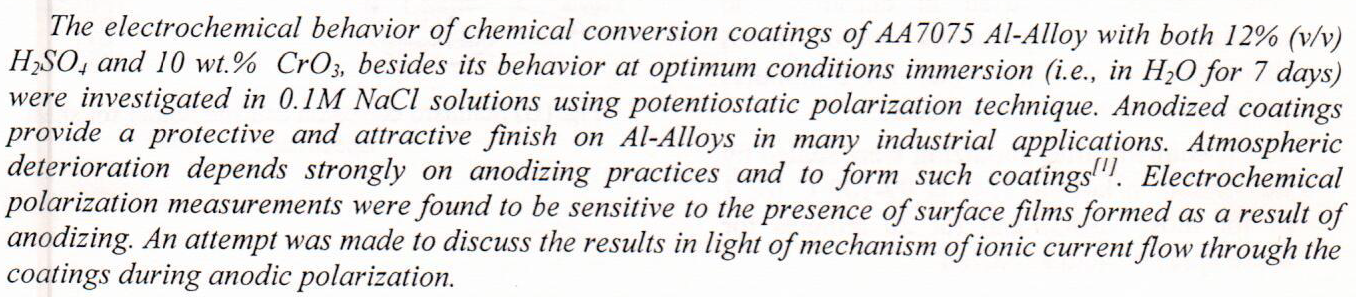
Electrochemical behavior of Anodized AA7075 Aluminum Alloy in 0.1M NaCl Solution as Investigated by Potentiostatic Polarization Ttechnique

The corrosion of carbon steel in single phase (water with 0.1N NaCl ) and two immiscible phases (kerosene-water) using turbulently agitated system is investigated. The experiments are carried out for Reynolds number (Re) range of 38000 to 95000 corresponding to rotational velocities from 600 to 1400 rpm using circular disk turbine agitator at 40 0C. In two-phase system test runs are carried out in aqueous phase (water) concentrations of 1 % vol., 5 % vol., 8% vol., and 16% vol. mixed with kerosene at various Re. The effect of Reynolds number (Re), percent of dispersed phase, dispersed drops diameter, and number of drops per unit volume on the corrosion rate is investigated and discussed. Test runs are carried out using two types of
... Show MoreRemoval of heavy metals from waste water has received a great deal of attention. The compare Cr
(VI) adsorption characteristics removing from wastewater by using thermally modified and non-modified
eggshells were examined

This study was aime to investigate the effect of addition different concentration of celery leaves to white soft cheese ,Treated cheese between 2018-2019, ,The finely Celery (Apium graveolens) leaves were adding to crude white cheese after texturizing in three leveles included (A,B,C) in addition of control antimicrobial activity of celery treated cheese against total account bacteria and coliform bacteria was estimated during (0, 5, 10, 15, 20) days. The results were shown that the higher concentration of celery in treated cheese, had a lower concentration of protein, lipid and ash content ( 16.81,15.13 and 4.30% respectively, but it had a higher moisture content 59.50%.also the total bacteria counts were decreasing significantly (0.05 P)w
... Show More (12)
(12)
 (6)
(6)
 (3)
(3)
 (14)
(8)
(14)
(8)
It is well known that petroleum refineries are considered the largest generator of oily sludge which may cause serious threats to the environment if disposed of without treatment. Throughout the present research, it can be said that a hybrid process including ultrasonic treatment coupled with froth floatation has been shown as a green efficient treatment of oily sludge waste from the bottom of crude oil tanks in Al-Daura refinery and able to get high yield of base oil recovery which is 65% at the optimum operating conditions (treatment time = 30 min, ultrasonic wave amplitude = 60 micron, and (solvent: oily sludge) ratio = 4). Experimental results showed that 83% of the solvent used was recovered meanwhile the main water
... Show More
(1)
Biologically active natural compounds are molecules produced by plants or plant-related microbes, such as endophytes. Many of these metabolites have a wide range of antimicrobial activities and other pharmaceutical properties. This study aimed to evaluate (in vitro) the antifungal activities of the secondary metabolites obtained from Paecilomyces sp. against the pathogenic fungus Rhizoctonia solani. The endophytic fungus Paecilomyces was isolated from Moringa oleifera leaves and cultured on potato dextrose broth for the production of the fungal metabolites. The activity of Paecilomyces filtrate against the radial growth of Rhizoctonia solani was tested by mixing the filtrate with potato dextrose agar medium at concentrations of 15%,
... Show More
(34)
(26)
(56)
(50)
Back ground: During acrylic resin processing, the mold must be separated from the surface of the gypsum to prevent liquid resin from penetrating into the gypsum, and water from the gypsum seeping into the acrylic resin. For many years, tin foil was the most acceptable separating medium, and because it's difficult to apply, a tin-foil substitute is used. In this study, olive oil is used as an alternative to tin foil separating medium for first time, so the aim of the study was to evaluate its effect as a separating medium on some physical properties such as (surface roughness, water sorption and solubility) of acrylic resins denture base comparing it with those processed using tin-foil and tin foil substitute such as (cold mold seal) separat
... Show MoreDecision-makers in each country work to define a list of internal and external interests, goals and threats to their countries according to the nature of their awareness of these interests, goals and threats.
Hence, Iraq is not an exception to this rule, and the process of evaluating its interests and the objectives of its foreign policy is subject to the pattern of awareness of decision-makers and the influencing forces in defining its basic interests, which often witness some kind of difference in defining them, evaluating their importance and determining the size of the threats they face. And among these interests and threats that have witnessed a difference in the assessment of their
... Show More