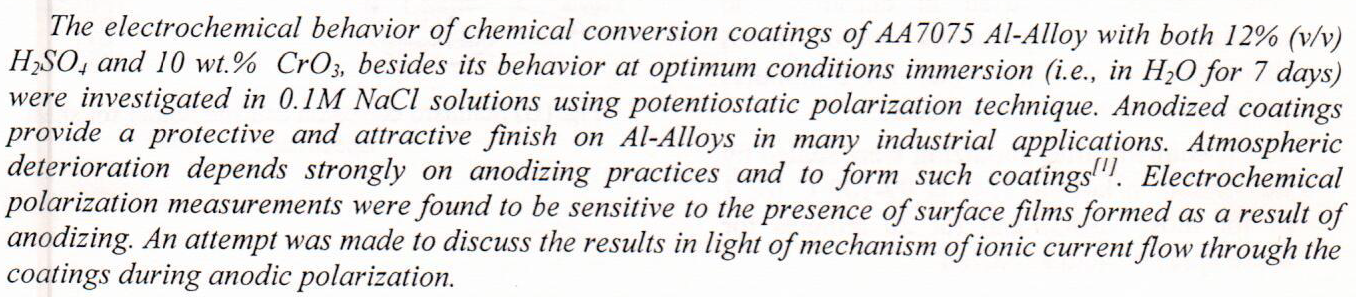
Electrochemical behavior of Anodized AA7075 Aluminum Alloy in 0.1M NaCl Solution as Investigated by Potentiostatic Polarization Ttechnique

Background: Congenital club foot is a complex deformity of foot .It is a collection of different abnormalities, with different etiologies. Consequently, Severity varies with difficulties in evaluating treatment strategies with outcome results. The treatment of congenital club foot remains controversial. Usually, the orthopedist's goal is to obtain anatomically and functionally normal feet in all patients. Objective: To asses short term follow up result of conservatively treated club feet in relation to the age
... Show More
 (43)
(43)
 (46)
(46)


As one type of resistance furnace, the electrical tube furnace (ETF) typically experiences input noise, measurement noise, system uncertainties, unmodeled dynamics and external disturbances, which significantly degrade its temperature control performance. To provide precise, and robust temperature tracking performance for the ETF, a robust composite control (RCC) method is proposed in this paper. The overall RCC method consists of four elements: First, the mathematical model of the ETF system is deduced, then a state feedback control (SFC) is constructed. Third, a novel disturbance observer (DO) is designed to estimate the lumped disturbance with one observer parameter. Moreover, the stability of the closed loop system including controller
... Show More
(12)
(11)
Mutans streptococci (MS) are a group of oral bacteria considered as the main cariogenic organisms. MS consists of several species of genus Streptococcus which are sharing similar phenotypes and genotypes. The aim of this study is to determine the genetic diversity of the core species of clinical strains of Streptococcus mutans, Streptococcus sobrinus and Streptococcus downei by using repitative extragenic palindromic (REP) primer. The DNA of the clinical strains of S. mutans (n=10), S. sobrinus (n=05) and S. downei (n=04) have been employed in the present study, which have been previously isolated from caries active subjects. The DNA of the clinical and reference strains was
... Show More
(3)
(3)
Box-Wilson experimental design method was employed to optimized lead ions removal efficiency by bulk liquid membrane (BLM) method. The optimization procedure was primarily based on four impartial relevant parameters: pH of feed phase (4-6), pH of stripping phase (9-11), carrier concentration TBP (5-10) %, and initial metal concentration (60-120 ppm). maximum recovery efficiency of lead ions is 83.852% was virtually done following thirty one-of-a-kind experimental runs, as exact through 24-Central Composite Design (CCD). The best values for the aforementioned four parameters, corresponding to the most restoration efficiency were: 5, 10, 7.5% (v/v), and 90 mg/l, respectively. The obtained experimental data had been
... Show More
(2)
In this work, the photocatalytic degradation of indigo carmine (IC) using zinc oxide suspension was studied. The effect of influential parameters such as initial indigo carmine concentration and catalyst loading were studied with the effect of Vis irradiation in the presence of reused ZnO was also investigated. The increased in initial dye concentration decreased the photodegradation and the increased catalyst loading increased the degradation percentage and the reused-ZnO exhibits lower photocatalytic activity than the ZnO catalyst. It has been found that the photocatalytic degradation of indigo carmine obeyed the pseudo-first-order kinetic reaction in presence of zinc oxide. This was found from plotting the relationship between ln
... Show More
(11)
(9)
Due to the deliberate disposal of industrial waste, a great amount of petroleum hydrocarbons pollute the soil and aquatic environments. Bioremediation that depends on the microorganisms in the removal of pollutants is more efficient and cost-effective technology. In this study, five rhizobacteria were isolated from Phragmites australis roots and exposed to real wastewater from Al-Daura refinery with 70 mg/L total petroleum hydrocarbons (TPH) concentration. The five selected rhizobacteria were examined in a biodegradation test for seven days to remove TPH. The results showed that 80% TPH degradation as the maximum value by Sphingomonas Paucimobilis as identified with Vitek® 2 Compact (France).
(7)
Diabetic kidney disease is an illness of the glomerulus that interferes with the glomerular filtration barrier (GFB), which is worked to enable kidney to selective purification of water and solutes in addition to limiting the movement of large macromolecules such as albumin. In the glomerular endothelium, mesangial cells, foot cells, and the brush border of the proximal tubules, ACE-2 is expressed and that the kidneys represent the highest-expressing region of this enzyme. Thus, the current study aimed to evaluate ACE-2 level in this case compared to healthy condition. The study Conducted with 120 male and female ranging in age (30-65) years old. Ninety patients with type 2 diabetes subdivided into three groups on the basis of A
... Show More
(5)
The study aimed to identify the treatment of the press image of the Great Return Marches in the French international news agency AFP by knowing the most important issues, their direction and the degree of interest in them. The study belongs to the descriptive research, and used the survey method, within the context of the content analysis method, and the researcher relied on the content analysis form tool and the interview tool to collect data. The study population is represented in the photos published by the French News Agency about the Great Return Marches during the period (end of March / 2018 until the end of November / 2019. The researcher chose an intentional sample using the Complete Census method. The study material represented
... Show More
The research involved a rapid, automated and highly accurate developed CFIA/MZ technique for estimation of phenylephrine hydrochloride (PHE) in pure, dosage forms and biological sample. This method is based on oxidative coupling reaction of 2,4-dinitrophenylhydrazine (DNPH) with PHE in existence of sodium periodate as oxidizing agent in alkaline medium to form a red colored product at ʎmax )520 nm (. A flow rate of 4.3 mL.min-1 using distilled water as a carrier, the method of FIA proved to be as a sensitive and economic analytical tool for estimation of PHE.
Within the concentration range of 5-300 μg.mL-1, a calibration curve was rectilinear, where the detection limit was 3.252 μg.mL
(4)