Electrochemical behavior of Anodized AA7075 Aluminum Alloy in 0.1M NaCl Solution as Investigated by Potentiostatic Polarization Ttechnique
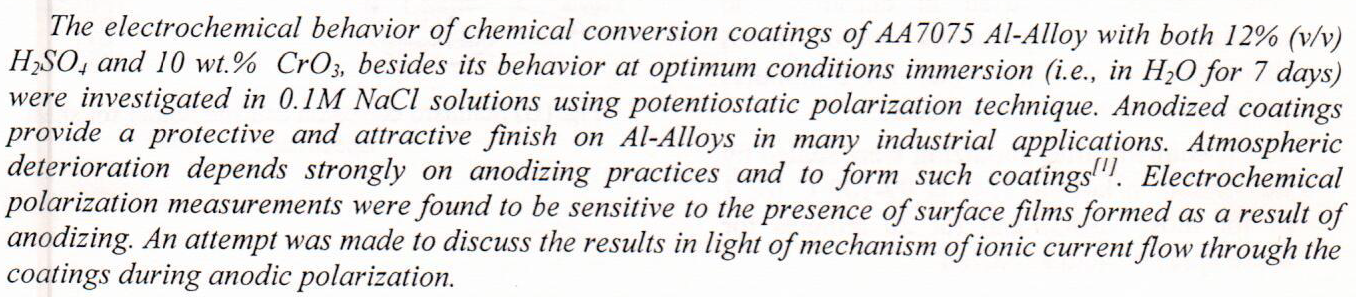

 (6)
(6)
 (1)
(1)


Due to increased consumption of resources, especially energy it was necessary to find alternatives characterized by the same quality as well as being of less expensive, and most important of these alternatives are characterized by waste and the fact that humancannot stop consumption. So we have consideredwaste as an alternative and cheap economic resources and by using environmental index the MIP (input materials per unit ,unit / service) is based on the grounds that the product is not the end of itselfit is a product to meet the need of a product or service, awarded a resource input and output within the five basic elements are the raw materials is ecological, Raw materials ecological, water, air and soil erosion for a
... Show More
In this work , the effect of chlorinated rubber (additive I), zeolite 3A with chlorinated rubber (additive II), zeolite 4A with chlorinated rubber (additiveIII), and zeolite 5A with chlorinated rubber (additive IV), on flammability for epoxy resin studied, in the weight ratios of (2, 4, 7,10 & 12%) by preparing films of (130x130x3) mm in diameters, three standard test methods used to measure the flame retardation which are ; ASTM : D-2863 , ASTM : D-635 & ASTM : D-3014. Results obtained from these tests indicated that all of them are effective and the additive IV has the highest efficiency as a flame retardant.
(12)
Parasitic diseases can affect infection with COVID-19 obviously, as protective agents, or by reducing severity of this viral infection. This current review mentions the common symptoms between human parasites and symptoms of COVID-19, and explains the mechanism actions of parasites, which may prevent or reduce severity of this viral infection. Pre-existing parasitic infections provide prohibition against pathogenicity of COVID-19, by altering the balance of gut microbiota that can vary the immune response to this virus infection.
(1)
In this study, sulfur was removed from imitation oil using oxidative desulfurization process. Silicoaluminophosphate (SAPO-11) was prepared using the hydrothermal method with a concentration of carbon nanotubes (CNT) of 0% and 7.5% at 190 °C crystallization temperature. The final molar composition of the as-prepared SAPO-11 was Al2O3: 0.93P2O5: 0.414SiO2. 4% MO/SAPO-11 was prepared using impregnation methods. The produced SAPO-11 was described using X-ray diffraction (XRD) and Brunauer-Emmet-Teller (N2 adsorption–desorption isotherms). It was found that the addition of CNT increased the crystallinity of SAPO-11. The results showed that the surface area of SAPO-11 cont
... Show More
(5)
Toxic substances have been released into water supplies in recent decades because of fast industrialization and population growth. Fenton electrochemical process has been addressed to treat wastewater which is very popular because of its high efficiency and straightforward design. One of the advanced oxidation processes (AOPs) is electro-Fenton (EF) process, and electrode material significantly affects its performance. Nickel foam was chosen as the source of electro-generated hydrogen peroxide (H2O2) due to its good characteristics. In the present study, the main goals were to explore the effects of operation parameters (FeSO4 concentration, current density, and electrolysis time) on the catalytic performance that was optimized by r
... Show More
(5)
AlPO4 catalysts supported with WO3 were prepared by impregnating the catalysts with ammonium metatungstate. The catalysts were checked by X-ray Diffraction (XRD), AFM, and SEM; also, the catalysts analysis was done by X-Ray (EDX). Finally, the N2 adsorption-desorption was used to measure the pore volume and surface area of the catalyst. The prepared catalyst has a surface area of 185.83 m2/g, pore volume of 0.645 cm3/g at a calcination temperature of 500°C for 3 hrs, and particle size of AlPO4 with an average of 35.36 nm. Transesterification of edible oil using WO3/AlPO4 was performed, it was observed that WO3/AlPO4 catalysts give high conversion of edible oil, and this is attributed to the high surface area, smaller particle size, and the
... Show More
Background: Irrigation has a central role in endodontic treatment. Several irrigating solutions have the antimicrobial activity and actively kill bacteria and yeasts when introduced in direct contact with the microorganisms. The purpose of this study was to evaluate the antimicrobial effectiveness of Dandelion (Taraxacum officinale) root and leaf extracts as possible irrigant solutions, used during endodontic treatments, and both were compared to Sodium hypochlorite, Propolis and Ethyl alcohol. Materials and Method: Forty seven human extracted single rooted teeth were selected. The teeth were decoronated using a diamond disk to have a length of 15 mm ±1 mm and they were instrumented using the hybrid technique. All roots were sterilized
... Show More