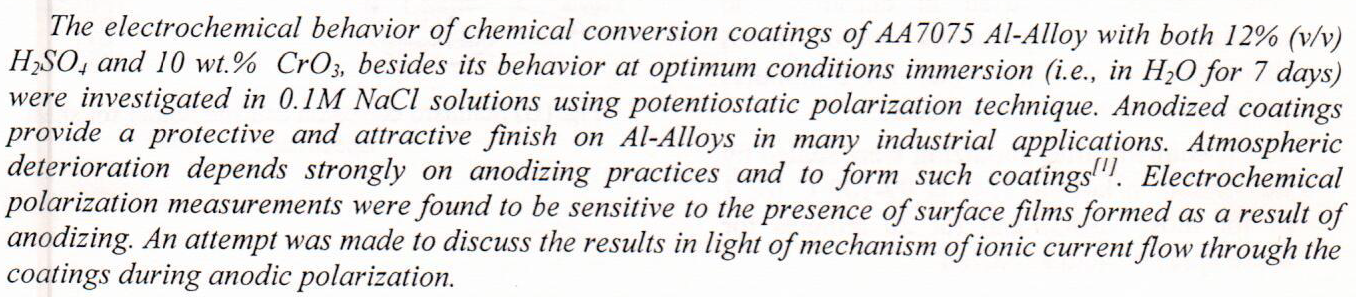
Electrochemical behavior of Anodized AA7075 Aluminum Alloy in 0.1M NaCl Solution as Investigated by Potentiostatic Polarization Ttechnique

Furfural is one of the one of pollutants in refinery industrial wastewaters. In this study advanced oxidation process using UV/H2O2 was investigated for furfural degradation in synthetic wastewater. The results from the experimental work showed that the degradation of furfural decreases as its concentration increases, reaching 100% at 50mg/l furfural concentration and increasing the concentration of H2O2 from 250 to 500 mg/l increased furfural removal from 40 to 60%.The degradation of furfural reached 100% after 90 min exposure time using two UV lamps, where it reached 60% using one lamp after 240 min exposure time. The rate of furfural degradation k increased at the pH and initial concentratio
... Show More<span lang="EN-US">Iraqi people have been without energy for nearly two decades, even though their geographic position provides a high intensity of radiation appropriate for the construction of solar plants capable of producing significant quantities of electricity. Also, the annual sunny hours in Iraq are between 3,600 to 4,300 hours which makes it perfect to use the photovoltaics arrays to generate electricity with very high efficiency compared to many countries, especially in Europe. This paper shows the amount of electric energy generated by the meter square of crystalline silicon in the photovoltaic (PV) array that already installed in 18 states in Iraq for each month of the year. The results of the meter-square of PV arr
... Show More (3)
(3)
 (1)
(1)


Autoimmune hepatitis is an inflammatory disease and its incidence has been increasing. The features of hepatitis are the release of inflammatory cytokines, the elevation of AST and ALT, and hepatocyte apoptosis and necrosis. Concanavalin A considered as essential model represents the acute immune-mediated liver damage in rodents. Thymoquinone is well known herbal compound that exert hepatoprotective, anti-inflammatory, and antioxidant activity. In this study, we focus on the immunoregulatory and liver protective effect of thymoquinone in a mouse model of concanavalin A-induced liver injury.
Twenty-four male mice were randomly divided into four groups each containing six animals: Negative control group, concanavalin A model group,
... Show More
(10)
(4)
In this research study the effect of irradiation by (CW) CO2 laser on some optical properties of (Cds) doping by Ni thin films of (1)µm thickness has been prepared by heat evaporation method. (X-Ray) diffraction technique showed the prepared films before and after irradiation are ploy crystalline hexagonal structure, optical properties were include recording of absorbance spectra for prepared films in the range of (400-1000) nm wave lengths, the absorption coefficient and the energy gap were calculated before and after irradiation, finally the irradiation affected (CdS) thin films by changing its color from the Transparent yellow to dark rough yellow and decrease the value absorption coefficient also increase the value of energy gap.
The current study was conductedas a pot experiment to determine the effect of soil texture on biological nitrogen fixation (BNF) of six most efficient local isolates, specified, of Bradyrhizobium. Cowpea (Vignaunguiculata L.), as a legume host crop, was used as a host crop and 15N dilution analysis was used for accurate determination of the amount of N biologically fixed under experimental parameters specified. Soils used are clay loam, sandy clay loam and sandy loam. Biological Nitrogen Fixation (BNF), in different soil textural classes, was as in the following order: medium texture soil > heavy texture soil > light textured soil. Statistical analysis showed that there is a significant variation in BNF % among six Iraqi isolates in the th
... Show More
(1)
Phenol is one of the worst-damaging organic pollutants, and it produces a variety of very poisonous organic intermediates, thus it is important to find efficient ways to eliminate it. One of the promising techniques is sonoelectrochemical processing. However, the type of electrodes, removal efficiency, and process cost are the biggest challenges. The main goal of the present study is to investigate the removal of phenol by a sonoelectrochemical process with different anodes, such as graphite, stainless steel, and titanium. The best anode performance was optimized by using the Taguchi approach with an L16 orthogonal array. the degradation of phenol sonoelectrochemically was investigated with three process parameters: current de
... Show More
Phenol oxidation by Fenton's reagent (H2O2 + Fe+2) in aqueous solution has been studied for the purpose of learning
more about the reactions involved and the extent of the oxidation process, under various operating conditions. An initial
phenol concentration of 100 mg/L was used as representative of a phenolic industrial wastewater. Working temperature
of 25C was tested, and initial pH was set at 5.6 . The H2O2 and the Fe+2 doses were varied in the range of
(H2O2/Fe+2/phenol = 3/0.25/1 to 5/0.5/1). Keeping the stirring speed of 200 rpm.
The results exhibit that the highest phenol conversion (100%) was obtained under (H2O/Fe+2/phenol ratio of 5/0.5/1)
at about 180 min. The study has indicated that Fenton's oxidation i
Physical adsorption by nitrogen gas was studied on seven commercial platinum reforming catalysts (RG-402, RG-412, RG-432, RG-451, RG 422,RG-482, PS-10), four prepared platinum catalysts (0.1%Pt/alumina, 0.2 %Pt/alumina, 0.45 %Pt/alumina and 0.55% Pt/alumina), and -alumina support. Physical adsorption was carried out by using Accelerated Surface Area and Porosimetry (ASAP 2400 device) at 77 K . The results indicate that the surface area in genaral decreases with increasing platinum percentage, high platinum loaded (0.45% and 0.55%) it was found that the percent increasing in surface area was lower than those obtained for low platinum loaded catalysts , and at very higher platinum loading 0.6 %Pt , some reduction in surface area was
... Show MoreBackground: The present study aimed to determine the influence of the different types of mouth wash on discoloration of different orthodontic ceramic, sapphire brackets and adhesives. Materials and methods: The sample composed of 120 ceramic brackets and 120 sapphire brackets, the brackets were divided according to bond material into three groups of 40 brackets include unbounded brackets, chemically cured (no-mix) bonded brackets and Light cured bonded brackets all these groups were further subdivided according to mouth wash type into three groups with 10 brackets each which include; Listerine, cetrimide, chlorhexidine 0.2%, and one control group which immersed in artificial saliva; then Staining measurements were performed with UV-Visibl
... Show More