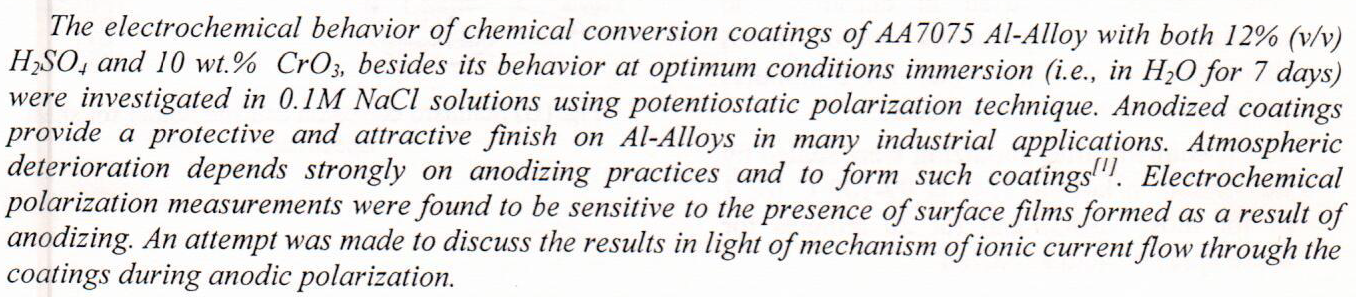
Electrochemical behavior of Anodized AA7075 Aluminum Alloy in 0.1M NaCl Solution as Investigated by Potentiostatic Polarization Ttechnique

Many pharmaceutical molecules have solubility problems that until yet consist a hurdle that restricts their use in the pharmaceutical preparations. Lacidipine (LCDP) is a calcium-channel blocker with low aqueous solubility and bioavailability.
Lipid dosage forms are attractive delivery systems for such hydrophobic drug molecules. Nanoemulsion (NE) is one of the popular methods that has been used to solve the solubility problems of many drugs. LCDP was formulated as a NE utilizing triacetin as an oil phase, tween 80 and tween 60 as a surfactant and ethanol as a co-surfactant. Nine formulas were prepared, and different tests performed to ensure the stability of the NEs, such as thermodyna
... Show More (24)
(24)
 (10)
(10)


Isradipine related to dihydropyridine (DHP) class of calcium channel blockers (CCBs). It is used to treat hypertension, angina pectoris, as well as Parkinson disease. It goes under the BCS class II drug (low solubility-high permeability). The drug will experience extensive first-pass metabolism in liver, thus, oral bio-availability will be approximately15 to 24 %.
The aim of the study is preparing stable oral oil in water (o/w) nanoemulsion of isradipine to promote the colloidial dispersion of isradipine in the nano range, so that it may be absorded by intestinal lymphatic transport in order to avoid hepatic first-pass metabolism (israpidi
... Show More
(42)
(12)
Heavy metals contamination in aquatic ecosystems is considered one of the most important threats of aquatic life. Submerge aquatic plants Ceratophyllum demersum in its non living form used for the removal of trace elements. This article studied the ability of the fine powder of C.demersum for the removal of some heavy metals (HM) like copper, cadmium, lead and chrome from aqueous solution with in variable experimental factors. The study occupy two treatments the first included different hydrogen ions pH within a range of 4, 5,6and 8 with a constant HM concentration (1000 ppm).While the second treatment represented by using variable HM concentrations within a range of (250,500,750and 1000 ppm) with a constant pH=7.In both treatments the a
... Show More
(5)
The current study investigated the stability and the extraction efficiency of emulsion liquid membrane (ELM) for Abamectin pesticide removal from aqueous solution. The stability was investigated in terms of droplet emulsion size distribution and emulsion breakage percent. The proposed ELM included a mixture of corn oil and kerosene (1:1) as a diluent, Span 80 (sorbitan monooleate) as a surfactant and hydrochloric acid (HCl) as a stripping agent without utilizing a carrier agent. Parameters such as homogenizer speed, surfactant concentration, emulsification time and internal to organic volume ratio (I/O) were evaluated. Results show that the lower droplet size of 0.9 µm and higher stable emulsion in terms of breakage percent of 1.12 % we
... Show More
(7)
The current study investigated the stability and the extraction efficiency of emulsion liquid membrane (ELM) for Abamectin pesticide removal from aqueous solution. The stability was investigated in terms of droplet emulsion size distribution and emulsion breakage percent. The proposed ELM included a mixture of corn oil and kerosene (1:1) as a diluent, Span 80 (sorbitan monooleate) as a surfactant and hydrochloric acid (HCl) as a stripping agent without utilizing a carrier agent. Parameters such as homogenizer speed, surfactant concentration, emulsification time and internal to organic volume ratio (I/O) were evaluated. Results show that the lower droplet size of 0.9 µm and higher stable emulsion in terms of breakage percent of 1.12 % were
... Show More
(7)
Five new ceftazidime derivatives were designed and synthesized in an attempt to improve the acid stability and may increase the spectrum of ceftazidime. The synthesized compounds included; Schiff base of ceftazidime (compound 1), ceftazidime lysine amide Schiff base (compound 2), ceftazidime lysine amide (compound 3), ceftazidime-di-lysine amide Schiff base (compound 4) and ceftazidime-di-lysine amide (compound 5). New ceftazidime derivatives were successfully prepared characterized and identified using spectral and elemental microanalysis (CHNS) analyses and the results comply with the calculated measurements.
Compounds 1 and 2 were subjected to a stability study in phosphate buffer (0.2M, pH 7.4) and in KCl/HCl buffer (0.
... Show More
(1)
(4)
(1)
Natural Bauxite (BXT) mineral clay was modified with a cationic surfactant (hexadecy ltrimethy lammonium bromide (BXT-HDTMA)) and characterized with different techniques: FTIR spectroscopy, X-ray powder diffraction (XRD) and scanning electron microscopy (SEM). The modified and natural bauxite (BXT) were used as adsorbents for the adsorption of 4- Chlorophenol (4-CP) from aqueous solutions. The adsorption study was carried out at different conditions and parameters: contact time, pH value, adsorbent dosage and ionic strength. The adsorption kinetic (described by a pseudo-first order and a pseudo-second order), equilibrium experimental data (analyzed by Langmuir, Freundlich and Temkin isotherm models) and thermodynamic parameters (change in s
... Show MoreThe paper presents a highly accurate power flow solution, reducing the possibility of ending at local minima, by using Real-Coded Genetic Algorithm (RCGA) with system reduction and restoration. The proposed method (RCGA) is modified to reduce the total computing time by reducing the system in size to that of the generator buses, which, for any realistic system, will be smaller in number, and the load buses are eliminated. Then solving the power flow problem for the generator buses only by real-coded GA to calculate the voltage phase angles, whereas the voltage magnitudes are specified resulted in reduced computation time for the solution. Then the system is restored by calculating the voltages of the load buses in terms
... Show More