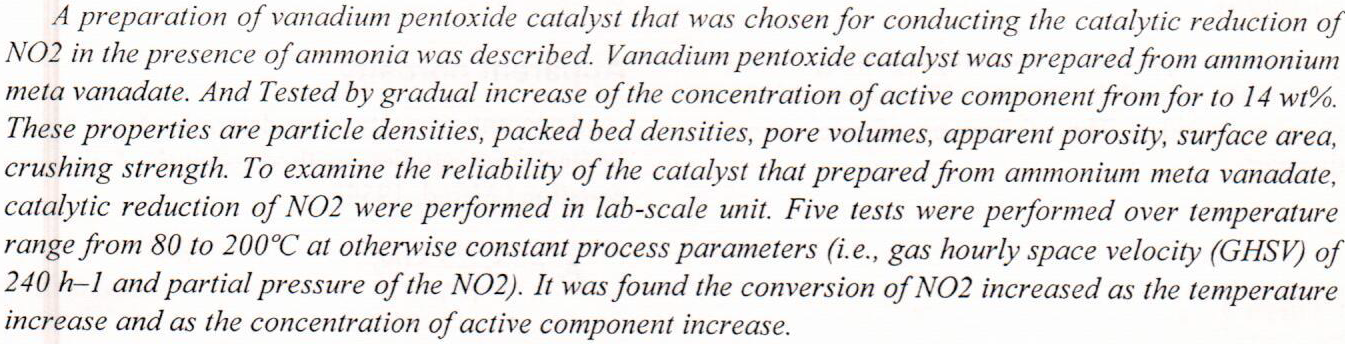
Catalytic Reduction of NOx using Locally Prepared Catalysts with Ammonia

characteristic tissues and cells, exerting their pharmacological aspects and alleviating a lot of diseased processes. Accordingly, this research is about introducing some isatins to be nucleophilically attacked at C3 forming products of azomethine ylide functionality. These iminium compounds were made by allowing certain isatins to be reacted with the secondary amino acid, proline, at acetic acid and methanol medium and then collected after purification to be identified with total Leukocyte count (TLC) and melting point. The structural characterization was performed by fourier-transform infrared spectroscopy (FTIR), proton nuclear magnetic resonance (1H-NMR), and community health nursing (CHN) analysis. The microbiological evaluatio
... Show More (2)
(2)


Tin Selenide (SnSe) Nano crystalline thin films of thickness 400±20 nm were deposited on glass substrate by thermal evaporation technique at R.T under a vacuum of ∼ 2 × 10− 5 mbar to study the effect of annealing temperatures (as-deposited, 100, 150 and 200) °C on its structural, surface morphology and optical properties. The films structure was characterized using X-ray diffraction (XRD) which showed that all the films have polycrystalline in nature and orthorhombic structure, with the preferred orientation along the (111) plane. These films was synthesized of very fine crystallites size of (14.8-24.5) nm, the effect of annealing temperatures on the cell parameters, crystallite size and dislocation density were observed.
... Show More
(14)
 (12)
(12)
 (41)
(37)
(41)
(37)
Undoped and Iodine (I)–doped chrome oxide (Cr2O3)thin films have been prepared by chemical spray pyrolysis technique at substrate temperatures(773K) on glass substrate. Absorbance and transmittance spectra have been recorded as a function of wavelength in the range (340-800 nm) in order to study the optical properties such as reflectance, Energy gap of allowed direct transition, extinction coefficient refractive index, and dielectric constant in real and imagery parts all as a function of wavelength. It was found that all the investigated parameters affect by the doping ratios.
Cadmium oxide thin films were prepared by D.C magnetron plasma sputtering using different voltages (700, 800, 900, 1000, 1100 and 1200) Volt. The Cadmium oxide structural properties using XRD analysis for just a voltage of 1200 volt at room temperature after annealing in different temperatures (523 and 623) K were studied .The results show that the films prepared at room temperature have some peaks belong to cadmium element along the directions (002), (100), (102) and (103) while the other peaks along the directions of (111), (200) and (222) belong to cadmium oxide. Annealed samples display only cadmium oxide peaks. Also, the spectroscopic properties of plasma diagnostic for CdO thin films were determined and the results show that the el
... Show More
Zinc oxide thin films were deposited by chemical spray pyrolysis onto glass substrates which are held at a temperature of 673 K. Some structural, electrical, optical and gas sensing properties of films were studied. The resistance of ZnO thin film exhibits a change of magnitude as the ambient gas is cycled from air to oxygen and nitrogen dioxide
In this work, multilayer nanostructures were prepared from two metal oxide thin films by dc reactive magnetron sputtering technique. These metal oxide were nickel oxide (NiO) and titanium dioxide (TiO2). The prepared nanostructures showed high structural purity as confirmed by the spectroscopic and structural characterization tests, mainly FTIR, XRD and EDX. This feature may be attributed to the fine control of operation parameters of dc reactive magnetron sputtering system as well as the preparation conditions using the same system. The nanostructures prepared in this work can be successfully used for the fabrication of nanodevices for photonics and optoelectronics requiring highly-pure nanomaterials.
A mathematical model was proposed to study the microkinetics of esterification reaction of oleic acid with ethanol over prepared HY zeolite catalyst. The catalyst was prepared from Iraqi kaolin source and its properties were characterized by different techniques. The esterification was done under different temperature (40 to 70˚C) with 6:1 for molar ratio of ethanol to oleic acid and 5 % catalyst loading.
The microkinetics study was done over two period of time each period was examined individually to calculate the reaction rate constant and activation energy. The impact of the mass transfer resistance to the reactant was also investigated; two different studies have been accomplished to do this purpose.
&nb
... Show More
CdS and CdS:Sn thin films were successfully deposited on glass
substrates by spray pyrolysis method. The films were grown at
substrate temperatures 300 C°. The effects of Sn concentration on the
structural and optical properties were studied.
The XRD profiles showed that the films are polycrystalline with
hexagonal structure grown preferentially along the (002) axis. The
optical studies exhibit direct allowed transition. Energy band gap
vary from 3.2 to 2.7 eV.
(1)