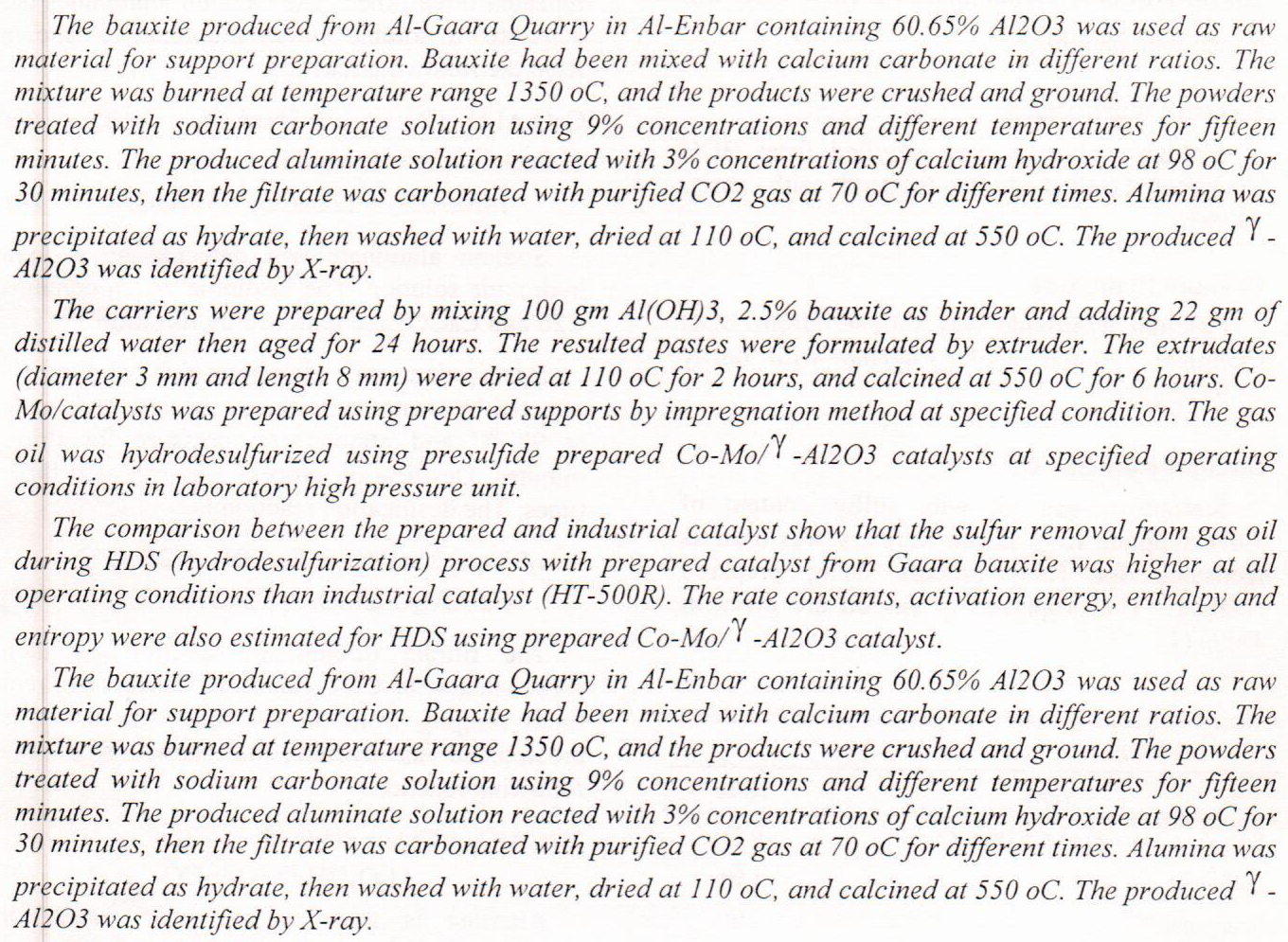
Active Alumina Extraction from Iraqi Bauxite for Catalyst's Support

Water-based drilling fluids (WBDFs) are the industry-preferred medium for drilling reactive shale formations, yet they remain susceptible to shale swelling, fluid invasion, and cuttings dispersion—all of which compromise wellbore stability. Although oil-based fluids (OBFs) provide effective shale inhibition, their high cost and adverse environmental profile limit their use. Nanoparticles (NPs) derived from waste feedstocks offer a low-cost, environmentally responsible alternative for enhancing WBDF performance, but no prior study has simultaneously evaluated both waste-derived SiO2 and Al2O2 NPs within a single WBDF system. This study synthesised SiO2 NPs from Halfaya bentonite clay waste and Al2O2 NPs from recycled aluminium scrap, char
... Show More (2)
(2)
 (2)
(2)


The usage of remote sensing techniques in managing and monitoring the environmental areas is increasing due to the improvement of the sensors used in the observation satellites around the earth. Resolution merge process is used to combine high resolution one band image with another one that have low resolution multi bands image to produce one image that is high in both spatial and spectral resolution. In this work different merging methods were tested to evaluate their enhancement capabilities to extract different environmental areas; Principle component analysis (PCA), Brovey, modified (Intensity, Hue ,Saturation) method and High Pass Filter methods were tested and subjected to visual and statistical comparison for evaluation. Both visu
... Show More
(1)
In many video and image processing applications, the frames are partitioned into blocks, which are extracted and processed sequentially. In this paper, we propose a fast algorithm for calculation of features of overlapping image blocks. We assume the features are projections of the block on separable 2D basis functions (usually orthogonal polynomials) where we benefit from the symmetry with respect to spatial variables. The main idea is based on a construction of auxiliary matrices that virtually extends the original image and makes it possible to avoid a time-consuming computation in loops. These matrices can be pre-calculated, stored and used repeatedly since they are independent of the image itself. We validated experimentally th
... Show More
(32)
(31)

The main objectives of this research is to extract essential oil from: orange ( citrus sinensis), lemon( citrus limon) and mandarin( citrus reticulata) peels by two methods: steam distillation (SD) and microwave assisted steam distillation (MASD), study the effect of extraction conditions (weight of the sample, extraction time, and microwave power, citrus peel type) on oil yield and compare the results of the two methods, the resulting essential oil was analyzed by Gas Chromatography (GC).
Essential oils are highly concentrated substances used for their flavor and therapeutic or odoriferous properties, in a wide selection of products such as foods, medicines and cosmetics. Extracti
... Show MoreThis work was conducted to study the extraction of pelletierine sulphate from Punica granatum L. roots by liquid membrane techniques. Pelletierine sulphate is used widely in medicine. The general behavior of extraction process indicates that pelletierine conversion increased with increasing the number of stages and the discs rotation speed but high rotation speed was not favored because of the increased risk of droplet formation during the operation. The pH of feed and acceptor solution was also important. The results exhibit that the highest pelletierine conversion was obtained when using two stages,(10 rpm) discs speed of stainless steel discs,(pH= 9.5) of feed solution and (pH= 2) of acceptor solution in n-decane. Assuming the existence
... Show MoreIn this work, the extraction of glycyrrhizin from Licorice using bulk liquid membrane technique was developed and optimized. The effect of various parameters such as pH of stripping and donor solutions, temperature, stirring speed and kinetic parameters were investigated. Moreover, to study the impact of the polarity of membrane solvent, two types of extraction solvents were used as a membrane solvent: n-Hexane was used as a non-polar solvent and 1-Hexanol was as a polar solvent. The optimum extraction condition was found (95.53%) using 1-Hexanol, rotating speed was 400 rpm, and pH of the acceptor and donor solutions were 8 and 5.5, respectively. The reaction kinetics constants ( and ) for the transport of glycyrrhizin from the donor pha
... Show More
(18)
(13)
This work was conducted to study the extraction of pelletierine sulphate from Punica granatum L. roots by liquid membrane techniques. Pelletierine sulphate is used widely in medicine. The general behavior of extraction process indicates that pelletierine conversion increased with increasing the number of stages and the discs rotation speed but high rotation speed was not favored because of the increased risk of droplet formation during the operation. The pH of feed and acceptor solution was also important. The results exhibit that the highest pelletierine conversion was obtained when using two stages, (10 rpm) discs speed of stainless steel discs, (pH=9.5) of feed solution and (pH=2) of acceptor solution in n-decane. Assuming the existen
... Show MoreLipase enzyme has attracted a lot of attention in recent years because of its diverse biotechnological applications. The present study was conducted to screen germinated seeds of four crops, namely sunflower (Helianthus annuus), flaxor linseed (Linum usitatissimum ), peanut (Arachis hypogaea ) and castor bean (Ricinus communis), for the activity of their lipases. to the study also included the extraction and purification of lipase from the seeds of the most promising crop using different solvents. The results indicated that the maximum enzymatic activity (0.669 U/ml) was obtained when 0.1 M Tris-HCl buffer extract was used after 3 days of seed germination of all the tested species, as compared to the other test solvents
... Show More
(12)
(6)
Morphologies of ceramic hollow fiber membranes prepared by a combined phase-inversion and sintering method were studied. The organic binder spinning solution containing suspended Al₂O₃ powders was spun to a hollow fiber precursor, which was then sintered at elevated temperatures( 300 ˚C, 1400 ˚C, 25 ˚C) in order to obtain the Al₂O₃ hollow fiber membranes. The spinning solution consisted of polyether sulfone (PES), N-methyl-2-pyrrolidone (NMP), which were used as polymer binder, solvent, respectively. The prepared Al₂O₃ hollow fiber membranes were characterized by a scanning electron microscope (SEM). It is believed that finger-like void formation in asymmetric ceramic membranes is initiated by hydrodynamically unstable vis
... Show More