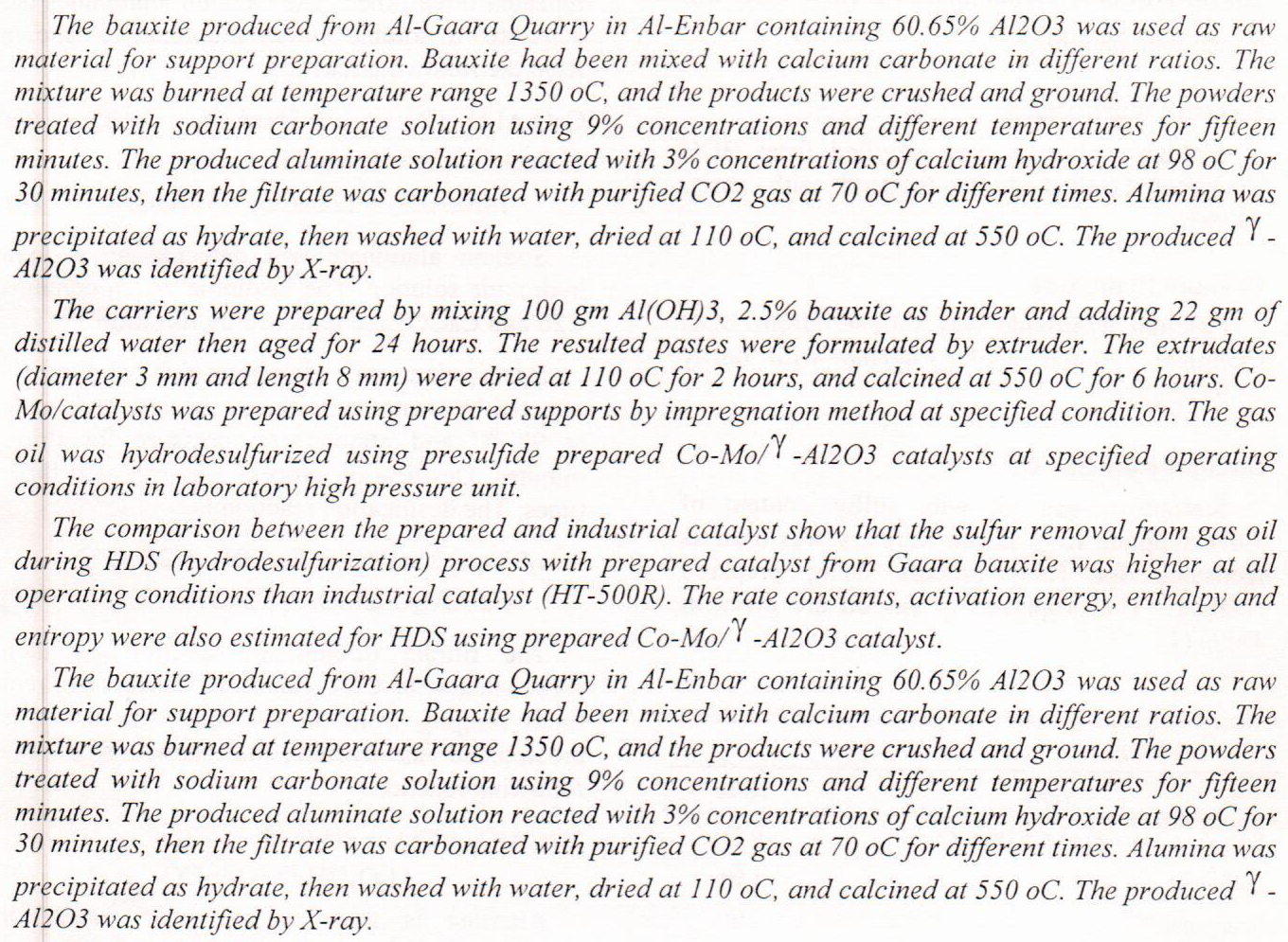
Active Alumina Extraction from Iraqi Bauxite for Catalyst's Support

 (7)
(7)

The study aimed to extract the lipase enzyme from different sources, estimate its enzymatic activity, choose the best sources in terms of enzymatic activity, partially purify, and characterize it. The enzyme was extracted from plant sources (pumpkin seeds, melon seeds, and orange peels). The enzyme extract was precipitated with ammonium sulfate at a saturation level of 80%. The dialysis and lyophilization processes were performed for the partially purified enzyme. The optimum temperature for the partially purified enzyme was 40°C and the optimum pH was 7. The enzyme activity of the plant sources was 2.598, 0.723, and 1.333 units g-1, respectively. Animal sources (chicken pancreas and intestinal tract of carp fish). The enzymatic ac
... Show More (3)
(3)

In this study Microwave and conventional methods have been used to extract and estimate pectin and its degree of esterification from dried grapefruit and orange peels. Acidified solution water with nitric acid in pH (1.5) was used. In conventional method, different temperature degrees for extraction pectin from grape fruit and orange(85 ,90 , 95 and 100?C) for 1 h were used The results showed grapefruit peels contained 12.82, 17.05, 18.47, 15.89% respectively, while the corresponding values were 5.96, 6.74, 7.41 and 8.00 %, respectively in orange peels. In microwave method, times were 90, 100, 110 and 120 seconds. Grapefruit peels contain 13.86, 16.57, 18.69, and 17.87%, respectively, while the corresponding values were of 6.53, 6.68, 7.2
... Show More
(3)
(9)
(7)

The problem of research is to identify the uses of Iraqi women for Facebook and the motives of these uses and the innovations that have been achieved from them, in view of the increasing role-played by social networking sites in the lives of individuals in general and women in particular.The research seeks to identify the following: Identify the extent to which Iraqi women use Facebook and the usage motives and innovations achieved by the interviewees When they using Facebook. This study belongs to the descriptive studies that are interested in monitoring the characteristics of a particular phenomenon to identify its characteristics and characteristics.This study adopted the survey methodology to test the hypotheses of the study and how
... Show MoreThis research includes a study of the ability of Iraqi porcelanite rocks powder to remove the basic Safranine dye from its aqueous process by adsorption. The experiments were carried out at 298Kelvin in order to determine the effect of the starting concentration for Safranin dye, mixing time, pH, and the effect of ionic Strength. The good conditions were perfect for safranine dye adsorption was performed when0.0200g from that adsorbed particles and the removal max percentage was found be 96.86% at 9 mg/L , 20 minutes adsorption time and at PH=8 and in 298 K. The isothermal equilibrum stoichiometric adsorption confirmed, the process data were examined by Langmuir, Freundlich and Temkin adsorption equations at different temperatures
... Show More
(11)
(8)
(2)
(40)
(38)
(11)
(9)
In the present work studies were carried out to extract a cationic dye (Methylene Blue MB) from an aqueous solution using emulsion liquid membrane process (ELM). The organic phase (membrane phase) consists of Span 80 as emulsifier, sulfuric acid solution as stripping agent and hexane as diluent.
In this study, important factors influencing the extraction of methylene blue dye were studied. These factors include H2SO4 concentration in the stripping phase, agitation speed in the dye permeation stage, Initial dye concentration and diluent type.
More than (98%) of Methylene blue dye was extracted at the following conditions: H2SO4 concentration (1.25) M, agitation
... Show More
(20)