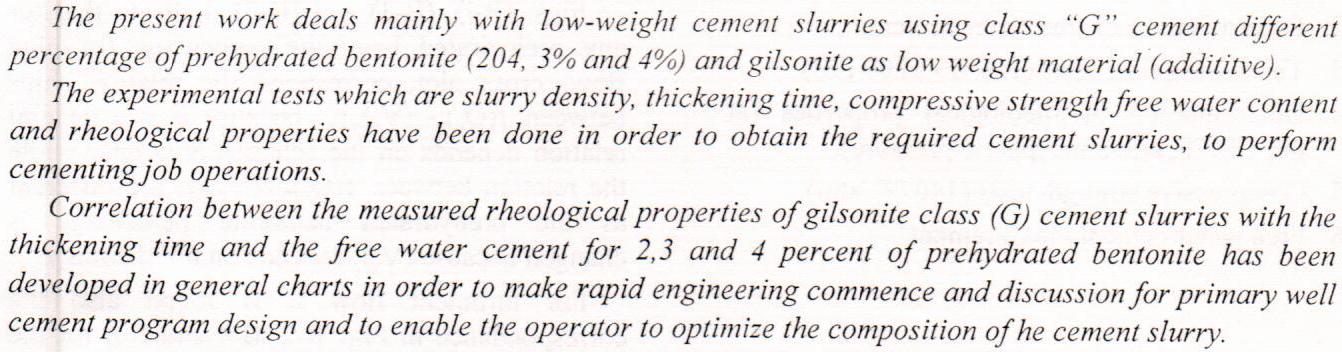
Physical and Rheological Properties of Class "G" Gilsonite Cement Slurries (Experimental Study)

 (7)
(7)
 (2)
(2)


Several schottky diodes were fabricated from polyaniline/ Carbon nanotube (single and multiwalled) composites. These composites were synthesized with different concentration and two carbon nanotubes types, Single and Multi-Walled Carbon Nanotubes (SWCNT & MWCNT). Aluminum and silver paste were chosen as schottky and ohmic contact respectively. physical and electrical were used to studied these composite by using Atomic Force Microscopy (AFM) and electrical measurements. The Root Mean Square RMS surface roughness of the composite samples was found to be around 4nm. The currentvoltage characteristic were measurements for all samples in the bias range ±15V at room temperature. The results shows the increasing in carbon nanotubes concentration
... Show More
(11)
(6)

Theoretical and experimental investigations of the transient heat transfer parameters of constant heat flux source subjected to water flowing in the downward direction in closed channel are conducted. The power increase transient is ensured by step change increase in the heat source power. The theoretical investigation involved a mathematical modeling for axially symmetric, simultaneously developing laminar water flow in a vertical annulus. The mathematical model is based on one dimensional downward flow. The boundary conditions of the studied case are based on adiabatic outer wall, while the inner wall is subjected to a constant heat flux. The heat & mass balance equation derived for specified element of bulk water within the annulu
... Show More
The earth-air heat exchanger (EHX) has a promising potential to passively save the energy consumption of traditional air conditioning systems while maintaining a high degree of indoor comfort. The use of EHX systems for air conditioning in commercial and industrial settings offers several environmental benefits and is capable of operating in both standalone and hybrid modes. This study tests the performance and effectiveness of an EHX design in a sandy soil area in Baghdad, Iraq. The area has a climate of the subtropical semi-humid type. Ambient air temperatures and soil temperatures were recorded throughout the months of 2021. During the months of January and June, the temperatures of the inlet and outflow air at varying air veloci
... Show More
(17)
(13)
(3)
Background: Biologic mechanisms of the form-function interaction are one of important component of orthodontic diagnosis. The purpose of this study is to search for the statistical associations between natural postural and craniofacial morphologic variables of the head. Materials and methods: The sample comprised natural head posture (NHP) cephalograms of 90 subjects, aged 18 to 25 years. Interpretation of the facial structure was made by using both intracranial and the extra-cranial reference lines in AutoCAD computer program. Results The measures of anteroposterior maxillary position, SNA showed a low negative correlations with the anterior cranial base angulation to true vertical (SN.Ver) and with the cranio-cervical position of the head
... Show MoreThe purpose of this paper is to preparing preventive exercises supported by collagen supplements and vitamin D for handball players, and identify the effect of preventive physical exercises supported by collagen supplements and vitamin D on some physical and skill abilities of handball players. The researchers used the experimental method and designed two groups, one experimental and the other control, with both pre- and post-tests, to suit the nature of the research. The research community was selected from handball players (specialized school players), numbering (14), and they were divided into two groups, each group numbering (7) players. One of the most important results reached by the researcher is that: The exercises prepared by the r
... Show MoreBackground: This study compared in vitro the marginal adaptation of three different, low shrink, direct posterior composites Filtekâ„¢ P60 (packable composite), Filtekâ„¢ P90 (Silorane-based composite) and Sonic fillâ„¢ (nanohybrid composite) at three different composite/enamel interface regions (occlusal, proximal and gingival regions) of a standardized Class II MO cavity after thermal changes and mechanical load cycling by scanning electron microscopy. Materials and methods:Thirty six sound human maxillary first premolars of approximately comparable sizes were divided into three main groups of (12 teeth) in each according to the type of restorative material that was used: group (A) the teeth were restored with Filtekâ„¢ P6
... Show MoreThe magnetic properties of a pure Nickel metal and Nickel-Zinc-Manganese ferrites having the chemical formula Ni0.1(Zn0.4Mn0.6)0.9Fe2O4 were studied. The phase formation and crystal structure was studied by using x-ray diffraction which confirmed the formation of pure single spinel cubic phase with space group (Fd3m) in the ferrite. The samples microstructure was studied with scanning electron microstructure and EDX. The magnetic properties of the ferrite and nickel metal were characterized by using a laboratory setup with a magnetic field in the range from 0-500 G. The ferrite showed perfect soft spinel phase behavior while the nickel sample showed higher magnetic loss an
... Show More
(1)