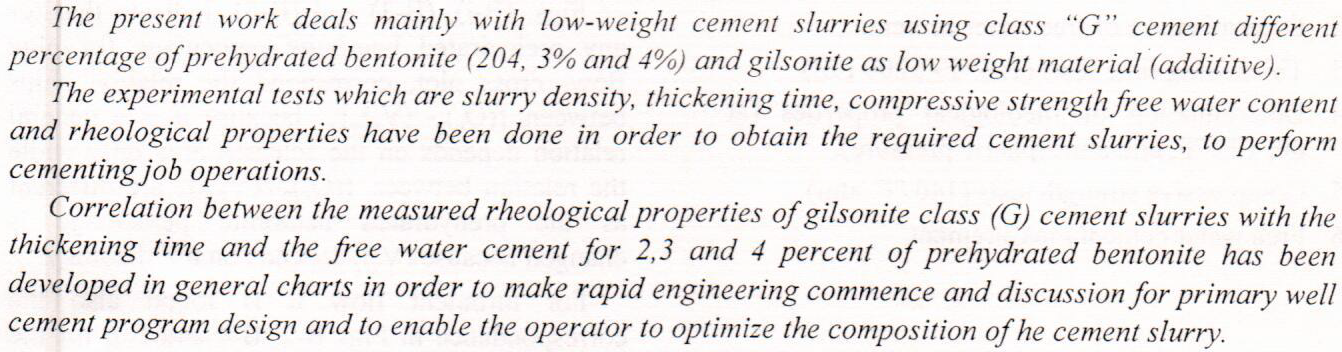
Physical and Rheological Properties of Class "G" Gilsonite Cement Slurries (Experimental Study)

 (20)

Thin films of (CdO)x (CuO)1-x (where x = 0.0, 0.2, 0.3, 0.4 and 0.5) were prepared by the pulsed laser deposition. The CuO addition caused an increase in diffraction peaks intensity at (111) and a decrease in diffraction peaks intensity at (200). As CuO content increases, the band gap increases to a maximum of 3.51 eV, maximum resistivity of 8.251x 10⁴ Ω.cm with mobility of 199.5 cm2 / V.s, when x= 0.5. The results show that the conductivity is ntype when x value was changed in the range (0 to 0.4) but further addition of CuO converted the samples to p-type.
 (9)
(10)

 (1)
(1)
In this work, (CdO)1-x (CoO)x thin films were prepared on glass slides by laser-induced plasma using Nd:YAG laser with (λ=1064 nm) and duration (9 ns) at different laser energies (200-500 mJ) with ratio (x=0.5), The influence of laser energy on structural and optical properties has been studied. XRD patterns show the films have a structure of polycrystalline wurtzite. As for AFM tests results for the topography of the surface of the film, where the results showed that the grain size and the average roughness increase with increasing laser energy. The optical properties of all films were also studied and the results showed that the absorption coefficient for within the wavelength range (280-1100 nm), The value of the optical power gap fo
... Show More
(4)
Background: Alginate impression material is the irreversible hydrocolloid material that is widely used in dentistry. The contact time between alginate and gypsum cast could have a detrimental effect on the properties of the gypsum cast. The objective of this study is to evaluate the impact of various contact time intervals of Alginate impressions & type III dental stone on surface properties of stone cast. Materials and Methods: Time intervals tested were 1hour, 6 hours and 9 hours. Surface properties of stone cast evaluated were surface detail reproduction, hardness and roughness. Surface detail reproduction was determined using cylindrical brass test block in accordance with ISO 1563. Surface roughness was measured by profilometer
... Show More
(2)
(1)
Blends of polyvinyl pyrrolidone (PVP) and polyvinyl alcohol (PVA) in equal weight ratios (50 wt.% PVP + 50 wt.% PVA) were doped with 15% of various lithium salts (Li2CO3, LiNO3, Li2SO4H2O, and LiCl) and prepared using the solution-casting method, with dimethylformamide (DMF) as the solvent. The impact of these salts on the blends was analyzed and the results showed that the energy gap was decreased by adding lithium salts Li2CO3, LiNO3 and Li2SO4.H₂O. The minimum energy gap value was 3.5 eV obtained from PVP/PVA:15% Li2CO3. The optical constants were determined in the range of 300-1100 nm. The results showed that all the optical constants for doped blends were grown with the addition of lithium salts. The FTIR study confirms the c
... Show More
(3)
(1)
Petrophysical properties evaluation from well log analysis has always been crucial for the identification and assessment of hydrocarbon bearing zones. East Baghdad field is located 10 km east of Baghdad city, where the southern area includes the two southern portions of the field, Khasib formation is the main reservoir of East Baghdad oil field.
In this paper, well log data of nine wells have been environmentally corrected, where the corrected data used to determine lithology, shale volume, porosity, and water saturation. Lithology identified by two methods; neutron-density and M-N matrix plots, while the shale volume estimated by single shale indicator and dual shale indicator, The porosity is calculated from the three common po
... Show More
In the present work, a z-scan technique was used to study the nonlinear optical properties, represented by the nonlinear refractive index and nonlinear absorption coefficients of nanoparticles cadmium sulfide thin film. The sample was prepared by the chemical bath deposition method. Several testing were done including, x-ray, transmission and thickness of thin film. z-Scan experiment was performed at two wavelengths (1064 nm and 532 nm) and different energies. The results showed the effect of self-focusing in the material at higher intensities, which evaluated n2 to be (0.11-0.16) cm2/GW. The effect of two-photon absorption was studied, which evaluated β to be (24-106) cm/GW. In addition, the optical limiting behavior has been studied.
... Show More