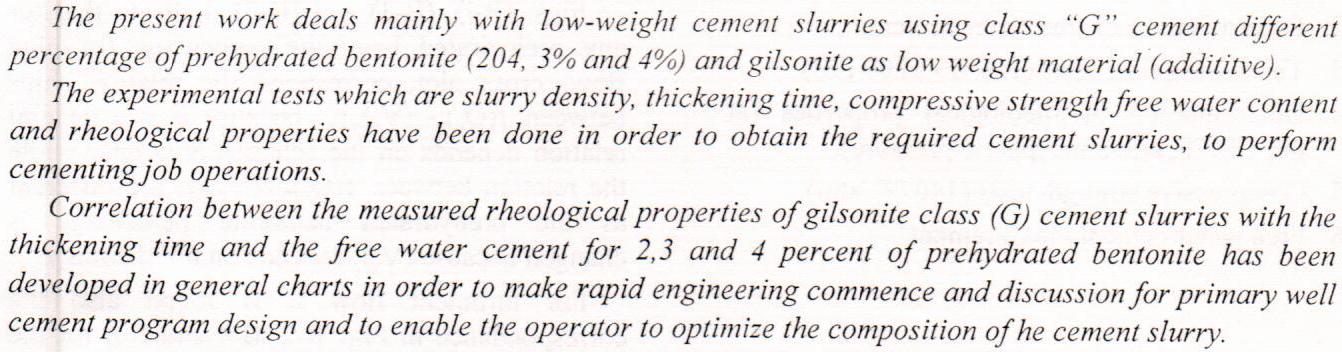
Physical and Rheological Properties of Class "G" Gilsonite Cement Slurries (Experimental Study)

This work aimed to study the effect of laser surface treatment on the mechanical characteristics and corrosion behaviour of grey cast iron type A159. Many technical applications used conventional surface treatment, but laser surface hardening has recently been used to enhance the surface properties of many alloys. The mechanical characteristics, including microstructure, microhardness, and wear resistance of A159 grey cast iron, were studied, in addition to corrosion behaviour. The experimental laser parameters in this work were 0.9, 1.2, and 1.5 KW power with continuous wave carbon dioxide lasers with scanning speeds of 10 and 12 mm/s were used. The results found that phase-transitional alterations in microstructure were influenced by lase
... Show More (4)
(4)

In recent years, various methods have been developed to enhance the characteristics of asphalt pavement in order to face the continuous challenges of increasing traffic loads and changing climate conditions. One of the most popular and successful methods is modifying the asphalt mixtures or asphalt binder with the addition of polymers. Therefore, two types of Polyethylene (PE) polymer, High-Density PE (HDPE) and Low-Density PE (LDPE), are used in this research. Two methods were applied to prepare PE-modified asphalt mixtures: Semi-Wet Method (S-WM) and Dry Method (DM). The findings of the investigation indicated that the addition of PE polymer can reduce the wear loss of aggregate. In general, the experimental results revealed that asphalt
... Show More
(5)
 (3)
(3)


A novel technique for nanoparticles with a chemical method and impact for resistance bacteria methicillin-resistant Staphylococcus aureus (MRSA), UV-visible analysis confirmed the by Fourier transform infrared spectroscopy (FT-IR) and Energy dispersive X-Ray (EDX), Scanning electron microscope (SEM) and X-ray diffraction pattern estimation antimicrobial excellent antibacterial activity against MRSA (with zone of inhibition of 11 ± 02 mm , 9 ± 01 mm,8 ± 03 mm and 7.5 ± 02 mm and 6.5 ± 02 mm) at different concentrations (0.5 ,0.25, 0.125, 0.0625, 0.03125) mg/ml while good activity was 16 ± 03 mm at 17 ± 02 mm zone at 0.25, 0.125 mg/mL, respectively. The increase in microorganism resistance to antibiotics a couple of have caused
... Show More
(17)
(12)
The concept of forming the living space in the American strategic thought has an
important position it is regarded as an strategic movement that it supports the American
United States with the huge capabilities in its own concern that enables it to approach of
American administration , we find that of different historical periods it works to establish that
the geopolitical dimension which is accompanied with the ability of American response for
the evens that in its own turn enables the American united states to seize the growing chances
in the global strategic environment This study includes five chapters :
- Chapter one: The idea of living space.
- Chapter two: Geopolitical dimension of living space theory.
-
Pure and Fe-doped zinc oxide nanocrystalline films were prepared
via a sol–gel method using -
C for 2 h.
The thin films were prepared and characterized by X-ray diffraction
(XRD), atomic force microscopy (AFM), field emission scanning
electron microscopy (FE-SEM) and UV- visible spectroscopy. The
XRD results showed that ZnO has hexagonal wurtzite structure and
the Fe ions were well incorporated into the ZnO structure. As the Fe
level increased from 2 wt% to 8 wt%, the crystallite size reduced in
comparison with the pure ZnO. The transmittance spectra were then
recorded at wavelengths ranging from 300 nm to 1000 nm. The
optical band gap energy of spin-coated films also decreased as Fe
doping concentra
(2)
In this study, plastic wastes named (PET and PVC) were used to prepare polymer matrix composite (PMC) which can be used in different applications. Composite materials were prepared by mixing unsaturated polyester resin (UP) with plastic wastes, two types of plastic waste were used in this work included polyethylene-terephthalate (PET) and Polyvinyl chloride (PVC) with various weight fractions (0, 5,10,15, 20 and 25%) added as a filler in flakes form. In this work, some of the tests that were carried out included (tensile, bending, and compressive strength) as mechanical tests, in addition to (thermal conductivity and water absorption) as physical tests. The values of tensile, compressive strength and Young's modulus of UP increased after
... Show MoreKE Sharquie, SA Al-Mashhadani, AA Noaimi, WM Katof, THE IRAQI POSTGRADUATE MEDICAL JOURNAL, 2013 - Cited by 6
The conjunctive ''and'' and its Arabic counterpart ''و'' are discourse markers that express certain meanings and presuppose the presence of other elements in discourse. They are indispensable aids to both the text writers and readers. The present study aims to show that such cohesive ties help the writer to organize his main argument and communicate his ideas vividly and smoothly. They also serve as explicit signals that help readers unfold text and follow its threads as realized in the progression of context. The researcher has utilized the Quirk Model of Semantic Implication for data analysis. A total of 42 (22 for English and 20 for Arabic) political texts selected from different elite newspapers in both Arabic and English for the analy
... Show MoreA comparative investigation of gas sensing properties of SnO2 doped with WO3 based on thin film and bulk forms was achieved. Thin films were deposited by thermal evaporation technique on glass substrates. Bulk sensors in the shape of pellets were prepared by pressing SnO2:WO3 powder. The polycrystalline nature of the obtained films with tetragonal structure was confirmed by X-ray diffraction. The calculated crystalline size was 52.43 nm. Thickness of the prepared films was found 134 nm. The optical characteristics of the thin films were studied by using UV-VIS Spectrophotometer in the wavelength range 200 nm to 1100 nm, the energy band gap, extinction coefficient and refractive index of the thin film were 2.5 eV , 0.024 and 2.51, respective
... Show More
(5)
(3)
Abstract
This study investigates the mechanical compression properties of tin-lead and lead-free alloy spherical balls, using more than 500 samples to identify statistical variability in the properties in each alloy. Isothermal aging was done to study and compare the aging effect on the microstructure and properties.
The results showed significant elastic and plastic anisotropy of tin phase in lead-free tin based solder and that was compared with simulation using a Crystal Plasticity Finite Element (CPEF) method that has the anisotropy of Sn installed. The results and experiments were in good agreement, indicating the range of values expected with anisotropic properties.
Keywords<
... Show More