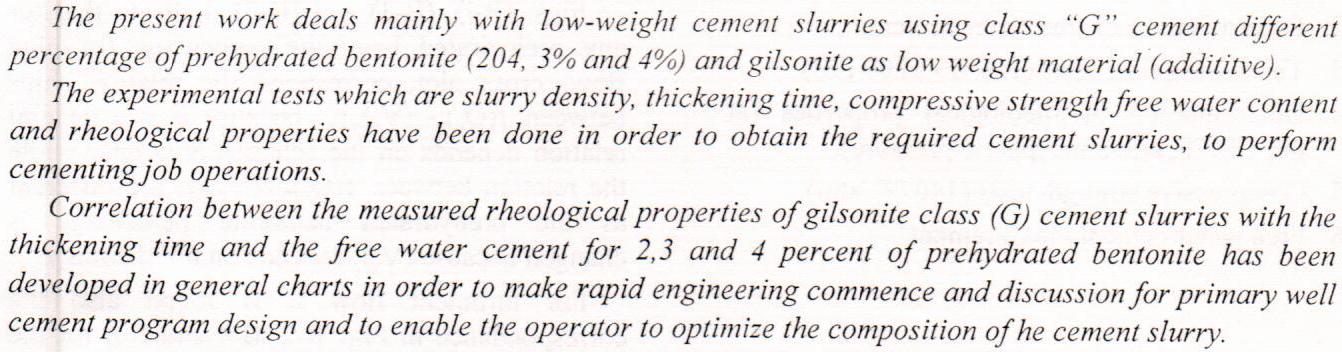
Physical and Rheological Properties of Class "G" Gilsonite Cement Slurries (Experimental Study)

Petrophysical characterization is the most important stage in reservoir management. The main purpose of this study is to evaluate reservoir properties and lithological identification of Nahr Umar Formation in Nasiriya oil field. The available well logs are (sonic, density, neutron, gamma-ray, SP, and resistivity logs). The petrophysical parameters such as the volume of clay, porosity, permeability, water saturation, were computed and interpreted using IP4.4 software. The lithology prediction of Nahr Umar formation was carried out by sonic -density cross plot technique. Nahr Umar Formation was divided into five units based on well logs interpretation and petrophysical Analysis: Nu-1 to Nu-5. The formation lithology is mainly
... Show More
57 isolates of Mycobacterium tuberculosis and Mycobacterium bovis were identified; they were isolated from different clinical sources which included sputum, bronchial wash, abscess, pleural fluid, gastric fluid, eye fluid, and CSF, also urine and ear swab. This investigation was carried out on 198 patient attended National Reference Laboratory for T.B during September 2009. Also the study declared that the ratio of separation of this bacterium from male was (67.6%) and it’s higher than the ratio of separation this bacterium from females which was (32.3%). The susceptibility of Mycobacterium tuberculosis to melatonin was evaluated. Many concentrati
... Show More
Every year, millions of tons of waste glass are created across the globe. It is disposed of in landfills, which is unsustainable since it does not disintegrate into the environment. This study aims to produce reactive powder concrete by using recycled glass powder and determine the influence on the mechanical properties. This study investigated the effect of partial replacement of cement with recycled glass powder at two percentages (0, 20) % by weight of cement on some mechanical properties (Fresh density, Splitting tensile strength, Impact Strength, and voids%) of reactive powder concrete containing 1 % micro steel (MSRPC). Furthermore, using steam curing for (5 hours) at 90 degrees celsius after hardening the sample directly, RPC was
... Show More (8)
(8)
A progression of Polyaniline (PANI) and Titanium dioxide (TiO2) nanoparticles (NPs) were prepared by an in-situ polymerization strategy within the sight of TiO2 NPs. The subsequent nanocomposites were analyzed using Fourier-transform infrared spectra (FTIR), X-ray diffraction (XRD), Scanning Electron Microscopy (SEM), and Energy Dispersive X-Ray Analysis (EDX) taken for the prepared samples. PANI/TiO2 nanocomposites were prepared by various compound materials (with H2SO4 0.3 M and without it, to compare the outcome of it) by the compound oxidation technique using ammonium persulfate (APS) as oxidant within the sight of ultrafine grade powder of TiO2 cooled in an ice bath.
... Show More
(4)
Epoxy resin has many chemical features and mechanical properties, but it has a small elongation at break, low impact strength and crack propagation resistance, i.e. it exhibits a brittle behavior. In the current study, the influence of adding kaolin with variable particle size on the mechanical properties (flexural modulus E, toughness Gc, fracture toughness Kc, hardness HB, and Wear rate WR) of epoxy resin was evaluated. Composites of epoxy with varying concentrations (0, 10, 20, 30, 40 weights %) of kaolin were prepared by hand-out method. The composites showed improved (E, Gc, Kc, HB, and WR) properties with the addition of filler. Also, similar results were observed with the decrease in particle size. In addition, in this study, mult
... Show More
(4)
(8)
The deposition process and investigation of the physical properties of tungsten trioxide (WO3) thin films before and after gamma irradiation are presented in this paper. The WO3 thin films were deposited, using the pulse laser deposition technique, on glass substrates at laser energies of 600mJ and 800mJ. After deposition, the samples were gamma irradiated with Co60. The structural and optical properties of polycrystalline WO3 thin films are presented and discussed before and after 5kGy gamma irradiation at the two laser energies. X-ray diffraction spectra revealed that all the films consisted of WO3 crystallized in the triclinic form; the dislocation density and lattice strain increased with the absorbed dosage of gamma
... Show More (1)
(1)
(1)
(1)

Polymer blended electrolytes of various concentrations of undoped PAN/PMMA (80/20, 75/25, 70/30, 65/35 and 60/40 wt%) and doped with lithium salts (LiCl, Li2SO4H2O, LiNO3, Li2CO3) at 20% wt have been prepared by the solution casting method using dimethylformamide as a solvent. The electrical conductivity has been carried out using an LCR meter. The results showed that the highest ionic conductivity was 2.80x10⁻⁷ (Ω.cm)-1 and 1.05x10⁻¹ (Ω.cm)-1 at 100 kHz frequency at room temperature for undoped (60% PAN + 40% PMMA) and (80% PAN + 20% PMMA) doped with 20%wt Li2CO3 composite blends, respectively. It was found from the measurements of the A.C conductivity of undoped (PAN+PMMA) and doped with different lithium salts in the frequency
... Show MoreIn this work, pure and copper mixed oxide PAni nanofiber thin films are successfully synthesized on silicon substrates by hydrothermal method and spin coating technique at room temperature with thickness of about 325 nm. The structural, surface morphological, optical and photoconductivity properties have been investigated. The XRD results showed that PAni films have crystalline nature, CuO and PAni/CuO nanostructure composites are monoclinic polycrystalline structure. The FESEM images of PAni clearly indicate that it has nanofiber-like structure, whereas the CuO film has spongelike shape. The surface morphology analysis of PAni/CuO composite shows that nanofiber caped with inorganic material which is CuO is a core-shell structure. Op
... Show More
(19)