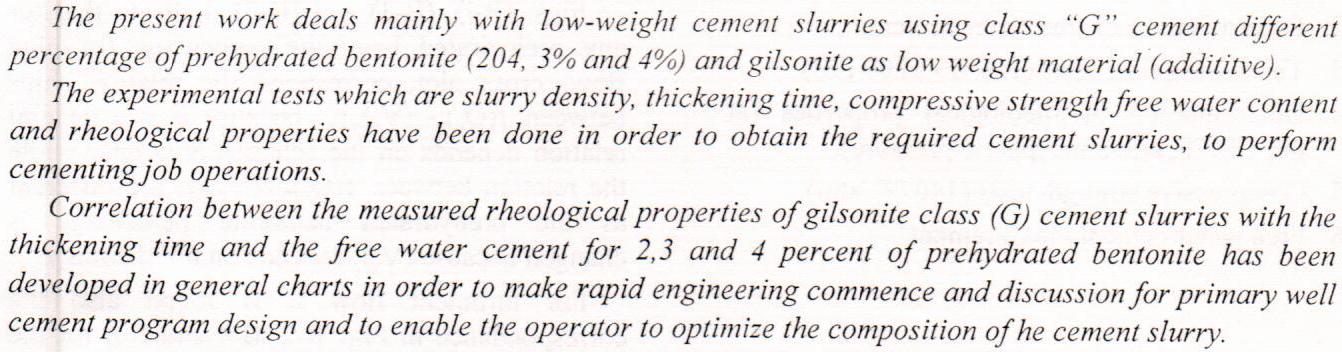
Physical and Rheological Properties of Class "G" Gilsonite Cement Slurries (Experimental Study)

Kiffil Shinafiya project was selected as it’s been conducted and covering the areas of grain crops agriculture in Najaf and Qadissiya provinces. Lands of this project are considered as a part of the Mesopotamian plain located in between N32⁰ 15′, N31⁰ 30′ and E44⁰ 44’, E44⁰ 20′. Three hydrosequences were disclosed with three transects (T1, T2, T3) in the area of study. The first hydrosequence was perpendicular on the other two sequences. Fifteen pedons were outcropped, five pedons in each transect in addition to eighteen more surface samples to be a total samples of 33 locations. Pedons were morphologically described due to soil survey manual (Soil Survey Staff, 2017). Spatial distribution of soil salinity showed that the
... Show MoreThe aim of this research is to study the influence of additives on the properties of soap greases, such as lithium, calcium, sodium, lithium-calcium grease, by adding varies additives, such as graphite, molybdenum disulfide, carbon black, corrosion inhibitor, and extreme pressure.
These additives have been added to grease to obtain the best percentages that improve the properties of grease such as load carrying, wear resistance, corrosion resistance, drop point, and penetration.
The results showed the best weight percentages to all types of grease which give good properties are 1.5% extreme pressure additive, 3% graphite, 1% molybdenum disulfide, 2.5% carbon black.
The other hand, the best weight percentage for corrosion inhibit
Background: Colonization of soft denture liners by Candida albicans and other microorganisms continued to be a serious problem. The aim of this study was to evaluate the effect of incorporating silver nanoparticles into heat cured acrylic-based soft denture liner on the antifungal activity, and on water sorption, solubility, shear bond strength and color change of the soft lining material. Furthermore, evaluating the amount of silver released. Materials and methods: Silver nanoparticles were incorporated into soft denture liner in different percentages (0.05%, 0.1% and 0.2% by weight). Four hundred and twenty specimens were prepared and divided into five groups according to the test to be performed. The antifungal activity of the soft liner
... Show MoreIn this work, the effects of solvent properties on the characteristics of absorption and fluorescence for two laser dyes was studied. Dyes used in this work include Coumarin 5400 and DCM, while the solvents include ethanol, methanol, acetone, propanol and chloroform. Coumarin 5400 dye shows sharp fluorescence peaks in the green band of visible region while the DCM dye shows relatively wide band within 590-630 nm. Therefore, the selection of any dye for random gain medium applications should be performed after determining the most appropriate solvent as the optimum fluorescence characteristics are obtained.
The physical and elastic characteristics of rocks determine rock strengths in general. Rock strength is frequently assessed using porosity well logs such as neutron and sonic logs. The essential criteria for estimating rock mechanic parameters in petroleum engineering research are uniaxial compressive strength and elastic modulus. Indirect estimation using well-log data is necessary to measure these variables. This study attempts to create a single regression model that can accurately forecast rock mechanic characteristics for the Harth Carbonate Formation in the Fauqi oil field. According to the findings of this study, petrophysical parameters are reliable indexes for determining rock mechanical properties having good performance p
... Show More (10)
(10)
 (1)
(1)

 (2)
(2)
In this work, the effect of anodizing duration on the morphology and photoelectrochemical properties of TiO2 nanotubes arrays (NTAs) has been investigated The samples were characterized by X-ray diffraction (XRD) and energy dispersive X-ray (EDX) to characterize their crystalline structure and compositional. Surface morphological and their dimensional variation was examined by field emission scanning electron microscopy (FESEM). The anodizing duration played a significant role in the formation of TiO2 nanotubes arrays. Moreover, the photoelectrochemical properties (PEC) were studied through photocurrent measurements. Optimum anodizing duration of 60 min at 40 V exhibited maximum photocurrent of 0.03 mA cm-2 under illumination of hal
... Show More
(7)
The present work involves studying the effect of electrolyte composition [@1= 0.5 wt.% NH4F / 5% H2O / 5% Glycerol (GLY)/ 90% Ethylene Glycol (EG)] and [ @2= 0.5 wt. % NH4F / 5% H2O / 95% Ethylene Glycol (EG)] on the structural and photoelectrochemical properties of titania nanotubes arrays (TNTAs). TNTAs substrates were successfully carried out via anodization technique and were carried out in 40 V for one hour in different electrolytes (@1, and @2). The properties of physicochemical of TNTAs were distinguished via an X-ray Diffractometer (XRD), Field Emission Scanning Electron Microscope (FESEM), an Energy Dispersive X-ray (EDX), and UV–visible diffuse reflectance. The photoelectrochemical response of TNTAs was evaluated
... Show More
(19)
(12)

The present work involves studying the effect of electrolyte composition [@1= 0.5 wt.% NH4F / 5% H2O / 5% Glycerol (GLY)/ 90% Ethylene Glycol (EG)] and [ @2= 0.5 wt. % NH4F / 5% H2O / 95% Ethylene Glycol (EG)] on the structural and photoelectrochemical properties of titania nanotubes arrays (TNTAs). TNTAs substrates were successfully carried out via anodization technique and were carried out in 40 V for one hour in different electrolytes (@1, and @2). The properties of physicochemical of TNTAs were distinguished via an X-ray Diffractometer (XRD), Field Emission Scanning Electron Microscope (FESEM), an Energy Dispersive X-ray (EDX), and UV–visible diffuse reflectance. T
... Show More
(19)
(12)