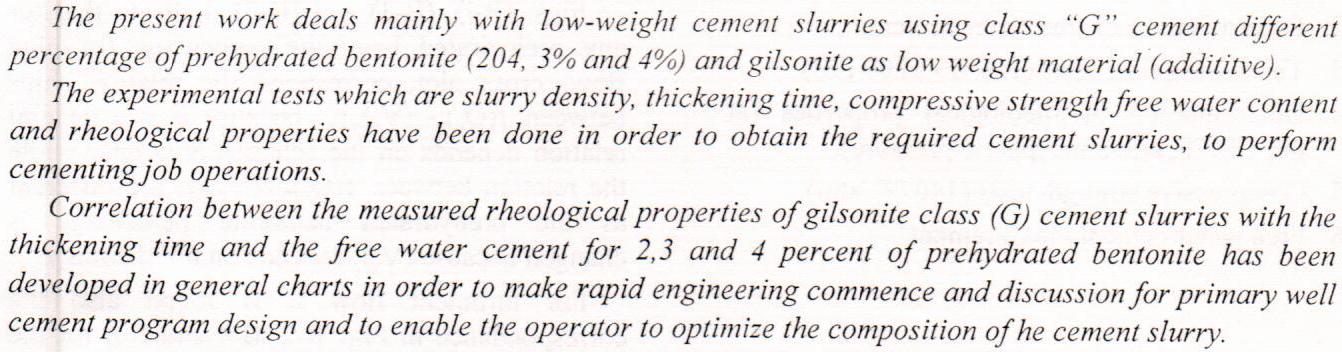
Physical and Rheological Properties of Class "G" Gilsonite Cement Slurries (Experimental Study)

Objective: Conventional approaches for disinfection, including spraying and immersion, resulted in only surface disinfection of impressions. As a result, self-disinfecting impression materials incorporated with antimicrobial compounds require more extensive studies. The incorporation of a disinfectant into irreversible hydrocolloid impression materials could eliminate the need for the disinfection step by conventional approaches, including spraying and immersion which only result in surface disinfection of impressions. The study was aimed to investigate the effect of incorporation of hypochlorous acid in irreversible hydrocolloid materials on antimicrobial efficiency, detail reproduction, and dimensional stability. Materials and
... Show More (1)
(1)


AlO-doped ZnO nanocrystalline thin films from with nano crystallite size in the range (19-15 nm) were fabricated by pulsed laser deposition technique. The reduction of crystallite size by increasing of doping ratio shift the bandgap to IR region the optical band gap decreases in a consistent manner, from 3.21to 2.1 eV by increasing AlO doping ratio from 0 to 7wt% but then returns to grow up to 3.21 eV by a further increase the doping ratio. The bandgap increment obtained for 9% AlO dopant concentration can be clarified in terms of the Burstein–Moss effect whereas the aluminum donor atom increased the carrier's concentration which in turn shifts the Fermi level and widened the bandgap (blue-shift). The engineering of the bandgap by
... Show More (1)
(1)
Compounds from ZnO doped with AgO in different ratio (0,3,5,7, and 9)wt.% were prepared.Thin films from the prepared compounds were deposited on a glass substrate using the pulsed laser deposition method. The XRD pattern confirmed the presence of a single-phase hexagonal wurtzite ZnO structure, without the presence of a secondary phase. AFM measurements showed an increase in both average grain size and average surface roughness with increasing concentration content of (AgO).The crystallite size of ZnO of the main peak corresponding to the preferred plane of crystal growth named (100) increases from 17.8 to 22.5nm by increasing of AgO doping ratio from 0 to 9%. The absorbance and transmittance in the wavelength range (350-1100 nm)
... Show More
(13)
(6)
Polymer matrix composites are suitable materials for medical applications, such as denture base resin polymethyl methacrylate (PMMA). This includes light weight and high strength. This paper describes the effect of selected weight fractions (1, 2, 3, 4 & 5) % wt of nano(Alumina AL2O3, Zirconia ZrO2, Hydroxyapatite HA and Halloysite nanoClay) reinforcements on the biopolymer matrix (PMMA). Some tribology tests were used to evaluate the prepared system (impact strength, hardness surface, and wear rate) tests. The samples were fabricated by (Hand Lay-Up) with different particle reinforcement percentages. All tests were accomplished at room temperature, and samples were developed according to the ASTM standard. The weight fraction of (4% for AL
... Show More
(4)
(93)
(94)

In this research work a composite material was prepared contains a matrix which is unsaturated polyester resin (UPE) reinforced with carbon nanotube the percentage weight (0.1, 0.2, 0.4.0.5) %, and Zn particle the percentage weight (0.1, 0.2,0.4,0.5)%.
All sample were prepared by hand lay-up, process the mechanical tests contains hardness test, wear rate test, and the coefficient of thermal conductivity. The results showed a significant improvement in the properties of overlapping, Article containing carbon nano-tubes and maicroparticles of zinc because of its articles of this characteristics of high quality properties led to an, an increase in the coefficient of the rmalconductivity, and increase the hardness values with increased pe
(30)
(15)
(15)
(11)
In the present work, the ternary compound MgxZn7-x O7Wurtzoid with variable Zn and Mg contents was analyzed using density functional theory with B3LYP 6-311G**basis set. The electronic and vibrational properties of MgxZn7-xO7 wurtzoids, were investigated, including energy gaps, bond lengths, spectral properties, such like infrared spectra and Raman. IR and Raman spectra were compared with experimental longitudinal optical modes frequency results. The theoretical results agree well with experiments and previous data. It has been found that the energy gap is increasing with the increased Mg concentration, and that the longitudinal optical position exposes a UV shift movement with an increase in the concentration.
(3)
(2)