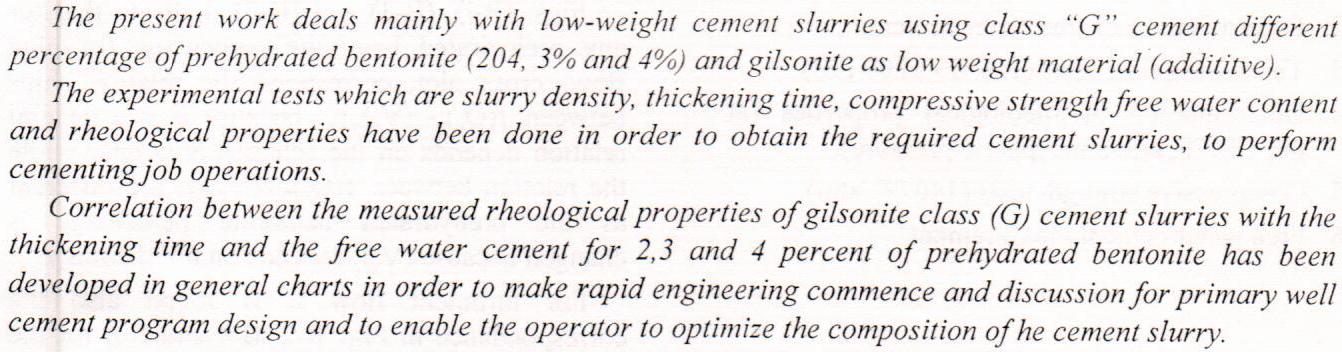
Physical and Rheological Properties of Class "G" Gilsonite Cement Slurries (Experimental Study)

ولاء طارق حميد, Mustansiriyah Journal of Sports Science, 2021
ZnS:MnP2+P nanoparticles were prepared by a simple microwave irradiation method under mild condition. The starting materials for the synthesis of ZnS:MnP 2+P quantum dots were zinc acetate as zinc source, thioacetamide as a sulfur source, manganese chloride as manganese source (R & M Chemical) and ethylene glycol as a solvent. All chemicals were analytical grade products and used without further purification. The quantum dots of ZnS:MnP 2+P with cubic structure were characterized by X-ray powder diffraction (XRD), the morphology of the film is seen by scanning electron microscopy (SEM) also by field effect scanning electron microscopy (FESEM). The composition of the samples is analysed by EDS. UV-Visible absorption spectroscopy analysis
... Show MoreNitinol (NiTi) is used in many medical applications, including hard tissue replacements, because of its suitable characteristics, including a close elastic modulus to that of bones. Due to the great importance of the mechanical properties of this material in tissue replacements, this work aims to study the hysteresis response in an attempt to explore the ability of the material to remember its previous mechanical state in addition to its ability to withstand stress and to obtain the optimal dimensions and specifications for the manufacturer of NiTi actuators. Stress-strain examination is done in a computational way using a mutable Lagoudas MATLAB code for various coil radii, environment temperatures, and coil lengths. The computational m
... Show More (1)
(1)

A study of characteristics of the lubricant oils and the physical properties is essential to know the quality of lubricant oils. The parameters that lead to classify oils have been studied in this research. Three types of multi-grades lubricant oils were applied under changing temperatures from 25 oC to 78oC to estimate the physical properties and mixture compositions. Kinematic viscosity, viscosity gravity constant and paraffin (P), naphthenes (N) and aromatics (A) (PNA) analysis are used to predict the composition of lubricants oil. Kinematic viscosity gives good behaviors and the oxidation stability for each lubricant oils. PNA analysis predicted fractions of paraffin (XP), naphthenes (XN),
... Show More
(2)
ABSTRACT: Thin film of CdS has been deposited onto clean glass substrate by using Spray pyrolysis technique. Results of Morphological (AFM) studied; electrical properties and optical conductivity studied are analysis. AFM results show a crystalline nature of the films. From the conductivity measurement at different temperatures, the activation energy of the films was calculated and found to be between 0.188 - 0.124 eV for low temperature regions, and between 1.67-1.19eV for high temperature regions. Hall measurements of electrical properties at room temperature show that the resistivity and mobility of CdS polycrystalline films deposited at 400 C0, were 3.878x10³ . cm and 1.302x104cm2/ (V.s), respectively. The electrical conductivity of th
... Show MoreRefractories are mineral and chemical-, based, materials with excellent heat resistance, making them ideal for use in the construction of ovens, furnace walls industries. According to this our research is concerned to study the effect of addition of (4% CaO) and (5% graphite) on the silica brick properties. Different amounts of CaO and Graphite were included in the white sand (raw ingredients) of silica bricks as a binder to prepare the composition then the composition were sintered using Different sintering temperatures ranging from (1000–1400)𝛐C under static air. Density, thermal conductivity, porosity, and water absorption Compression there was power tested after sintering. XRD analysis was used to identify raw materials’
... Show More
The central marshes are one of the most important wetlands/ecosystems in the southern area of Iraq. This study evaluates the bed soil's mechanical, physical, and chemical properties at certain southern Iraqi central marshes sites. This was conducted to investigate their types and suitability for enhancing the agricultural reality of most field crops and for construction purposes. Soil samples were collected from 15 sites at 10-100 cm depth. Hence, numerous parameters were determined: index properties, unconfined compressive strength, direct shear strength, consolidation, texture, and sieve analysis, water content, specific gravity, dry density, permeability, pH, total soluble salts (TSS), organic materials (OM) and total sulfate con
... Show More
 (4)
(4)
(4)
(4)

This study was conducted in an orchard pomegranate's Department of Horticulture College of Agriculture, University of Baghdad for two seasons 1999-2000 on cultivars pomegranate Salimi and narrators seedless to study the effect spraying Nizant growth in sex ratio of flowers and recipes flowering and winning was selected 27 trees per class 15 years old planted
The effect of annealing on the structural and optical properties of Antimony trisulfide (Sb2S3) is investigated. Sb2S3 powder is vaporized on clean glass substrates at room temperature under high vacuum pressure to form thin films. The structural research was done with the aid of X-ray diffraction (XRD) and atomic force microscopy (AFM). The amorphous to the polycrystalline transformation of these thin films was shown by X-ray diffraction analysis after thermal annealing. These films' morphology is explained. The absorption coefficient and optical energy gap of the investigated films are calculated using transmission spectra. Both samples have strong absorption in the visible spectrum, according to UV-visible absorption spectra. The optical
... Show More
(5)
(2)