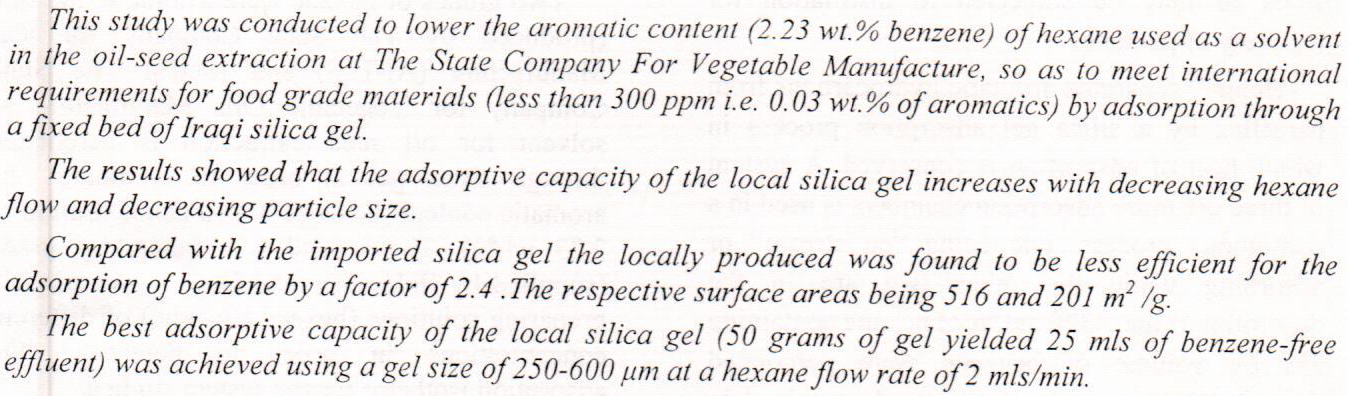
Reduction of Aromatic Content from Hexane by Silica Gel

 (60)
(60)
 (54)
(54)



Gypseous soil is a collapsible soil, which causes large deformations in buildings that are constructed on it. Various methods have been used to minimise this effect, such as replacing the gypseous soil or using soil stabilisation (grouting or soil improvement). This study was carried out on four types of gypseous soils that have different properties and various gypsum contents. The testing was carried out on remoulded samples to evaluate the compressibility of gypseous soil under different conditions. The samples were grouted with acrylate liquid. The relationships between the injection pressure and the radius of flow, between time of injection and radius of flow, and between time and quantity of acrylate liquid are investigated on
... Show More
(21)
Aim of the present study is Identification of specific gene for GPCR using specific primers .and identification of difference in PCR analysis in patients with heart thrombosis and compared with healthy, Sequencing of PCR product regarding GPCR compared for all three subject, Identification the similarity of human GPCR with local strain of yeast fifty healthy control and fifty patients with thrombosis which diagnosed medically with cardiac specific troponin t, troponin 1 levels and electro myocardiogram ECG. The aged for all subjects ranged (39-75) years patients were lying in cardiac care unit at Ibn- al- Nafees teaching hospital and Sheikh Zayed teaching hospital. Genomic DNA of whole blood was extracted from buffy coat and cell cu
... Show More
(33)
(21)
The interest of application of liquid membrane (pertraction) processes for recovery of medicinal compounds from dilute ammoniacal leach solutions is demonstrated. Selectivity of the liquid membrane ensures a preferential transport of the desired solute from the native extract into the strip solution, vinblastine was successfully extracted from basic media (pH 9.2) and stripped by acidic media of sulfuric acid (pH= 1.3) applying continuous pertraction in a rotating discs contactor and using n-decane as liquid membrane. Transport of vinblastine in three-liquid-phase system was studied and performed by means of a kinetic model involving two consecutive irreversible first-order reactions. The kinetic parameters (apparent rate constants of th
... Show MoreThis research was conduct to evaluate the cytotoxic effect of exotoxin A (ETA) produced by Pseudomonas aeruginosa on mice in comparison with (phosphate buffer saline (PBS) as a negative control. The effect of the toxin was measured by employing the cytogenetic analysis which included (the mitotic index (MI), chromosomal aberrations (CAs), micronucleus (MN) and sperm abnormalities) parameters. In order to specify the cytotoxic effect of the toxin, three doses of ETA (125, 250 and 500 ng/ml) were used. Results showed that ETA was found to cause a significant decrease in mitotic index (MI) percentage, while significant increase in micronucleus (MN), chromosomal aberrations (CAs) and sperm abnormalities parameters in compression with control wa
... Show MoreThere is currently a pressing need to create an electro-analytical approach capable of detecting and monitoring genosensors in a highly sensitive, specific, and selective way. In this work, Functionalized Multiwall Carbon Nanotubes, Graphene, Polypyrrole, and gold nanoparticles nanocomposite (f-MWCNTs-GR-PPy-AuNP) were effectively deposited on the surface of the ITO electrode using a drop-casting process to modify it. The structural, morphological, and optical analysis of the modified ITO electrodes was carried out at room temperature using X-ray diffraction (XRD), field emission scanning electron microscopy (FE-SEM) images, atomic force microscopy (AFM) and Fourier transform infrared (FTIR) spectra. Cyclic voltammetry (CV) and electrochemi
... Show MoreA procedure, depending on the derivatization and determination of aniline was depicted andvalidated in this study. 8-hydroxyquinoline (8-HQ) was used as the derivatizing agent for thedetermination of aniline. An optimization study was performed for the derivatization reaction, i.e.,the diazonium coupling reaction, the optimum parameters were as follows: 22 mM of hydrochloricacid, 54mM of sodium hydroxide, and 1.8mM of sodium nitrate. The optimization study of themethod of cloud point extraction (CPE) revealed that the extraction solvent was 0.5 ml of Triton X-100, the optimum temperature was 90 °C, and the incubation time was 25 min. The linearity,correlation coefficients, molar absorptivities, and limits of detection were improved using t
... Show More