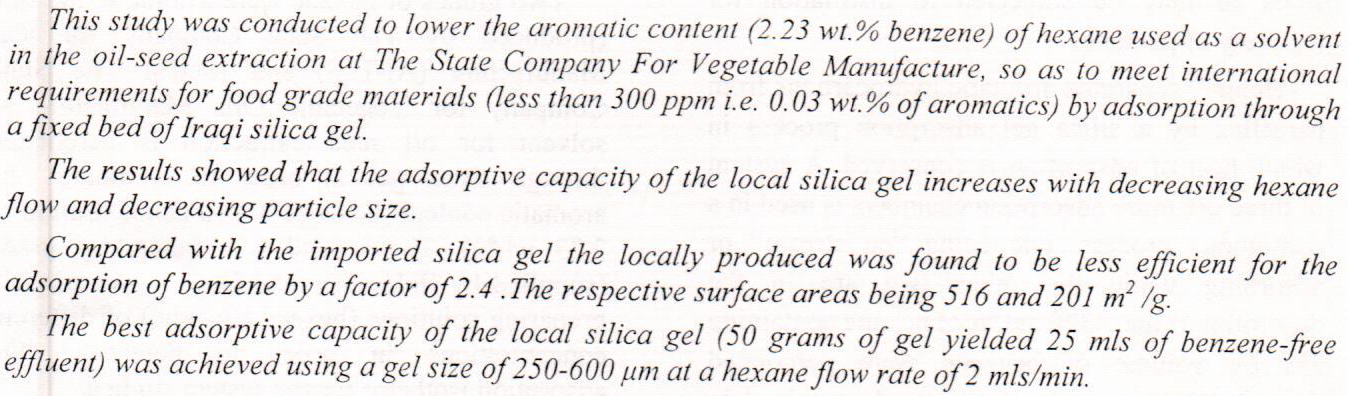
Reduction of Aromatic Content from Hexane by Silica Gel

The aim of the present study was to isolated the Enterococcus spp. from milk samples of cow and vaginal swabs from aborted women and patient women in Baghdad during September 2016 to april 2017. All 100 milk sample collecting was carried out on California Mastitis Test (CMT) and the positive Percentage of CMT reactions was 5% and the percentage of Enterococcus isolates from mastitic milk was 60% and 30% from nonmasitic milk. The prevalence of Enterococcus spp was 31% of milk samples and the prevalence of Enterococcus spp. Isolates were 67.74% of the isolates of cow milk samples were Enterococcus faecalis, 25.80% was Group D and 6.45% was non groupable while Enterococcus spp. isolates from aborted women samples were 20% and all isolated was
... Show MoreA many risk challenge in (settings hospital) are multi- bacteria are antibiotic-resistant. Some type strains that ability adhesion surface-attached bio-film census. Fifteen MRSA isolates were considered as high biofilm producers Moreover all MRSA isolates; M3, M5, M7 and M11 produced biofilms but the thickest biofilm seen M7strain. The MIC values of N. sativa oil against clinical isolates of MRSA were between (0.25, 0.5, 0.75, 1.0) μg/ml While MRSAcin (50, 75, 100, 125) µg\ ml. All biofilms treated with MRSAcin and Nigella sativa developed a presence of live cells after cultured on plate agar with inhibition zone between MIC (18 – 15) and (14- 11)mm respectively.Yet, results showed that MRSA supernatant developed a inhibitory ef
... Show More (9)
(9)
 (8)
(8)


It is often noted that disordered materials have different chemical properties to their more “ordered” cousins. Quantifying these effects in terms of thermodynamics is challenging in part because disordered materials can be difficult to characterize and are frequently relatively unstable. During the course of our experiments to understand the effects of disorder in catalysts for water oxidation we observed that many disordered manganese and cobalt oxide water oxidation catalysts directly oxidized peroxide in contrast to their more ordered analogues which catalyzed its disproportionation, that is, MnO2+2H+ +H2O2! Mn2+ +2H2O+O2(oxidation) versus H2O2!H2O+1=2 O2(disproportionation). By measuring the efficiency for one reaction over the oth
... Show More
(6)
(5)

Interested current Research measuring damage currency Swap by converting The ministry of higher Education and scientific Research money The Iraqi dinar To U.S dollar by Trade Bank Of Iraq , And that The damage Generated resulting from Deferent Between the Exchange Rate adopted From Central Bank of Iraq and Market Exchange Rate adopted by The Trade Bank Of Iraq , and Which led to the greet damage ( losses ) in Bearing by the ministry, which led to the reduction of the financial allocations for licensed curriculum outside of Iraq , and this in turn leads to reduction in the number of students Sender ( scholarships ) outside Iraq.
Where the estimated loss (damage) that suffer by the Ministry of H
... Show More
In this research, production of ethanol from waste potatoes fermentation was studied using Saccharmyses cerevisiae. Potato Flour was prepared from potato tubers after cooking and drying at 85°C. Homogenous slurry of potato flour was prepared in water at solid liquid ratio 1:10. Liquefaction of potato flour slurry with α-amylase at 80°C for 40 min followed by saccharification with glucoamylase at 65°C for 2 hr .Fermentation of hydrolysate with Saccharomyces cerevisiae at 35°C for two days resulted in production of 33 g/l ethanol.
The parameters studied were; temperature, time of fermentation and pH. It was found that Saccharification process is affected by enzyme Amylo 300 conc
... Show MoreThe extraction process of chlorophyll from dehydrated and pulverized alfalfa plant were studied by percolation method. Two solvent systems were used for the extraction namely; Ethanol-water and Hexane-Toluene systems . The effect of circulation rate, solvent concentration, and solvent volume to solid weight ratio were studied. In both ethanol water, and Hexane-Toluene systems it appears that solvent concentration is the most effective variable.