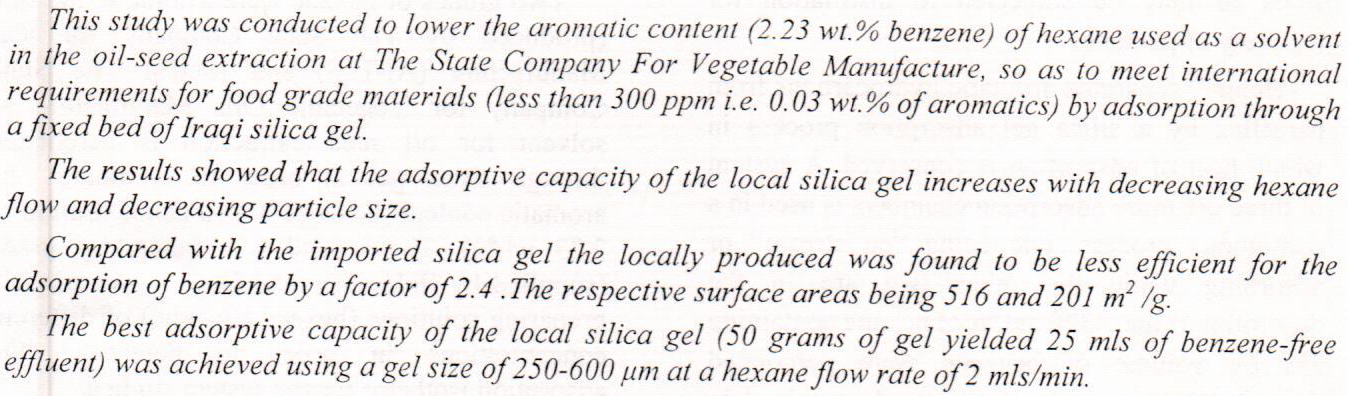
Reduction of Aromatic Content from Hexane by Silica Gel

Slag of aluminum is a residue which results during the melting process of primary and secondary aluminum production. Salt slag of aluminum is hazardous solid waste according to the European Catalogue for Hazardous Wastes. Hence, recovery of aluminum not only saves the environment, but also has advantages of financial and economic returns. In this research, aluminum was recovered and purified from the industrial wastes generated as waste from both of State Company for Electrical and Electronic Industries (Baghdad/AlWaziriya) and General Company for Mechanical Industries (Babylon/-Al-Escandria). It was found that these wastes contain tiny proportions of other elements such as iron, copper, nickel, titanium, lead, and potassium. Wastes were
... Show More (3)
(3)

 (46)
(49)
(46)
(49)

 (8)
(8)
(8)
(8)
In the present work, the pollutants of the municipal wastewater are reduced using Chlorella vulgaris microalgae. The pollutants that were treated are: Total organic carbon (TOC), Chemical oxygen demand (COD), Nitrate (NO3), and Phosphate (PO4). Firstly, the treatment was achieved at atmospheric conditions (Temperature = 25oC), pH 7 with time (1 – 48 h). To study the effect of other microorganisms on the reduction of pollutants, sterilized wastewater and unsterilized wastewater were used for two types of packing (cylindrical plastic and cubic polystyrene) as well as algae's broth (without packing), where the microalgae are grown on the packing then transported to the wastewater for treatment. Th
... Show More
(5)
In this work, the possibility of utilizing osmosis phenomenon to produce energy as a type of the renewable energy using Thin Film Composite Ultra Low Pressure membrane TFC-ULP was studied. Where by forward osmosis water passes through the membrane toward the concentrated brine solution, this will lead to raise the head of the high brine solution. This developed static head may be used to produce energy. The aim of the present work is to study the static head developed and the flux on the high brine water solution side when using forward and reverse osmosis membranes for an initial concentration range from 35-300 g/l for each type of membrane used at room temperature and pressure conditions, and finally calculating the maximum possible po
... Show MoreThis work studies the performance of zeolite permeable reactive barrier in removing cadmium from a contaminated shallow aquifer. Batch tests have been performed to characterize the equilibrium sorption properties of the zeolite in cadmium-containing aqueous solutions. A 1D numerical finite difference model has been developed to describe pollutant transport within groundwater taking pollutant sorption on the permeable reactive barrier (PRB), which is performed by Langmuir equation, into account. Numerical results show that the PRB starts to saturate after a period of time (~120 h) due to reduction of the retardation factor, indicating a decrease in the percentage of zeolite functionality. However, a reasonable agreement between model predict
... Show More
(40)
(26)
(9)
(7)
(22)
(22)
Realistic implementation of nanofluids in subsurface projects including carbon geosequestration and enhanced oil recovery requires full understanding of nanoparticles (NPs) adsorption behaviour in the porous media. The physicochemical interactions between NPs and between the NP and the porous media grain surface control the adsorption behavior of NPs. This study investigates the reversible and irreversible adsorption of silica NPs onto oil-wet and water-wet carbonate surfaces at reservoir conditions. Each carbonate sample was treated with different concentrations of silica nanofluid to investigate NP adsorption in terms of nanoparticles initial size and hydrophobicity at different temperatures, and pressures. Aggregation behaviour and the
... Show More
(59)
(53)
Several previous investigations and studies utilized silica fume (SF) or (micro silica) particles as supplementary cementitious material added as a substitute to cement-based mortars and their effect on the overall properties, especially on physical properties, strength properties, and mechanical properties. This study investigated the impact of the inclusion of silica fume (SF) particles on the residual compressive strengths and microstructure properties of cement-based mortars exposed to severe conditions of elevated temperatures. The prepared specimens were tested and subjected to 25, 250, 450, 600, and 900 °C. Their residual compressive strengths and microstructure were evaluated and compared with control samples (C
... Show More
(8)
(5)