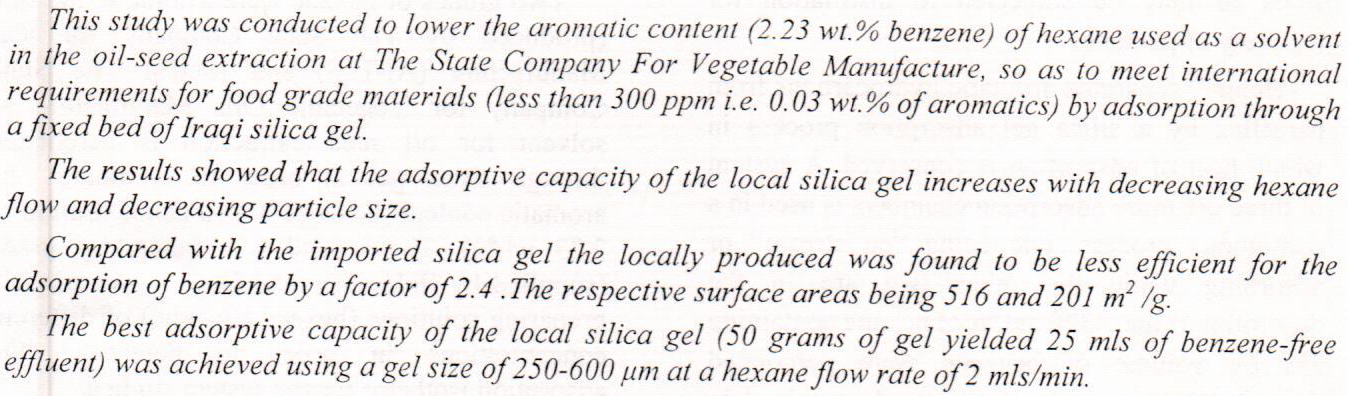
Reduction of Aromatic Content from Hexane by Silica Gel

The removal of Anit-Inflammatory drugs, namely; Acetaminophen (ACTP), from wastewater by bulk liquid membrane (BLM) process using Aliquat 336 (QCl) as a carrier was investigated. The effects of several parameters on the extraction efficiency were studied in this research, such as the initial feed phase concentration (10-50) ppm of ACTP, stripping phase (NaCl) concentration (0.3,0.5,0.7 M), temperature (30-50oC), the volume ratio of feed phase to membrane phase (200-400ml/80ml), agitation speed of the feed phase (75-125 rpm), membrane stirring speed (0, 100, 150 rpm), carrier concentration (1, 5, 9 wt%), the pH of feed (2, 4, 6, 8, 10), and solvent type (CCl4 and n-Heptane). The study shows that high ext
... Show More (4)
(4)

يهدف البحث الى صياغة استراتيجية اعلامية لمواجهة اعلام التنظيمات الارهابية
ABSTRACTBackground : Acne vulgaris is a
common skin disease, affecting more than 85% of
adolescents and often continuing into adulthood.
People between 11 and 30 years of age and up to
5% of older adults. For most patients acne remains
a nuisance with occasional flares of unsightly
comedones, pustules and nodules. For other less
fortunate persons, the sever inflammatory response
to Propionibacterium acnes (P.acnes) results in
permanent
Methods: Disfiguring scars. (1, 2) Stigmata of sever
acne cane lead to social ostracism, withdrawal
from society and severe psychologic
depression (1-4).
Result Pathogenesis of acne Traditionally, acne
has been thought of as a multifactorial disease of
the fo
(2)
 (18)
(15)
(18)
(15)


This work focuses on the preparation of pure nanocrystalline SnO2 and SnO2:Cu thin films on cleaned glass substrates utilizing a sol-gel spin coating and chemical bath deposition (CBD) procedures. The primary aim of this study is to investigate the possible use of these thin films in the context of gas sensor applications. The films underwent annealing in an air environment at a temperature of 500 ◦C for duration of 60 minutes. The thickness of the film that was deposited may be estimated to be around 300 nm. The investigation included an examination of the structural, optical, electrical, and sensing characteristics, which were explored across various preparation circumstances, specifically focusing on varied
... Show More
(9)
(8)
(3)
The growing demand for energy, coupled with the continued dominance of fossil fuels as the primary energy source, necessitates eco-friendly technologies that simultaneously enhance oil recovery (EOR) and reduce the impact of their emissions. Only one task, which is the CO2-EOR project, can combine these two sustainable development goals. Further, employing green nanotechnology, including nanoparticles and nanofluids, ensures a sustainable approach to controlling and enhancing rock wettability, thereby enhancing hydrocarbon production and carbon storage. However, the performance of nanofluids in subsurface formations is limited by the stability of these nano-dispersions at the harsh conditions of reservoirs. This work thus synthesize
... Show More
Mesoporous silica (MPS) nanoparticle was prepared as carriers for drug delivery systems by sol–gel method from sodium silicate as inexpensive precursor of silica and Cocamidopropyl betaine (CABP) as template. The silica particles were characterized by SEM, TEM, AFM, XRD, and N2adsorption–desorption isotherms. The results show that the MPS particle in the nanorange (40-80 nm ) with average diameter equal to 62.15 nm has rods particle morphology, specific surface area is 1096.122 m2/g, pore volume 0.900 cm3/g, with average pore diameter 2.902 nm, which can serve as efficient carriers for drugs. The adsorption kinetic of Ciprofloxacin (CIP) drug was studied and the data were analyzed and found to match well with
... Show More
(31)
(13)
This study investigated the healing effects of topical application of zerumbone, a well‐known anti‐inflammatory compounds loaded on nanostructured lipid carrier gel (Carbopol 940) (ZER‐NLCG) on excisional wounds in streptozotocin‐induced diabetic rats. Diabetic rats with inflicted superficial skin wound were topically treated with ZER‐NLCG, empty NLCG, and silver sulfadiazine cream (SSDC) once daily for 21 days. Wound tissue samples were analyzed for proinflammatory cytokines, namely, interleukin‐6 (IL‐6), interleukin‐1
(18)
(17)