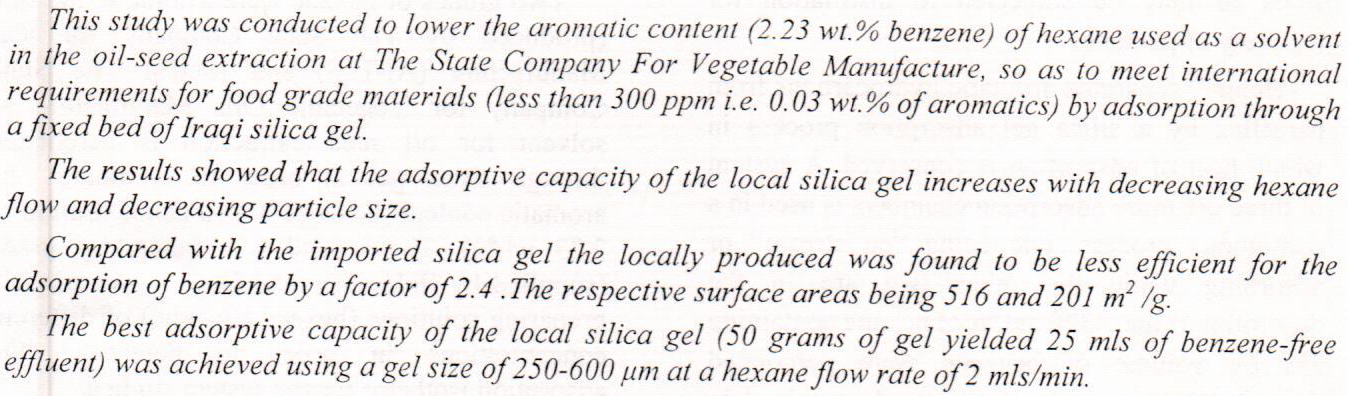
Reduction of Aromatic Content from Hexane by Silica Gel

the study including isolation and identification of candida spp causing UTIs from patintes coming to al-yarmouk hospital
This paper introduces a non-conventional approach with multi-dimensional random sampling to solve a cocaine abuse model with statistical probability. The mean Latin hypercube finite difference (MLHFD) method is proposed for the first time via hybrid integration of the classical numerical finite difference (FD) formula with Latin hypercube sampling (LHS) technique to create a random distribution for the model parameters which are dependent on time t . The LHS technique gives advantage to MLHFD method to produce fast variation of the parameters’ values via number of multidimensional simulations (100, 1000 and 5000). The generated Latin hypercube sample which is random or non-deterministic in nature is further integrated with the FD method t
... Show More (4)
(4)
 (1)
(1)


 (6)
(2)
(6)
(2)
Data <span>transmission in orthogonal frequency division multiplexing (OFDM) system needs source and channel coding, the transmitted data suffers from the bad effect of large peak to average power ratio (PAPR). Source code and channel codes can be joined using different joined codes. Variable length error correcting code (VLEC) is one of these joined codes. VLEC is used in mat lab simulation for image transmission in OFDM system, different VLEC code length is used and compared to find that the PAPR decreased with increasing the code length. Several techniques are used and compared for PAPR reduction. The PAPR of OFDM signal is measured for image coding with VLEC and compared with image coded by Huffman source coding and Bose-
... Show More
In the present work, a closed loop circulation system consist of three testing sections was designed and constructed. The testing sections made from (3m) of commercial carbon steel pipe of diameters(5.08, 2.54 and 1.91 cm) . Anionic surfactant (SDBS )with concentrations of (50, 100, 150, 200 and 250 ppm) was tested as a drag reducing agent. The additive(SDBS)studied using crude oil from south of Iraq. The flow rates of crude oil were used in 5.08 and 2.54 cm I.D. pipes are (1 - 12) m3/hr while (1-6) m3/hr were used in 1.91 cm J .D. pipe . Percentage drag reduction (%Dr) was found to increase by increasing solution velocity, pipe diameter and additives concentration (i.e. increasi
... Show MoreStraight tendons in pretensioned members can cause high-tensile stresses in the concrete extreme fibers at end sections because of the absence of the bending stresses due to self-weight and superimposed loads and the dominance of the moment due to prestressing force alone. Accordingly, the concrete tensile stresses at the ends of a member prestressed with straight tendons may limit the service load capacity of the member. It is therefore important to establish limiting zone in the concrete section within which the prestressing force can be applied without causing tension in the extreme concrete fibers. Two practical methods are available to reduce the stresses at the end sections due to the prestressing force. The first method based
... Show More
This work studied the facilitation of the transportation of Sharqi Baghdad heavy crude oil characterized with high viscosity 51.6 cSt at 40 °C, low API 18.8, and high asphaltenes content 7.1 wt.%, by reducing its viscosity from break down asphaltene agglomerates using different types of hydrocarbon and oxygenated polar solvents such as toluene, methanol, mix xylenes, and reformate. The best results are obtained by using methanol because it owns a high efficiency to reduce viscosity of crude oil to 21.1 cSt at 40 °C. Toluene, xylenes and reformate decreased viscosity to 25.3, 27.5 and 28,4 cSt at 40 °C, respectively. Asphaltenes content decreased to 4.2 wt. % by using toluene at 110 °C. And best improvement in API of the heavy crude o
... Show More
(27)
In recent years, observed focus greatly on gold nanoparticles synthesis due to its unique properties and tremendous applicability. In most of these researches, the citrate reduction method has been adopted. The aim of this study was to prepare and optimize monodisperse ultrafine particles by addition of reducing agent to gold salt, as a result of seed mediated growth mechanism. In this research, gold nanoparticles suspension (G) was prepared by traditional standard Turkevich method and optimized by studying different variables such as reactants concentrations, preparation temperature and stirring rate on controlling size and uniformity of nanoparticles through preparing twenty formulas (G1-G20). Subsequently, the selected formula that pr
... Show More
(5)
This work studied the facilitation of the transportation of Sharqi Baghdad heavy crude oil characterized with high viscosity 51.6 cSt at 40 °C, low API 18.8, and high asphaltenes content 7.1 wt.%, by reducing its viscosity from break down asphaltene agglomerates using different types of hydrocarbon and oxygenated polar solvents such as toluene, methanol, mix xylenes, and reformate. The best results are obtained by using methanol because it owns a high efficiency to reduce viscosity of crude oil to 21.1 cSt at 40 °C. Toluene, xylenes and reformate decreased viscosity to 25.3, 27.5 and 28,4 cSt at 40 °C, respectively. Asphaltenes content decreased to 4.2 wt. % by using toluene at 110 °C. And best improvement in API of the heavy cr
... Show More
(7)