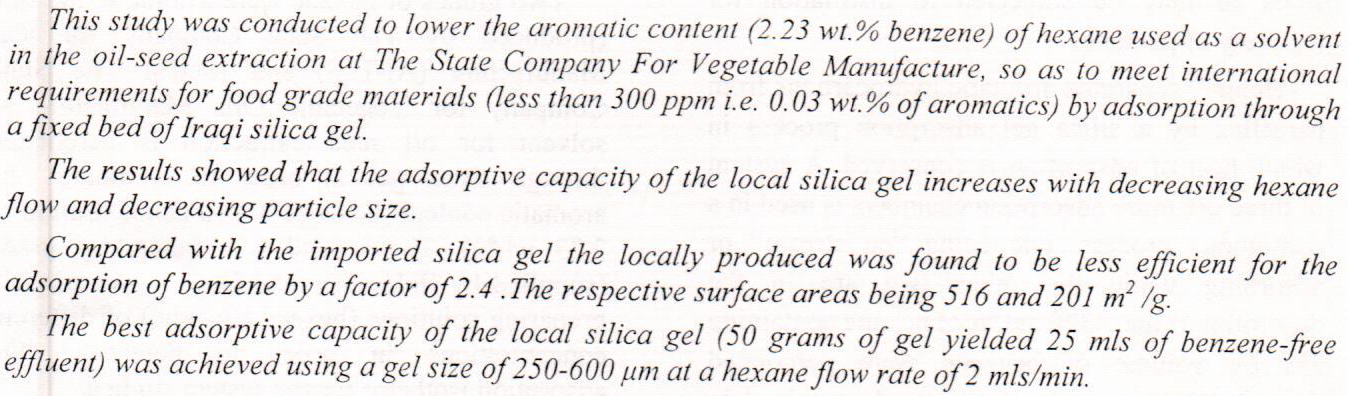
Reduction of Aromatic Content from Hexane by Silica Gel

Due to the broad range uses of chromium for industrial purposes, besides its carcinogenic effect, an efficient, cost effective removal method should be obtained. In this study, cow bones as a cheap raw material were utilized to produce active carbon (CBAC) by physiochemical activation, which was characterized using: SEM to investigate surface morphology and BET to estimate the specific surface area. The best surface area of CBAC was 595.9 m2/gm which was prepared at 600 ᵒC activation temperature and impregnation ratio of 1:1.5. CBAC was used in aqueous chromium ions adsorption. The investigated factors and their ranges are: initial concentration (10-50 mg/L), adsorption time (30-300 min), temperature (20-50
... Show More (10)
(10)

In this study miconazole nitrate was formulated as topically applied emulgel; different formulas were prepared using sodium carboxymethylcellulose (SCMC) and carboxypolymethylene (carbomer 941) as gelling agents. The influence of type of gelling agent and concentration of both oil phase and emulsifying agent on drug release was studied and compared with commercially available miconazole nitrate cream (Mecozalen®). The results of in vitro release showed that SCMC emulgel bases gave better release than carbomer 941 bases and the release of drug increase from both bases as a function of increasing the concentration of emulisifying agent. The oil phase had retardation effect when
... Show More
(7)
Room temperature ionic liquids show potential as an alternative to conventional organic membrane solvents mainly due to their properties of low vapour pressure, low volatility and they are often stable. In the present work, the technical feasibilities of room temperature ionic liquids as bulk liquid membranes for phenol removal were investigated experimentally. In this research several hydrophobic ionic liquids were synthesized at laboratory. These ionic liquids include (1-butyl-3-methylimidazolium bis (trifluoromethylsulfonyl) imide[Bmim][NTf2], 1-Hexyl-3-methylimidazolium bis (trifluoromethylsulfonyl) imide[Hmim][NTf2], 1-octyl-3-methylimidazolium bis (trifluoromethylsulfonyl)imide[Omim][NTf2],1‐butyl
... Show MoreThe study aimed to identify how to raise grateful children from an Islamic educational perspective. For that objective to be achieved, the researcher used both of deductive and descriptive approaches using the method of documentary research. The study's results show that children are the real wealth of the community and the foundation of cultural building; therefore, paying attention their raising is a responsibility that must be shared by everyone; gratitude is part parcel of the Islamic doctrine, which is one of the greatest virtues; the virtue of gratitude is the attitude of the believers which in turn strengthens the bonds and expands the network of positive social relationships; It is also considered a cultural significance
... Show MoreThe performance of a batch undivided electrochemical reactor with a rotating cylinder electrode of woven-wire (60 mesh size), stainless steel 316, is examined for the removal of copper from synthetic solution of o.5 M sodium chloride containing 125 ppm at pH ≈ 3.5. The effect of total applied current, rotation speed on the figures of merit of the reactor is analyzed. For an applied current of 300 mA at 100 rpm, the copper concentration decreased from 125 to mg l-1 after 60 min of electrolysis with a specific energy consumption of 1.75 kWh kg-1 and a normalized space velocity of 1.62 h-1. The change in concentration was higher when the total applied currents were increased because of the turbulence
... Show MoreBiosorption of cadmium ions from simulated wastewater using rice husk was studied with initial concentration of 25 mg/l. Equilibrium isotherm was studied using Langmuir, Freundlich, BET and Timken models. The results show that the Freundlich isotherm is the best fit model to describe this process with high determination coefficient equals to 0.983. There was a good compliance between the experimental and theoretical results. Highest removal efficiency 97% was obtained at 2.5g of adsorbent, pH 6 and contact time 100 min.
The possibility of using zero-valent iron as permeable reactive barrier in removing lead from a contaminated groundwater was investigated. In the batch tests, the effects of many parameters such as contact time between adsorbate and adsorbent (0-240 min), initial pH of the solution (4-8), sorbent dosage (1-12 g/100 mL), initial metal concentration (50-250 mg/L), and agitation speed
(0-250 rpm) were studied. The results proved that the best values of these parameters achieve the maximum removal efficiency of Pb+2 (=97%) were 2 hr, 5, 5 g/100 mL, 50 mg/L and 200 rpm respectively. The sorption data of Pb+2 ions on the zero-valent iron have been performed well by Langmuir isotherm model in compared with Freundlich model under the studied
(5)
This research aims to design a high-speed laser diode driver and photodetector, the result is the
design of the high-speed laser diode driver with a short pulse of 10 ns at 30 KHz frequency and the
delivered maximum pulse voltage is 5.5 mV. Also, its optical output power of the laser diode driver is
about 2.529 mW for the centroied wavelength 1546.7 nm with FWHM of 286 pm and (1270-1610) nm.
The design of the circuit based on bipolar transistor where the input pulse signal is simply generated by
an arduino kit with 15 kHz frequency and then compensated to trigger to small signal amplifier which
was is simply NPN C3355 transistor and the output is a current driver to the laser diode. OptiSystem
software and Electronic

