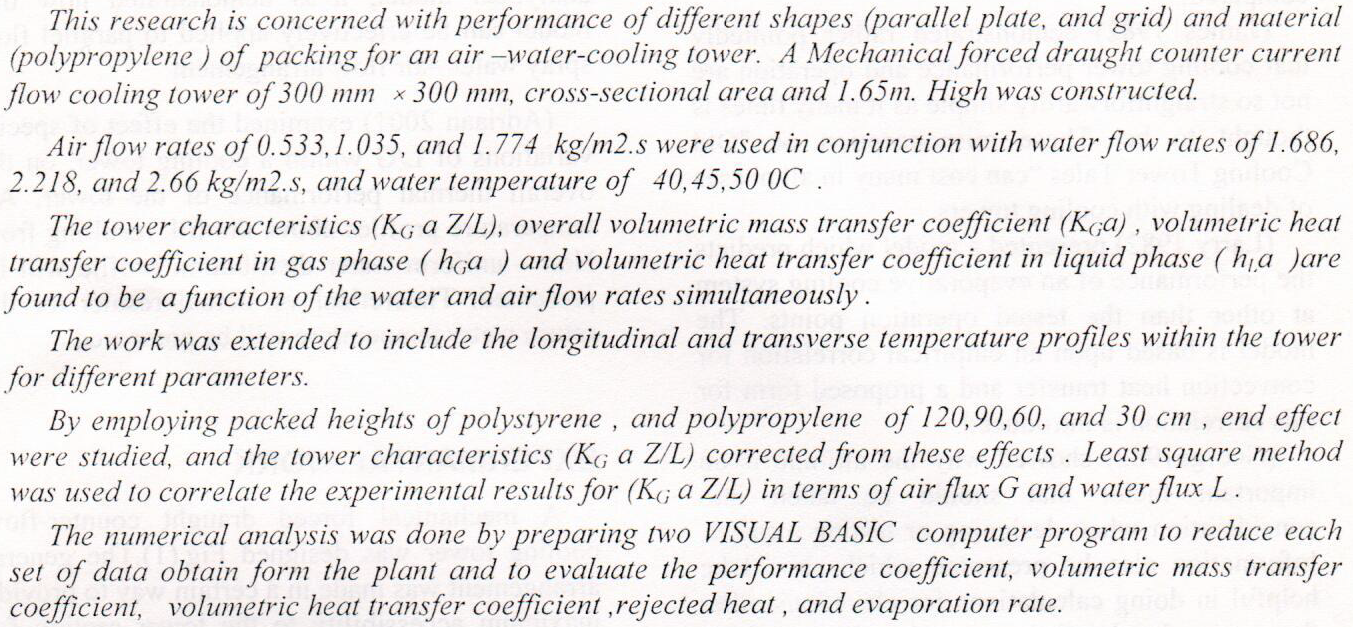
Performance of Countercurrent Flow Cooling Towers

Mn2+ and Ce3+ Doped ZnS nanocrystals were prepared by a simple microwave irradiation method under mild condition. The starting materials for the synthesis of Mn2+ and Ce3+ Doped ZnS P nanocrystals were zinc acetate as zinc source, thioacetamide as a sulfur source, manganese chloride and Cerium chloride as manganese and cerium sources respectively (R & M Chemical) and ethylene glycol as a solvent. All chemicals were analytical grade products and used without further purification. The nanocrystals of Mn2+ and Ce3+ Doped ZnS P with cubic structure were characterized by X-ray powder diffraction (XRD), the morphology of the film is seen by field effect scanning electron microscopy (FESEM). The composition of the samples is analyzed by EDS. The s
... Show MoreThe present study aims at knowing the effect of discussion method for students of fifth grade in preparatory school.
Methodology of the Study:
In order to achieve the objective of the study, the researcher chooses non-randomly the preparatory school affiliated to the District Chamchamal \ Suliemnaniya. The sample attained 64 students in 32 per group (control and experimental) groups. The researcher used the discussion method which was applied on experimental group. She uses the traditional method on the control group.
The researcher matched the two group in ago, intelligence, marks at the Kurdish Language in the previous year , pretest and posts for the indepe
... Show MoreThe present study illustrates observations, record accurate description and discussion about the behavior of twelve tested, simply supported, precast, prestressed, segmental, concrete beams with different segment numbers exposed to high fire temperatures of 300°C, 500°C, and 700°C. The test program included thermal tests by using a furnace manufactured for this purpose to expose to high burning temperature (fire flame) nine beams which were loaded with sustaining dead load throughout the burning process. The beams were divided into three groups depending on the precast segments number. All had an identical total length of 3150mm but each had different segment number (9, 7, and 5 segments), in other words, different segment length
... Show More (6)
(6)

The knowledge related with lexical items can be realized as including relations of meaning a cross words. Words that share a similarity of meaning are called to be synonymous, and words that share a contrary of meaning are called to be antonymous. Both of them are universal linguistic phenomenon that exist in terms of linguistic system of every language. The present study aims at finding out areas of difficulty that Iraqi EFL learners encounter in the use of synonymy and antonymy, both on the recognition and production levels. Also tries to detect the main reasons behind such difficulties. A diagnostic test of two parts, namely, recognition and production, is designed. The test is built to include two linguistic phenomenon which are: synony
... Show More
(2)
Zigbee, which has the standard IEEE 802.15.4. It is advisable method to build wireless personal area network (WPAN) which demands a low power consumption that can be produced by Zigbee technique. Our paper gives measuring efficiency of Zigbee involving the Physical Layer (PL) and Media Access Control (MAC) sub-layer , which allow a simple interaction between the sensors. We model and simulate two different scenarios, in the first one, we tested the topological characteristics and performance of the IEEE802.15.4 standard in terms of throughput, node to node delay and figure of routers for three network layouts (Star, Mesh and Cluster Tree) using OPNET simulator. The second scenario investigates the self-healing feature on a mesh
... Show MoreTurbidity is a visual property of water that expresses the amount of suspended substances in the water. Its presence in quantities more significant than the permissible limit makes the water undrinkable and reduces the effectiveness of disinfectants in treating pathogens. On this basis, turbidity is used as a basic indicator for measuring water quality. This study aims to evaluate the removal efficiency of AL- Muthanna WTP. Water turbidity was used as a basic parameter in the evaluation, using performance improvement evaluation and data from previous years (2016 to 2020). The average raw water turbidity was 26.7 NTU, with a minimum of 14 NTU, with a maximum of 48 NTU. Water turbidity value for 95% of settling daily readi
... Show More (9)
(6)
(9)
(6)

This research utilized natural asphalt (NA) deposits from sulfur springs in western Iraq. Laboratory tests were conducted to evaluate the performance of an asphalt mixture incorporating NA and verify its suitability for local pavement applications. To achieve this, a combination of two types of NA, namely soft SNA and hard HNA, was blended to create a binder known as Type HSNA. The resulting HSNA exhibited a penetration grade that adhered to Iraqi specifications. Various percentages of NA (20%, 40%, 60%, and 80%) were added to petroleum asphalt. The findings revealed enhanced physical properties of HSNA, which also satisfied the requirements outlined in the Iraqi specifications for asphalt cement.
Consequently, HS
... Show More
(17)
(8)
To evaluate and improve the efficiency of photovoltaic solar modules connected with linear pipes for water supply, a three-dimensional numerical simulation is created and simulated via commercial software (Ansys-Fluent). The optimization utilizes the principles of the 1st and 2nd laws of thermodynamics by employing the Response Surface Method (RSM). Various design parameters, including the coolant inlet velocity, tube diameter, panel dimensions, and solar radiation intensity, are systematically varied to investigate their impacts on energetic and exergitic efficiencies and destroyed exergy. The relationship between the design parameters and the system responses is validated through the development of a predictive model. Both single and mult
... Show More
(38)
(45)

The durability of asphalt pavement is associated with the properties and performance of the binder. This work-study intended to understand the impact of blending Styrene-Butadiene-Styrene (SBS) to conventional asphalt concrete mixtures and calculating the Optimum Asphalt Content (OAC) for conventional mixture also; compare the performance between SBS modified with the conventional mixture. Two different kinds of asphalt penetration grades, A.C. (40-50) and A.C. (60-70), were improved with 2.5 and 3.5% SBS polymer, respectively. Marshall properties were determined in this work. Optimum Asphalt Content (OAC) was 4.93 and 5.1% by weight of mixture for A.C. (40-50) and (60-70), respectively. Marshall properties results show an increasem
... Show More
(19)
(12)
(4)
(3)