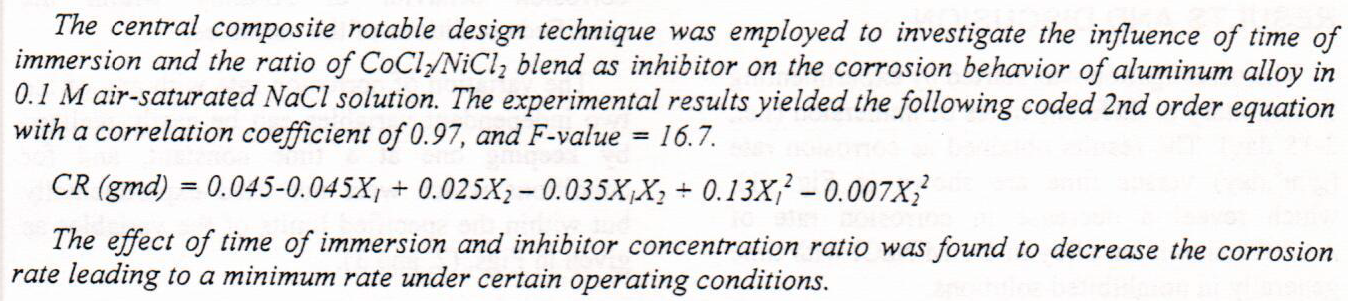
The Optimal Corrosion Inhibition of Aluminum in 0.1M NaCl Solution

In this work, corrosion parameters were evaluated using potentiodynamic polarization curves. In order to determine corrosion parameters of potential and current density of the interesting metal, carbon steel, environmental conditions of external corrosion of buried carbon steel pipeline in Iraqi soil were prepared in the laboratory using simulated prepared conditions. Solutions of sodium chloride at different concentrations (300, 1100, 1900, 2700, and 3500 ppm) were used. pH of solution were acidic at pH =5, and alkaline at pH = 9. Laboratory conditions were similar to those of Iraqi soil where the pipelines were buried. Temperature was constant at 20 °C. Potentiodynamic polarization curves, of potential vs. log current density, were ob
... Show MoreThe current study executes a fully coupled thermomechanical simulation of friction stir welding (FSW) process of aluminum 6061-T6 alloy T-joint type using finite element method. The analysis simulation accounts for the three steps of the FSW process which includes: plunging, dwelling, and moving stages. The temperature history, associated stresses and strains generated through the FSW phases, tool reaction force, and time-dependence of the energy dissipation were evaluated. To overcome the shortcomings of purely Lagrangian and Eulerian descriptions, Arbitrary Lagrangian Eulerian (ALE) formulation, adaptive meshing, and the mass scaling were used as techniques to improve sequence modeling of the friction stir welding process. Coulomb’s fri
... Show More (110)
(110)
 (102)
(102)


The blade pitch angle (BPA) controller is key factor to improve the power generation of wind turbine (WT). Due to the aerodynamic structural behavior of the rotor blades, wind turbine system performance is influenced by pitch angle and environmental conditions such as wind speed, which fluctuate throughout the day. Therefore, to overcome the pitch angle control (PAC) problem, high wind speed conditions, and due to type-1 and type-2 fuzzy logic limitations for handling high levels of uncertainty, the newly proposed optimal hybrid type-3 fuzzy logic controller has been applied and compared since type-3 fuzzy controllers utilize three-dimensional membership functions, unlike type-2 and type-1 fuzzy logic controllers. In this paper six differen
... Show More
(8)
(8)

The flexible joint robot manipulators provide various benefits, but also present many control challenges such as nonlinearities, strong coupling, vibration, etc. This paper proposes optimal second order integral sliding mode control (OSOISMC) for a single link flexible joint manipulator to achieve robust and smooth performance. Firstly, the integral sliding mode control is designed, which consists of a linear quadratic regulator (LQR) as a nominal control, and switching control. This control guarantees the system robustness for the entire process. Then, a nonsingularterminal sliding surface is added to give a second order integral sliding mode control (SOISMC), which reduces chartering effect and gives the finite time convergence as well. S
... Show More
(17)
(10)
Accurate calculation of transient overvoltages and dielectric stresses from fast-front excitations is required to obtain an optimal dielectric design of power components subjected to these conditions, which are commonly due to switching and lightning, as well as utilization of power-electronic devices. Toroidal transformers are generally used at the low voltage level. However, recent investigations and developments have explored their use at the medium voltage level. This paper analyzes the model-based improvement of the insulation design of medium voltage toroidal transformers. Lumped and distributed parameter models are used and compared to predict the transient response and dielectric stress along the transformer winding. The parameters
... Show More
(1)
(2)
To reduce the effects of discharging heated water disposed into a river flow by a single thermal source, two parameters were changed to get the minimum effect using optimization. The first parameter is to distribute the total flow of the heated water between two disposal points (double source) instead of one and the second is to change the distance between these two points. In order to achieve the solution, a two dimensional numerical model was developed to simulate and predict the changes in temperature distribution in the river due to disposal of the heated water using these two points of disposal.
MATLAB-7 software was used to build a program that could solve the governing partial equations of thermal pollution in rivers by using t
Abstract In this paper the effect of light exposure duration on Anthracene solution in chloroform is studied. It is found that: the Anthracene solution change its color when it is exposed to light, and that its relative quantum efficiency, Φ, decreases as the light exposure duration, t, increases and this govern by following empirical equation:- Φ = 0.7918-0.0762 In (t)
Abstract
Stainless steel (AISI 304) has good electrical and thermal conductivities, good corrosion resistance at ambient temperature, apart from these it is cheap and abundantly available; but has good mechanical properties such as hardness. To improve the hardness and corrosion resistance of stainless steel its surface can be modified by developing nanocomposite coatings applied on its surface. The main objective of this paper is to study effect of electroco-deposition method on microhardness and corrosion resistance of stainless steel, and to analyze effect of nanoparticles (Al2O3, ZrO2 , and SiC) on properties of composite coatings. I
... Show More
(11)
(8)
In this paper two modifications on Kuznetsov model namely on growth rate law and fractional cell kill term are given. Laplace Adomian decomposition method is used to get the solution (volume of the tumor) as a function of time .Stability analysis is applied. For lung cancer the tumor will continue in growing in spite of the treatment.