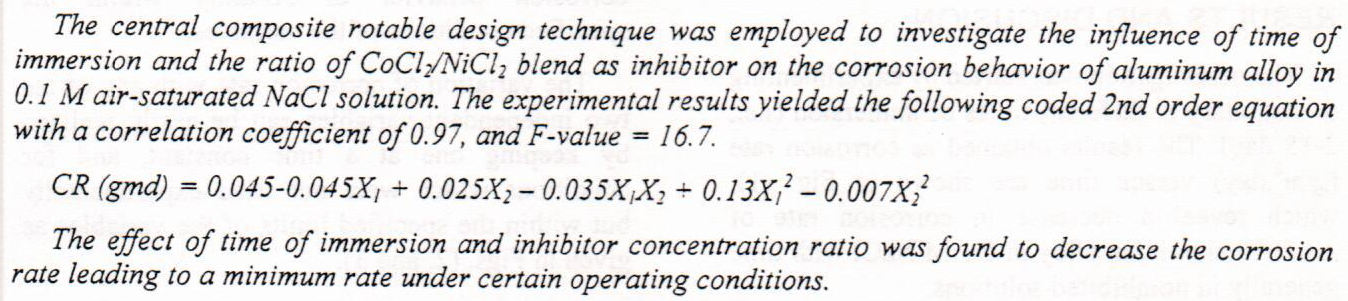
The Optimal Corrosion Inhibition of Aluminum in 0.1M NaCl Solution

rhabditid Mesorhabditis franseni Fuchs, 1933 (Family, Mesorhabditidae) and pratylenchid nematode Pratylenchus goodeyi Sher and Allen, 1953 (Family, Pratylenchidae). They were illustrated by molecular aspects. All specimens of both genera were cultured and reproduced for DNA extraction. M. franseni (IRQ.ZAh2 PP528819.1 isolate) was characterized. P. goodeyi (IRQ.ZAh5 PP535537 isolate) was also characterized. Selected specimens of these two species were molecularly characterized using the partial ITS-rRNA gene sequences. The ITS-rRNA sequence of IRQ.ZAh2 PP528819.1 isolate had a range of (98.62%-100%) sequence homology with ITS-rRNA sequence of M. franseni available in NCBI database. While, the ITS-rRNA sequence of IRQ.ZAh5 PP535537 isolate h
... Show More (60)
 (56)


 (66)
(63)
The design of coordination compounds with solvent-responsive optical properties remains a central challenge in molecular photonics. Here, we describe the synthesis and full characterisation of a symmetrical tetradentate diamine ligand, 3,3′-((1,2-phenylenebis(azanediyl))- bis(methanylylidene))bis(pentane-2,4-dione) (H₂L), and its neutral square-planar complexes [M(L)] (M(II) = Co, Ni, Cu). The Cu(II) complex crystallised as [Cu(L)]⋅0.5 (pyrazine), adopting a nearly square-planar geometry (τ₄ = 0.06) in the solid state, as confirmed by single-crystal X-ray diffraction. In DMSO solution, UV–Vis spectra revealed reversible axial coordination of two solvent molecules, driving a transformation to a distorted octahedral geometry. Struc
... Show More
(4)
This study investigated the prevalence of quinolones resistance proteins encoding genes (qnr genes) and co-resistance for fluoroquinolones and β-lactams among clinical isolates of Klebsiella pneumoniae. Out of 150 clinical samples, 50 isolates of K. pneumoniae were identified according to morphological and biochemical properties. These isolates were collected from different clinical samples, including 15 (30%) urine, 12 (24%) blood, 9 (18%) sputum, 9 (18%) wound, and 5 (10%) burn. The minimum inhibitory concentrations (MICs) assay revealed that 15 (30%) of isolates were resistant to ciprofloxacin (≥4µg/ml), 11 (22%) of isolates were resistant to levofloxacin (≥8 µg/ml), 21 (42%) of isolates were re
... Show More
(11)
(6)
The H-Point Standard Addition Method (H-PSAM) has been applied for spectrophotometric simultaneous determination of Cimetidine and Erythromycin ethylsuccinate using Bromothymol Blue (BTB) as a chromogenic complexing agent in a buffer solution at pH 5.5.
Biodiesel can be prepared from various types of vegetable oils or animal fats with the aid of a catalyst.
Calcium oxide (CaO) is one of the prospective heterogeneous catalysts for biodiesel synthesis. Modification
of CaO by impregnation on silica (SiO2) can improve the performance of CaO as catalyst. Egg shells and rice
husks as biomass waste can be used as raw materials for the preparation of the silica modified CaO catalyst.
The present study was directed to synthesize and characterize CaO impregnated SiO2 catalyst from biomass
waste and apply it as catalyst in biodiesel synthesis. The catalyst was synthesized by wet impregnation
method and characterized by x-ray diffraction, x-ray fluorescence, nitr
(9)
(3)
(10)
(10)
New chelating ligand derived from triazole and its complexes with metal ions Rhodium, Platinum and Gold were synthesized. Through a copper (I)-catalyzed click reaction, the ligand produced 1,3-dipolar cycloaddition between 2,6-bis((prop-2-yn-1-yloxy) methyl) pyridine and 1-azidododecane. All structures of these new compounds were rigorously characterized in the solid state using spectroscopic techniques like: 1HNMR, 13CNMR, Uv-Vis, FTIR, metal and elemental analyses, magnetic susceptibility and conductivity measurements at room temperature, it was found that the ligand acts as a penta and tetradentate chelate through N3O2, N2O2, and the geometry of the new complexes are identified as octahedral for (Rh & Pt) complexes a
... Show More
(14)
(9)