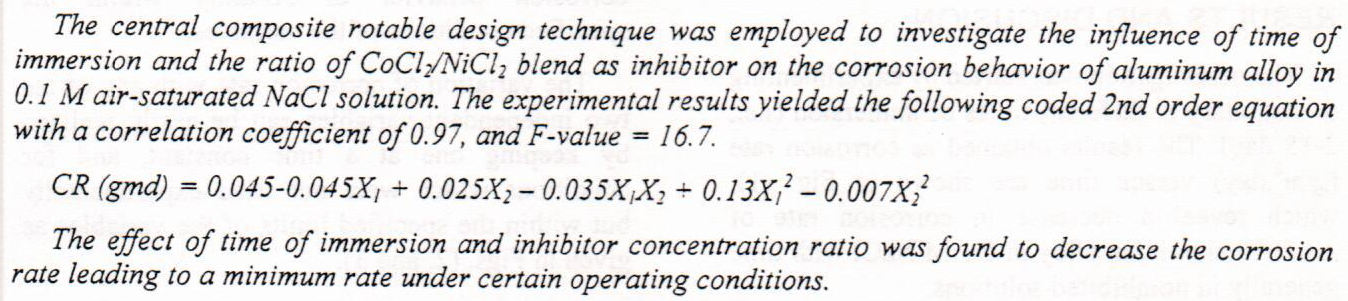
The Optimal Corrosion Inhibition of Aluminum in 0.1M NaCl Solution

The paper is devoted to solve nth order linear delay integro-differential equations of convolution type (DIDE's-CT) using collocation method with the aid of B-spline functions. A new algorithm with the aid of Matlab language is derived to treat numerically three types (retarded, neutral and mixed) of nth order linear DIDE's-CT using B-spline functions and Weddle rule for calculating the required integrals for these equations. Comparison between approximated and exact results has been given in test examples with suitable graphing for every example for solving three types of linear DIDE's-CT of different orders for conciliated the accuracy of the results of the proposed method.

 (10)
 (8)


This study expands the state of the art in studies that assess torsional retrofit of reinforced concrete (RC) multi-cell box girders with carbon fiber reinforced polymer (CFRP) strips. The torsional behavior of non-damaged and pre-damaged RC multi-cell box girder specimens externally retrofitted by CFRP strips was investigated through a series of laboratory experiments. It was found that retrofitting the pre-damaged specimens with CFRP strips increased the ultimate torsional capacity by more than 50% as compared to the un-damaged specimens subjected to equivalent retrofitting. This indicated that the retrofit has been less effective for the girder specimen that did not develop distortion beforehand as a result of pre-loading. From
... Show More
(16)
(14)
Abstract: Background: Staphylococcus aureus is Gram-positive bacteria that lives as a normal flora in living organisms but can be pathogenic to humans. Although a relatively unspectacular, nonmotile coccoid bacterium, S. aureus is a dangerous human pathogen in both community-acquired and nosocomial infections. Due to the increasing emergence of new strains of this antibiotic-resistant bacteria, it has become essential to approach different methods to control this pathogen. One of these methods is the antimicrobial photodynamic inactivation process using a low-level laser, in this paper, the Photodynamic effects of Rose Bengal and LLLL on the virulence factors of S.aureus were evaluated.
Some new norms need to be adapted due to COVID-19 pandemic period where people need to wear masks, wash their hands frequently, maintain social distancing, and avoid going out unless necessary. Therefore, educational institutions were closed to minimize the spread of COVID-19. As a result of this, online education was adapted to substitute face-to-face learning. Therefore, this study aimed to assess the Malaysian university students’ adaptation to the new norms, knowledge and practices toward COVID-19, besides, their attitudes toward online learning. A convenient sampling technique was used to recruit 500 Malaysian university students from January to February 2021 through social media. For data collection, all students
... Show More
(1)
Background: Appreciation of the crucial role of risk factors in the development of coronary artery disease (CAD) is one of the most significant advances in the understanding of this important disease. Extensive epidemiological research has established cigarette smoking, diabetes, hyperlipidemia, and hypertension as independent risk factors for CADObjective: To determine the prevalence of the 4 conventional risk factors(cigarette smoking, diabetes, hyperlipidemia, and hypertension) among patients with CAD and to determine the correlation of Thrombolysis in Myocardial Infarction (TIMI) risk score with the extent of coronary artery disease (CAD) in patients with unstable angina /non ST elevation myocardial infarction (UA/NSTEMI).Methods: We
... Show MoreThis study uses an environmentally friendly and low-cost synthesis method to manufacture zinc oxide nanoparticles (ZnO NPs) by using zinc sulfate. Eucalyptus leaf extract is an effective chelating and capping agent for synthesizing ZnO NPs. The structure, morphology, thermal behavior, chemical composition, and optical properties of ZnO nanoparticles were studied utilizing FT-IR, FE-SEM, EDAX, AFM, and Zeta potential analysis. The FE-SEM pictures confirmed that the ZnO NPs with a size range of (22-37) nm were crystalline and spherical. Two methods were used to prepare ZnO NPs. The first method involved calcining the resulting ZnO NPs, while the second method did not. The prepared ZnO NPs were used as adsorbents for removing acid black 210
... Show More
(6)
(4)
Experimental measurements were done for characterizing current-voltage and power-voltage of two types of photovoltaic (PV) solar modules; monocrystalline silicon (mc-Si) and copper indium gallium di-selenide (CIGS). The conversion efficiency depends on many factors, such as irradiation and temperature. The assembling measures as a rule cause contrast in electrical boundaries, even in cells of a similar kind. Additionally, if the misfortunes because of cell associations in a module are considered, it is hard to track down two indistinguishable photovoltaic modules. This way, just the I-V, and P-V bends' trial estimation permit knowing the electrical boundaries of a photovoltaic gadget with accuracy. This measure
... Show More
(6)
(39)
(39)
Greywater is a possible water source that can be improved for meeting the quality required for irrigation. Treatment of greywater can range from uncomplicated coarse filtration to advanced biological treatment. This article presents a simple design of a small scale greywater treatment plant, which is a series of physical and natural processes including screening, aeration, sedimentation, and filtration using granular activated carbon filter and differentiates its performance with sand filter. The performance of these units with the dual filter media of (activated carbon with sand) in treatment of greywater from Iraqi house in Baghdad city during 2019 and that collected from several points including washbasins, kitchen si
... Show More
(2)