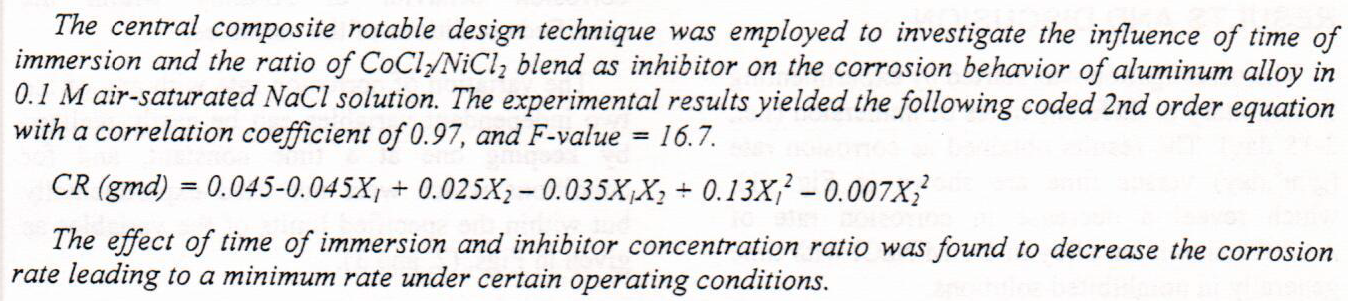
The Optimal Corrosion Inhibition of Aluminum in 0.1M NaCl Solution

The (NiTsPc) thin films operating by vacuum evaporation technique are high recital and good desirable for number of applications, were dumped on glass substrates at room temperature with (200±20nm) thickness and doped with Al at different percentage (0.01,0.03) besides annealing the sample with 200˚C for 1 hours . The stimuluses of aluminum dopant percentage on characterization of the dropped (Ni Ts Pc) thin films were studied through X-ray diffraction in addition from the attained results, were all the films have polycrystalline in nature, as well the fallouts of XRD aimed at film illustrations polycrystalline, depending on the Al ratio doping, the results, SEM exposed the surface is regularly homogeneous. Utilizing first-ideolog
... Show More (7)
(7)
 (7)
(7)



This study was aimed to extract the effective material from the dry nests of termites and detect its antibacterial activity against some pathogenic bacterial isolates and inhibit synthesis of its biofilm. Termites dry nests were collected and the effective material was extracted then the antibacterial activity was detected using the disc diffusion assay. Results were showed that the extract have antibacterial material from the Termites dry nests, this extract showed antibacterial activity against Gram positive bacteria (Staphylococcus aureus) at (21.5mm) and Gram negative bacteria ( Enterobacter sp. and Pseudomonas aeruginosa) at (26 mm and 20 mm) respectively by inhibiting their growth, as well as its effect on biofilm production o
... Show More
(3)
An experimental of kinetics investigation of the solution free radical polymerization of isopropylacrylamide (IPAM) initiated with potassium persulfate (PPS) was conducted. The reactions were carried out at constant temperature of 60 °C in distilled water under unstirred and inert conditions. Using the well-known conversion vs. time technique, the effects of initiator and monomer concentration on the rate of polymerization (Rp) were investigated over a wide range. Under the conditions of our work, the orders 0.38 and 1.68 were found with respect to initiator and monomer, respectively. However, the rate of polymerization (Rp) is not straight forwardly corresponding monomer concentration. The value 46.11 kJ mol1 was determined as the o
... Show More
(2)
Three of imide intermediate products were synthesized by reacting of phthalic anhydride with glycine (2a), and tetrachloro phthalic anhydride with glycine , (S)-2-[(tert-Butoxycarbonyl)amino]-3-aminopropionic acid ( 2b,c) respectively in dry toluene with azeotropic removal of water using Dean- stark apparatus then carboxyl functional group activated by refluxing with thionyl chloride, the resulted acid chloride (3a-c) were reacted with different amine (5-flourouracil, 4-chloroaniline, 4-bromoaniline, 2-amino thiazole, and pyrrolidine) (4a-e) , the resulted products consider as
... Show More
(4)
(2)
Zerumbone (ZER), a natural compound has been extracted from Zingiber zerumbet with known pharmacological activities. The aim was to determine the anti-human Burkitt’s lymphoma (Raji) cell effect of ZER. The 3-(4,5-dimethylthiazol-2-yl)-2,5,-diphenyltetrazolium bromide (MTT) assay was used to determine cytotoxic effect while the Annexin-V-fluorescein isothiocyanate/propidium iodide-PI flow cytometric assays was used to determine apoptotic effect of ZER on the human Burkitt’s lymphoma (Raji) cell (ATCC CCL-86) cell line. The expressions of Bax, Bcl-2, and c-Myc genes were determined via real-time PCR. ZER suppressed the proliferation of Raji cells with a 48 h IC50 value of 5.1 μg/mL. Treated Raji cells also underwen
... Show More
(19)
(6)
The corrosion behavior of carbon steel at different temperatures 100,120,140 and 160 Cͦ under different pressures 7,10 and 13 bar in pure distilled water and after adding three types of oxygen scavengers Hydroquinone, Ascorbic acid and Monoethanolamine in different concentrations 40,60 and 80 ppm has been investigated using weight loss method. The carbon steel specimens were immersed in water containing 8.2 ppm dissolved oxygen (DO) by using autoclave. It was found that corrosion behavior of carbon steel was greatly influenced by temperature with high pressure. The corrosion rate decreases, when adding any one of oxygen scavengers. The best results were obtained at a concentration of 80 ppm of each scavenger. It was observed that
... Show MoreRotating cylinder electrode (RCE) is used . in weight loss technique , the salinity is 200000 p.p.m, temperatures are (30,5060,7080Co) . the velocity of (RCE) are (500,1500,3000 r.p.m). the water cut (30% , 50%). The corrosion rate of carbon steel increase with increasing rotating cylinder velocity. In single phase flow, an increase im rotational velocity from 500 to 1500 r.p.m, the corrosion rate increase from 6.88258 mm/y to 10.11563 mm/y respectively.
In multiphase flow, an increase in (RCE) from 500 to 1500 r.p.m leads to increase in corrosion rate from 0.786153 to 0.910327 mm/y respectively. Increasing brine concentration leads to increase in corrosion rate at water cut 30%.
(3)
In this work, the copper metal was treated using Nd:YAG laser with energy 1Joul to enhance corrosion resistance and improve surface properties. The copper metal has many applications in industry as well as water, oil and gas pipes. The same conditions, (laser power density, scan speed, distance between paths, medium gas-air) were applied in the laser surface treatment, After laser treatment, the samples microstructures were investigated using optical microscope (OM) to examine micro structural changes due to laser irradiation. Specimen surfaces were investigated using atomic force microscopy (AFM), X-ray diffraction (XRD), macro hardness, and corrosion test before and after laser treatment to
... Show More
(7)
(6)
(3)