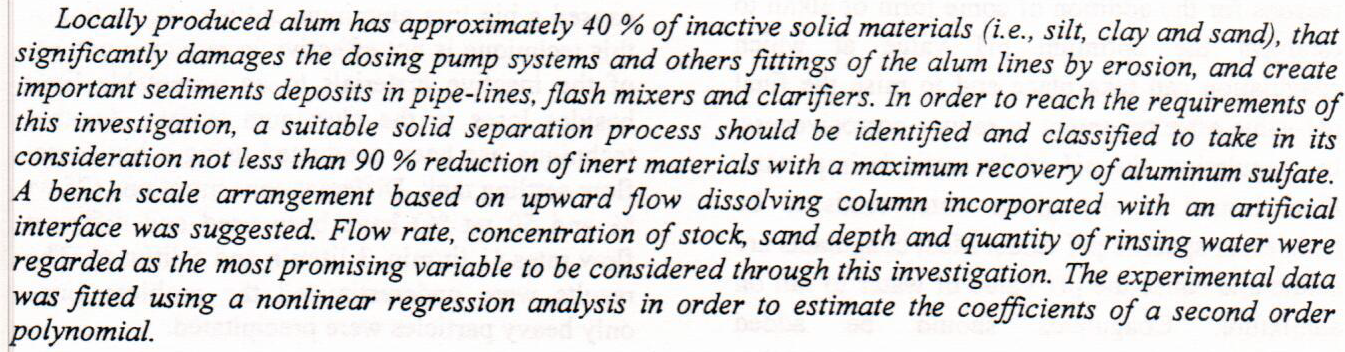
Quality Improvement of the Locally Produced Alum

Due to their recalcitrant characteristics, Azo dyes such as methyl orange (MO) are extremely poisonous substances, making their removal from textile industry wastewater a major problem. By employing various EC-Adsorption combined system configurations and reusing alum sludge as an adsorbent, the current study seeks to investigate the efficiency of these various systems in removing MO dye. To estimate their benefits and limitations, experiments were carried out utilizing nickel foam (NiF) and aluminum plate (Al plate) as anodes, and stainless-steel mesh (SS mesh) as cathode in the presence of alum sludge as an adsorbent in all systems. The EC-Adsorption combined system with NiF as anode and two SS meshes as cathodes with 10 g/L
... Show More
Background The Transportation Problem (TP) is a detailed model in operations study with applications in logistics, supply chain management, and resource allocation. The classical IBFS methods including North-West Corner, Least Cost and Vogel’s Approximation have competitive computational efficiency, but they are very sensitive to the structure of the problem and usually lead to a solution that is far from the global optimum. Classic enhancement strategies like the Generalized Distribution (MODI) and Stepping-Stone (SS) approaches have low computational complexity but may fall into a local optimum quickly, which makes them ineffective in large-scale or unbalanced problems. Methods We propose the first generic hybrid algorithm, calle
... Show More
In this study, a review of variety of processes that are used in the treatment produced water prior to reuse or to responsible disposal are presented with their environmental issues and economical benefits. Samples of produced water from five locations in Rumaila oilfield/in south of Iraq were taken and analyzed for their contents of brine, some heavy metals, total suspended solids and oil and grease. Moreover, two samples of water were treated using reverse osmosis technique which showed its ability to treat such contaminated water. The results showed that the environmental impact of produced water arises from its chemical composition; i.e., its salt content, its heavy metals, and hydrocarbon contents.
We studied the effect of certain environmental conditions for removing heavy metal elements from contaminated aqueous solutions (Cd, Cu, Pb, Fe, Zn, Ni, Cr) using the bacterium Bacillus subtilis to appoint the optimal conditions for removal ,The best optimum temperature range for two isolate was 30-35○C while the hydrogen number for the maximum mineral removal range was 6-7. The best primary mineral removal was 100 mg/L, while the maximum removal for all minerals was obtained after 6 hrs of Cu element time and the maximum removal efficiency was obtained after 24 hrs of Cu element. The results have proved that the best aeration for maximum removal was obtained at rotation speed of 150 rpm/minute. Inoculums of 5ml/100ml which contained 1
... Show MoreSome microorganisms can produce nanocellulose, which is known as bacterial nanocellulose (BNC); the most active bacterial producer is acetic acid bacteria (AAB), which is a gram-negative, motile and obligate aerobic belongs to the family Acetobacteraceae. Bacterial nanocellulose has excellent attention in medical (surgical domain), industrial and pharmaceutical fields because of its flexible properties, characteristics and advantages. So, in this study, the AAB (5AC) isolate was isolated from apple vinegar. The production of BNC was performed by using a natural medium called palm dates liquid medium, the produced bacterial Cellulose was purified by using the sodium hydroxide method; it was observed that the wet weight of the BNC was a
... Show More (4)
(4)

This research explores the preparation of polypyrrole (PPy) using chemical oxidation and its enhancement with graphene oxide (GO) for optical sensor applications. PPy was synthesized by polymerizing pyrrole monomers with ferric chloride (Fe2Cl3) as the oxidant. The resulting PPy was then combined with GO to form a composite material, aiming to improve its electrical and optical properties. Polypyrrole nanofibers were obtained and after adding graphene oxide, the sensitivity increased. Characterization techniques including UV-Vis spectroscopy, DC conductivity measurements, Field Emission Scanning Electron Microscopy (FESEM) and response of photocurrent analysis were employed. The incorporation of GO into PPy resulted in a significant reducti
... Show More

ABSTRACT Wound is damage or disruption to the normal anatomical structure and function. Carrageenan is sulphated polysaccharide found in Gigartina, Chondrus and Eucheuma species in the red algal family. Having anticancer, anti-inflammatory and renewal of tissues. Our study aimed to detect the role of kappa carrageenan in the burned skin wound repair. Skin burn were performed in the right and left cheek of 20 male rats (aged 7-8 weeks weighing 300-350 g). Burned skin rats were categorized into two equal groups. Burned areas of right side were treated with a local application of 1 ml of kappa carrageenan solution once daily (treatment group) and the left side receive no treatment (control group). After 5, and 10 days, 5 rats from each
... Show MoreRisperidone is an atypical antipsychotic drug that is used for treating schizophrenia, bipolar mania, and autism. Risperidone rebalances dopamine and serotonin to improve thinking, mood, and behavior by working on dopamine and serotonin α2receptor antagonism. Risperidone has poor solubility and high permeability through the intestine, so it belongs to Biopharmaceutical Classification System (BCS) class II exhibits poor oral biopharmaceutical properties.
The aim of the present work was to improve solubility and dissolution of Risperidone by preparing nanosuspension using different stabilizers and different solvents in a method known as solvent-antisolvent precipitation method. Twenty-eight formulas were prepared
... Show More
(11)
 (4)
(3)
(1)
(4)
(3)
(1)
The best optimum temperature for the isolate was 30○C while the pH for the maximum mineral removal was 6. The best primary mineral removal was 100mg/L, while the maximum removal for all minerals was obtained after 8 hrs, and the maximum removal efficiency was obtained after 24 hrs. The results have proved that the best aeration for maximum removal was obtained at rotation speed of 150 rpm/ minute. Inoculums of 5ml/ 100ml which contained 106 cell/ ml showed maximum removal for the isolate.