Removal of Wool Dyes from Industrial Wastewater by Reverse Osmosis Process
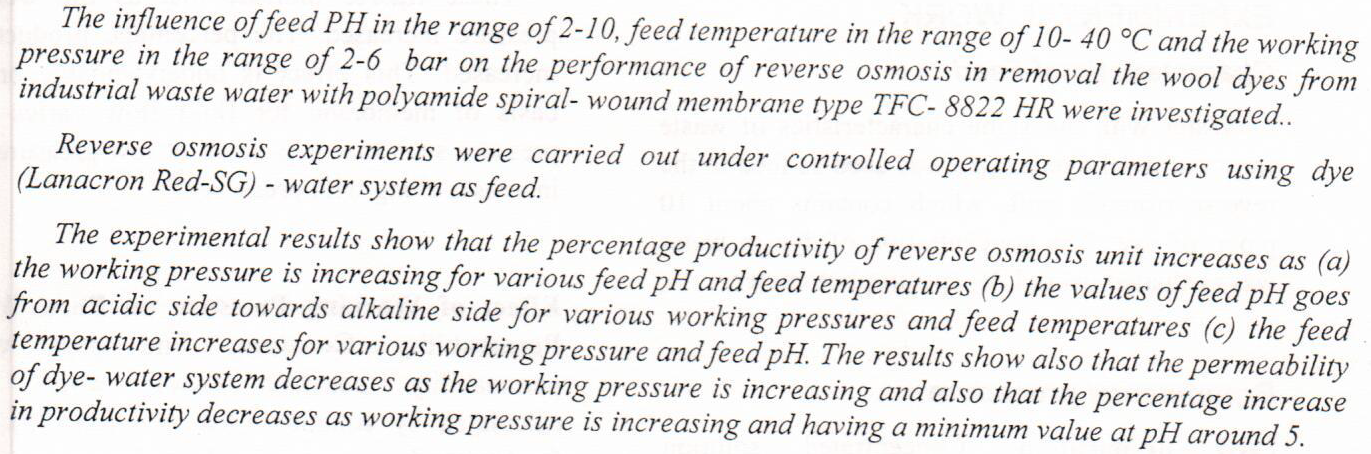

Date stones were used as precursor for the preparation of activated carbons by chemical
activation with ferric chloride and zinc chloride. The effects of operating conditions represented
by the activation time, activation temperature, and impregnation ratio on the yield and adsorption
capacity towards methylene blue (MB) of prepared activated carbon by ferric chloride activation
(FAC) and zinc chloride activation (ZAC) were studied. For FAC, an optimum conditions of 1.25
h activation time, 700 °C activation temperature, and 1.5 impregnation ratio gave 185.15 mg/g
MB uptake and 47.08 % yield, while for ZAC, 240.77 mg/g MB uptake and 40.46 % yield were
obtained at the optimum conditions of 1.25 h activation time, 500
 (7)
(7)

Baghdad city has been faced numerous issues related to freshwater environment deteriorations due to many reasons, mainly was the discharge of wastewater without adequate treatment. Al- Rustamiya Wastewater Treatment Plant (WWTP) have been constructed among many plants in Baghdad city to reduce the amount of wastewater discharged into natural environment and its subsequent adverse effects. This study was conducted to evaluate the performance of the plant which consist of a conventional activated sludge (CAS) and sequencing batch reactors (SBR) systems as secondary treatment units and its ability to meet Iraqi specifications. A reliability level determination and analysis also were conducted to find the plant's stability and its capabi
... Show MoreBaghdad city has been faced numerous issues related to freshwater environment deteriorations due to many reasons, mainly was the discharge of wastewater without adequate treatment. Al-Rustamiya Wastewater Treatment Plant (WWTP) have been constructed among many plants in Baghdad city to reduce the amount of wastewater discharged into natural environment and its subsequent adverse effects. This study was conducted to evaluate the performance of the plant which consist of a conventional activated sludge (CAS) and sequencing batch reactors (SBR) systems as secondary treatment units and its ability to meet Iraqi specifications. A reliability level determination and analysis also were conducted to find the plant's stability an
... Show MoreIn recent years and decades, there is a great need for developing new alternative energy sources or renewable sustainable energy. On the other hand, new technology approaches are growing . towards benefits from the valuable nutrients in wastewater which are unrecoverable by traditional wastewater treatment processes. In the current study, a novel integrated system of microbial fuel cell and anoxic bioreactor (MFC-ANB) was designed and constructed to investigate its potential for slaughterhouses wastewater treatment, nitrogen recovery, and power generation. The system consisted of a double-chamber tubular type MFC with biocathode inoculated with freshly collected activated sludge. The MFC-ANB system was continuously fed with real-fi
... Show MoreInefficient wastewater disposal and wastewater discharge problems in water bodies have led to increasing pollution in water bodies. Pollutants in the river contribute to increasing the biological oxygen demand (BOD), total suspended solids (SS), total dissolved solids (TDS), chemical oxygen demand (COD), and toxic metals render this water unsuitable for consumption and even pose a significant risk to human health. Over the last few years, water conservation has been the subject of growing awareness and concern throughout the world, so this research focused on review studies of researches that studied the importance of water quality of wastewater treated disposal in water bodies and modern technology to management w
... Show More
(2)
The present study addresses adopting the organic and nutritious materials in dairy wastewater as media for cultivation of microalgae, which represent an important source of renewable energy. This study was carried out through cultivation of three types of microalgae; Chlorella sp., Synechococcus, and Anabaena. The results shows the success the cultivation of the Synechococcus and Chlorella Sp, while the Anabaena microalgae were in low-growth level. The highest growth was in the Synechococcus farm, followed by Chlorella and Anabaena. However, the growth of Synechococcus required 10 days to achieve this increase that re
... Show More
(2)
 (2)
(1)
(2)
(1)
 (21)
(17)
(21)
(17)
 (45)
(37)
(45)
(37)
Iron slag is a byproduct generated in huge quantities from recycled remnants of iron and steel factories; therefore, the possibility of using this waste in the removal of benzaldehyde from contaminated water offers an excellent topic in sustainability field. Results reveal that the removal efficiency was equal to 85% for the interaction of slag and water contaminated with benzaldehyde at the best operational conditions of 0.3 g/100 mL, 6, 180 min, and 250 rpm for the sorbent dosage, initial pH, agitation time, and speed, respectively with 300 mg/L initial concentration. The maximum uptake capacity of iron slag was 118.25 mg/g which was calculated by the Langmuir model. Physical sorption may be the major mechanism for the removal of
... Show More
(33)
(29)