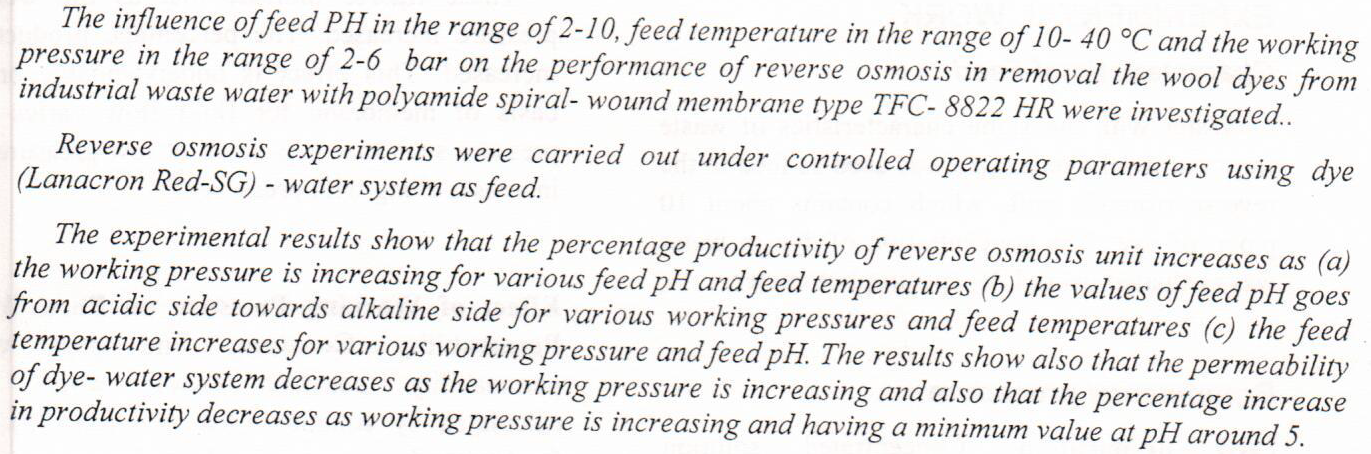
Removal of Wool Dyes from Industrial Wastewater by Reverse Osmosis Process

Acinetobacter baumannii ability to form biofilm makes it to be opportunistic pathogen causing of nosocomial infections and to be good survivor in adverse environmental conditions including medical devices and hospital environments. Six isolates of A. baumannii were isolated from drinking water and tested to investigate biofilm formation capacity on three different type of abiotic surface, also several factors were examined such as hydrophobicity, PH and temperature. All A. baumannii isolates displayed a positive biofilm on congored aga test CRA (pigmented colonies with black color) and Christensen's test (adhesive layer of stained material to the inside surface of the tube).The obtained data of microbial adhesion to hydrocarbons assay (MATH
... Show MoreKE Sharquie, AA Noaimi, HA Al-Mudaris, Journal of Cosmetics, Dermatological Sciences and Applications, 2012 - Cited by 6
Azo ligand 4-((2-hydroxy-3,5-dimethylphenyl)diazenyl) benzoic acid was synthesized from 4-aminobenzoic acid and 2,4- dimethylphenol. Azo dye compounds have been characterized by different techniques (1H-NMR, UV-Vis and FT-IR). Metal chelates of (ZnII, CdII and HgII) have been synthesized with azo ligand (L). Produced compounds have been identified by using spectral studies, elemental analysis(C.H.N.) and conductivity. Produced metal chelates were studied using mole ratio as well sequences contrast types. Rate of concentration(1×10⁻⁴-3×10⁻⁴ Mole/L) sequence Beer's law. Compound solutions have been noticed height molar absorptivity. The addendum of ligand and compounds has applied as disperse dyes on cotton fabrics for antibacterial activit
... Show MoreThe icon and the symbol represent the constituents of the communication process, through their intellectual and philosophical concepts that have been addressed by the current research that it has touched upon their importance in conveying the design idea for the recipient and showing the specificity of each one of them in the communication process. The research problem has been limited by the following question: what are the communication roles that the symbol and the icon present for the user in designing the industrial product?
The research objective is to reveal the theoretical visualization that describes the icon and the symbol in the industrial product and its importance in the communication process through stating the of simil

This study aimed to recognize and understand the concept of strategic management accounting (SMA) and how it's the effect on the competitive advantage for industrial companies in Jordan. The study's importance arises due to the lack of Arab studies that dealt with this topic, in addition to the important and vital role of strategic management accounting on companies that represent the artery of the decision-making process, and to identify the benefits associated with SMA technology. The necessary data were collected through the literature review and theoretical study of the references that relevant to the study subject, in addition to a questionnaire developed for this purpose, the study used (124) out of (250) questionnaires tha
... Show More
The Knowledge Workers is The Largest And Most Powerful Resource Of The Organizational Excellence it is A Precious Treasure, Therefore Find Organizations at present is looking for them and seek to invest their ideas For achieving excellence, creativity and access to the excellence Organizational , As a result of their importance in terms of engagement and influence in the success or failure of the as an organizational Of The Research is Measuring The Correlation And Impact Between Knowledge Workers And Organizational Excellence in Sample Of Companies Iraqi Industrial By Standing The Dimensions Of Knowledge Workers ( Characteristics , Skills , Roles , Competencies ) And
... Show More
 (1)
(1)

The current research is concerned with methods of formation and their effect on the sintering process of ceramic materials. The research is divided into a number of chapters. The first chapter addressed the research structure (the research problem, importance, objective, limits, and it also defined the terms used in the research). The second chapter addressed the theoretical framework, where the theoretical framework has been divided into three sections. The first section dealt with methods of formation of ceramic materials including: Plasticizing method 2- semi-dry pressing method 3- dry pressing method 4- extrusion method 5- casting method.
The researcher found that there is a clear difference between the methods through her formati
(1)