Preferred Language
Articles
/
ijcpe-634
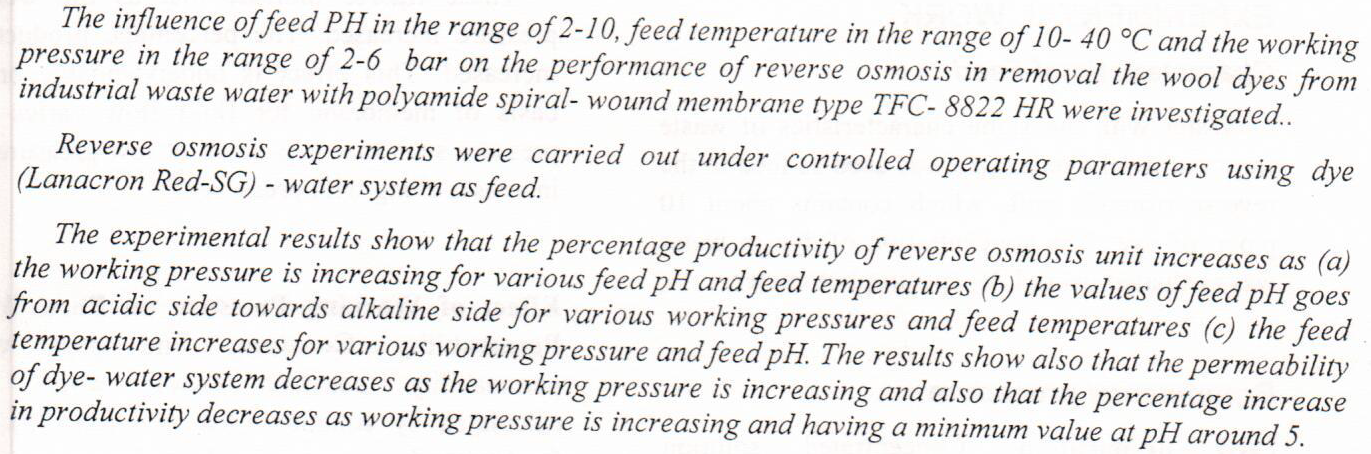
Removal of Wool Dyes from Industrial Wastewater by Reverse Osmosis Process
...Show More Authors

View Publication Preview PDF
Quick Preview PDF
Publication Date
Sun Feb 05 2017
Journal Name
Iraqi Journal Of Market Research And Consumer Protection
STUDY OF OPTIMUM CONDITIONS FOR REMOVAL OF HEAVY METAL ELEMENTS BY LOCALLY ISOLATED FUNGI Aspergillus niger.: STUDY OF OPTIMUM CONDITIONS FOR REMOVAL OF HEAVY METAL ELEMENTS BY LOCALLY ISOLATED FUNGI Aspergillus niger.
...Show More Authors

The best optimum temperature for the isolate was 30○C while the pH for the maximum mineral removal was 6. The best primary mineral removal was 100mg/L, while the maximum removal for all minerals was obtained after 8 hrs, and the maximum removal efficiency was obtained after 24 hrs. The results have proved that the best aeration for maximum removal was obtained at rotation speed of 150 rpm/ minute. Inoculums of 5ml/ 100ml which contained 106 cell/ ml showed maximum removal for the isolate.

View Publication Preview PDF
Publication Date
Tue Jun 01 2021
Journal Name
Baghdad Science Journal
Removal of Congo Red Dye From Aqueous Solution Using Eco-Friendly Adsorbent of Nanosilica
...Show More Authors

            The development of a new, cheap, efficient, and ecofriendly adsorbents has become an important demand for the treatment of waste water, so nano silica is considered a good choice. A sample of nanosilica (NS) was prepared from sodium silicate as precursor and the nonionic surfactant Tween 20 as a template. The prepared sample was characterized using various characterization techniques such as FT-IR, AFM, SEM and EDX analysis. The spectrum of FTIR confirms the presence of silica in the sample, while SEM analysis of sample shows nanostructures with pore ranging (2-100nm).The adsorptive properties of this sample were studied by removing Congo red dye (CR) from aqueous solution. Batch experimental methods were carried o

... Show More
View Publication Preview PDF
Scopus (10)
Crossref (4)
Scopus Clarivate Crossref
Publication Date
Mon Aug 01 2022
Journal Name
Water, Air, & Soil Pollution
Cladophora Algae Modified with CuO Nanoparticles for Tetracycline Removal from Aqueous Solutions
...Show More Authors

Modified algae with nano copper oxide (CuO) were used as adsorption media to remove tetracycline (TEC) from aqueous solutions. Functional groups, morphology, structure, and percentages of surfactants before and after adsorption were characterised through Fourier-transform infrared (FTIR), X-ray diffraction (XRD), scanning electron microscopy (SEM), and energy-dispersive spectroscopy (EDS). Several variables, including pH, connection time, dosage, initial concentrations, and temperature, were controlled to obtain the optimum condition. Thermodynamic studies, adsorption isotherm, and kinetics models were examined to describe and recognise the type of interactions involved. Resultantly, the best operation conditions were at pH 7, contact time

... Show More
Crossref (30)
Crossref
Publication Date
Mon Apr 19 2021
Journal Name
Iraqi Journal Of Agricultural Sciences
TETRACYCLINE ANTIBIOTIC REMOVAL FROM AQUEOUS SOLUTION USING CLADOPHORA AND SPIRULINA ALGAE BIOMASS
...Show More Authors

Cladophora and Spirulina algae biomass have been used for the removal of Tetracycline (TC) antibiotic from aqueous solution. Different operation conditions were varied in batch process, such as initial antibiotic concentration, different biomass dosage and type, contact time, agitation speed, and initial pH. The result showed that the maximum removal efficiencies by using 1.25 g/100 ml Cladophora and 0.5 g/100 ml Spirulina algae biomass were 95% and 94% respectively. At the optimum experimental condition of temperature 25°C, initial TC concentration 50 mg/l, contact time 2.5hr, agitation speed 200 rpm and pH 6.5. The characterization of Cladophora and Spirulina biomass by Fourier transform infrared (FTIR) indicates that the presenc

... Show More
Crossref (4)
Crossref
Publication Date
Mon Aug 01 2022
Journal Name
Water, Air And Soil Pollution
Cladophora Algae Modified with CuO Nanoparticles for Tetracycline Removal from Aqueous Solutions
...Show More Authors

Modified algae with nano copper oxide (CuO) were used as adsorption media to remove tetracycline (TEC) from aqueous solutions. Functional groups, morphology, structure, and percentages of surfactants before and after adsorption were characterised through Fourier-transform infrared (FTIR), X-ray diffraction (XRD), scanning electron microscopy (SEM), and energy-dispersive spectroscopy (EDS). Several variables, including pH, connection time, dosage, initial concentrations, and temperature, were controlled to obtain the optimum condition. Thermodynamic studies, adsorption isotherm, and kinetics models were examined to describe and recognise the type of interactions involved. Resultantly, the best operation conditions were at pH 7, contact time

... Show More
Scopus (32)
Crossref (31)
Scopus Clarivate Crossref
Publication Date
Thu Sep 05 2013
Journal Name
Eng. & Tech. Journal
Snubber Network Design for Triac Driving Single – Phase Industrial Heater by Applying Fuzzy Logic Method
...Show More Authors

Power switches require snubbing networks for driving single – phase industrial heaters. Designing these networks, for controlling the maximum allowable rate of rise of anode current (di/dt) and excessive anode – cathode voltage rise (dv/dt) of power switching devices as thyristors and Triacs, is usually achieved using conventional methods like Time Constant Method (TCM), resonance Method (RM), and Runge-Kutta Method (RKM). In this paper an alternative design methodology using Fuzzy Logic Method (FLM) is proposed for designing the snubber network to control the voltage and current changes. Results of FLM, with fewer rules requirements, show the close similarity with those of conventional design methods in such a network of a Triac drivin

... Show More
View Publication Preview PDF
Publication Date
Mon Jan 09 2023
Journal Name
Indian Journal Of Economics And Business
Evaluation of reverse logistics options for international and local companies in Iraq
...Show More Authors

Many international companies have branches or agencies in Iraq and have large market shares, and this has contributed to the increase in the import of these companies' products. This process created an additional problem of handling a large number of expired or defective products. There are many methods that contribute significantly to reducing these problems. The most prominent of these is the activation of reverse logistics options in Iraq by international and local companies. This research aims to conduct a survey of the reverse logistics options approved by some local and international companies and compare between them. This paper found that Amaron, Hitachi, Apple, Samsung and Huawei have limited options for reverse logistics and that

... Show More
Publication Date
Sun Sep 01 2013
Journal Name
Journal Of Economics And Administrative Sciences
The role of competitive intelligence and reverse engineering to achieve competitive advantage
...Show More Authors

Abstract

In light of the great technological development and the emergence of globalization has increased global competition, where it became competitive exercise pressure on all sectors. In light of this companies mast enviorment depend on the means that keeps them on the competitive position through access to information about competitors in order to help them to draw a strategy that will achieve a competitive edge either through excellence or reduce the costs of their products and this means intelligence competitive and reverse engineering that help to gain information on competitors analyze and put of the decision-maker From this point formed the idea of ​​research in the statement of the role of

... Show More
View Publication Preview PDF
Crossref
Publication Date
Thu Jan 31 2019
Journal Name
International Journal Of Ambient Energy
Energy generation by membraneless microfluidic fuel cell using acidic wastewater as a fuel
...Show More Authors

A simple and novel membraneless paper-based microfluidic fuel cell was presented in this study. The occurrence of laminar flow was employed to ensure no mixing of the fuel and oxidant fluids along the bath of reaction. The acidic wastewater was used as a fuel. It was an air-breathing cell, so air and tab water were used as oxidants. Both the fuel and tab water flowed continuously under gravity. Whatman filter paper was used for preparation of the fuel cell channel and two carbon fibre electrodes were used and firmed on the edges of the cell. The performance of the cell was examined over three consecutive days. The results indicated that the present cell has the potential to generate electric power, but an extensive study is required to harv

... Show More
View Publication Preview PDF
Scopus (4)
Crossref (3)
Scopus Clarivate Crossref
Publication Date
Tue Sep 14 2021
Journal Name
Egyptian Journal Of Chemistry
Real wastewater Treatment by Electrocoagulation- Electro-oxidation Combined System: Optimization using Taguchi Approach
...Show More Authors

In this study, the optimum conditions for COD removal from petroleum refinery wastewater by using a combined electrocoagulation- electro-oxidation system were attained by Taguchi method. An orthogonal array experimental design (L18) which is of four controllable parameters including NaCl concentration, C.D. (current density), PH, and time (time of electrolysis) was employed. Chemical oxygen demand (COD) removal percentage was considered as the quality characteristics to be enhanced. Also, the value of turbidity and TDS (total dissolved solid) were estimated. The optimum levels of the studied parameters were determined precisely by implementing S/N analysis and analysis of variance (ANOVA). The optimum conditions were found to be NaCl = 2.5

... Show More
View Publication Preview PDF
Scopus (7)
Crossref (1)
Scopus Clarivate Crossref


