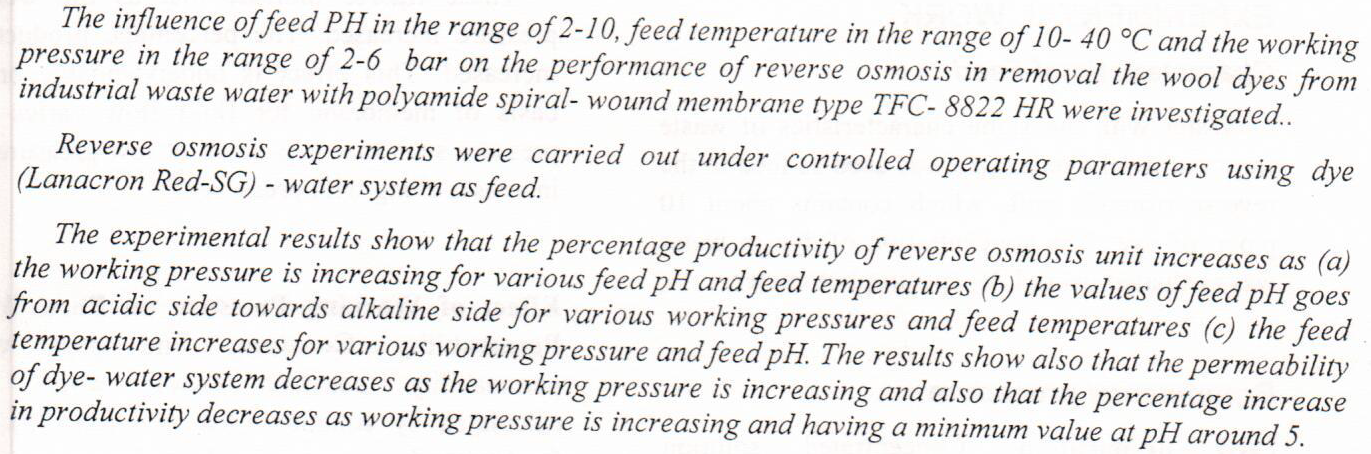
Removal of Wool Dyes from Industrial Wastewater by Reverse Osmosis Process

This research after financial ratios in the detection of fraud to the financial statements published which enables specialists from the work of their studies and their conclusions to obtain the information they seek on the activities of the entity. Has provided researchers what these relics They then field study to test the validity and sincerity of the findings of the suggestions that have been upheld the need to study all financial ratios extracted in general, organized and used in decision-making processes necessary administrative.And that the financial management attention more financial analysis and extraction of financial ratios and compare them with industry standards taken from historical norms

Activated carbon (AC) is a highly important adsorbent material, as it is a solid form of pure carbon that boasts a porous structure and a large surface area, making it effective for capturing pollutants. Thanks to its exceptional features, AC is widely used for purifying water that is contaminated with odors and removing dyes in a cost-effective manner. A variety of carbonic materials have been employed to prepare AC, and this study aimed to evaluate the suitability of utilizing waste mango and avocado seeds for this purpose, followed by testing their efficacy in removing dye from aqueous solutions. The results indicate that using waste mango and avocado as AC is technically feasible, achieving dye removal percentages of 98% and 93%,
... Show More (2)
(2)
 (29)
(29)
 (23)
(23)
 (3)
(2)
(3)
(2)
The effect of electrolysis operating parameters on the removal efficiency of cadmium from a simulated wastewater was studied by adopting response surface methodology combined with Box–Behnken Design. As a new electrode design, spiral-wound woven wire mesh rotating cylinder electrode was used for cadmium removal. Current (240–400 mA), rotation speed (200–1000 rpm), initial cadmium concentration (200–600ppm), and cathode mesh number (30–60) were chosen as independent variables while the removal efficiency of cadmium was considered as a response function. The results revealed that the rotation speed has the major effect on the removal efficiency of cadmium. Regression analysis showed good fit of the experimental data to the second-or
... Show More
(29)
(23)
The purpose of this study was to evaluate the anesthetic effectiveness of a buccal infiltration technique combined with local massage (using 2% lidocaine) in the extraction of mandibular premolars to be utilized as an alternative to the conventional inferior alveolar nerve block.
Patients eligible included any subject with a clinical indication for tooth extraction of the mandibular 1st or 2nd premolars. All patients were anesthetized buccally by local infiltration technique followed by an external pressure applied for 1 min directly over the injection area. In each case, another local
(8)
(23)
(21)
This study aimed to investigate the effect of total suspended solids (TSS) on the performance of a continuously operated dual-chamber microbial fuel cell (MFC) proceeded by primary clarifier to treat actual potato chips processing wastewater. The system was also tested in the absence of the primary clarifier and the results demonstrated a significant effect of TSS on the polarization curve of the MFC which was obtained by operating the graphite anodic electrode against Ag/AgCl reference electrode. The maximum observed power and current densities were decreased form 102.42 mW/m2 and 447.26 mA/m2 to 80.16 mW/m2 and 299.10 mA/m2, respectively due to the adverse effect of TSS. Also
... Show More
(6)
To assess the biochemical, mechanical and structural characteristics of retained dentin after applying three novel bromelain‑contained chemomechanical caries removal (CMCR) formulations in comparison to the conventional excavation methods (hand and rotary) and a commercial papain‑contained gel (Brix 3000). Seventy‑two extracted permanent molars with natural occlusal carious lesions (score > 4 following the International Caries Detection and Assessment System (ICDAS‑II)) were randomly allocated into six groups (n = 12) according to the excavation methods: hand excavation, rotary excavation, Brix 3000, bromelain‑contained gel (F1), bromelain‑chloramine‑T (F2), and bromelain chlorhexidine gel (F3). The superficial and deepe
... Show More
(4)
(6)
The current study aims to show the importance of plant products as mosquitocides against Culex quinquefasciatus. Castor oil Nanoemulsions were subedit in various ratios including castor oil, ethanol, tween 80, and deionized water by using ultrasonication. Thermodynamic, centrifugation, PH, assay which improved that the formula of 10 ml of castor oil, ethanol 5ml, tween 80 (14 ml) and deionized water 71ml was more stable than other formulas. The stable formula of castor oil nanoemulsion was characterized by transmission electron microscopy (TEM) and dynamic light scattering (DLS). Nanoemulsion droplets were spherical in shape and were found to have a Z-average diameter of 87.4nm. A concentration of ca
... Show More
(4)
(3)