Preferred Language
Articles
/
ijcpe-632
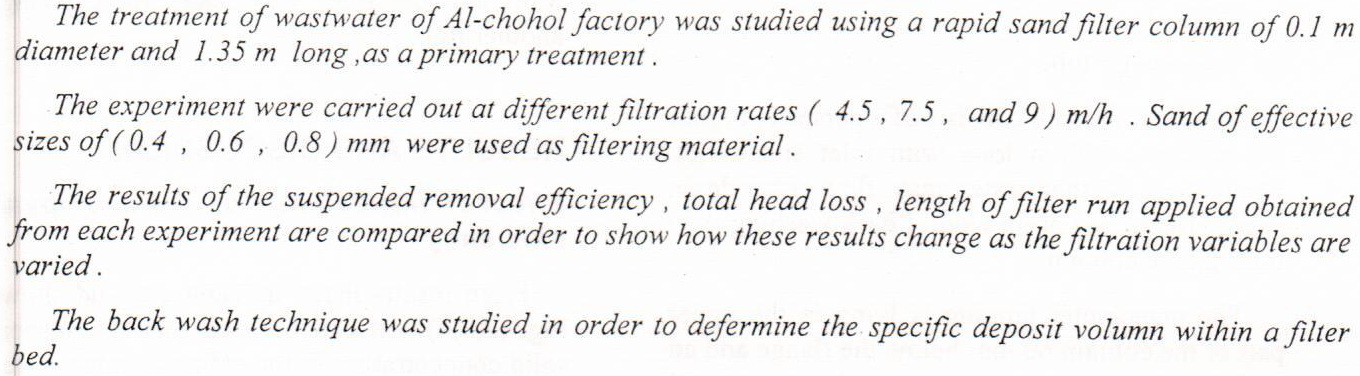
The Treatment of Wastewater of Alcohol Factory by Filtration as Primary Treatment
...Show More Authors

View Publication Preview PDF
Quick Preview PDF
Publication Date
Sun Oct 01 2023
Journal Name
Baghdad Science Journal
Solid Waste Treatment Using Multi-Criteria Decision Support Methods Case Study Lattakia City
...Show More Authors

Lattakia city faces many problems related to the mismanagement of solid waste, as the disposal process is limited to the random Al-Bassa landfill without treatment. Therefore, solid waste management poses a special challenge to decision-makers by choosing the appropriate tool that supports strategic decisions in choosing municipal solid waste treatment methods and evaluating their management systems. As the human is primarily responsible for the formation of waste, this study aims to measure the degree of environmental awareness in the Lattakia Governorate from the point of view of the research sample members and to discuss the effect of the studied variables (place of residence, educational level, gender, age, and professional status) o

... Show More
View Publication Preview PDF
Scopus (5)
Crossref (1)
Scopus Crossref
Publication Date
Sun Dec 06 2009
Journal Name
Baghdad Science Journal
THE EFFECT OF RAMADI SEWAGE TREATMENT PLANT ON THE PHYTOPLANKTON AND SOME PHYSICO – CHEMICAL CHARACTERS IN EUPHRATES RIVER , IRAQ
...Show More Authors

Four localities were selected in Euphrates River and Ramadi sewage treatment plant to collect water samples monthly during the period between October 2001 to July 2002 . Total cell count of phytoplankton and its physico- chemical concentrations were determined . The study aimed to demonstrate the effect of Ramadi sewage treatment plant on Euhprates River . It is concluded that the sewage had an dilution effect for the total hardness , total alkalinity , electrical conductivity and salinity of Euphrates River , but it is also caused in the presence of a contaminated area . This was cleared from the depletion of dissolved oxygen and high values of biological oxygen demand with lower valuse of pH in this area . The water of Euphrates

... Show More
View Publication Preview PDF
Crossref (1)
Crossref
Publication Date
Sat Sep 30 2023
Journal Name
Iraqi Journal Of Chemical And Petroleum Engineering
Removal of Lead Ions from Wastewater by using a Local Adsorbent from Charring Tea Wastes
...Show More Authors

   Adsorption of lead ions from wastewater by native agricultural waste, precisely tea waste. After the activation and carbonization of tea waste, there was a substantial improvement in surface area and other physical characteristics which include density, bulk density, and porosity. FTIR analysis indicates that the functional groups in tea waste adsorbent are aromatic and carboxylic. It can be concluded that the tea waste could be a good sorbent for the removal of Lead ions from wastewater. Different dosages of the adsorbents were used in the batch studies. A random series of experiments indicated a removal degree efficiency of lead reaching (95 %) at 5 ppm optimum concentration, with adsorbents R2 =97.75% for tea. Three mo

... Show More
View Publication Preview PDF
Crossref (1)
Crossref
Publication Date
Mon Sep 30 2002
Journal Name
Iraqi Journal Of Chemical And Petroleum Engineering
Removal of Wool Dyes from Industrial Wastewater by Reverse Osmosis Process
...Show More Authors

View Publication Preview PDF
Publication Date
Sat Dec 31 2016
Journal Name
Iraqi Journal Of Chemical And Petroleum Engineering
Removal of Heavy Metals from Industrial Wastewater by Using RO Membrane
...Show More Authors

Industrial wastewater containing nickel, lead, and copper can be produced by many industries. The reverse osmosis (RO) membrane technologies are very efficient for the treatment of industrial wastewater containing nickel, lead, and copper ions to reduce water consumption and preserving the environment. Synthetic industrial wastewater samples containing Ni(II), Pb(II), and Cu(II) ions at various concentrations (50 to 200 ppm), pressures (1 to 4 bar), temperatures (10 to 40 oC), pH (2 to 5.5), and flow rates (10 to 40 L/hr), were prepared and subjected to treatment by RO system in the laboratory. The results showed that high removal efficiency of the heavy metals could be achieved by RO process (98.5%, 97.5% and 96% for Ni(II),

... Show More
View Publication Preview PDF
Publication Date
Sat Jul 22 2023
Journal Name
Journal Of Engineering
Removal of 4-Chlorophenoles from Simulated Wastewater by Advanced Oxidation Processes
...Show More Authors

The degradation and mineralization of 4-chlorophenol (4-CP) by advanced oxidation processes (AOPs) was investigated in this work, using both of UV/H2O2 and photo-Fenton UV/H2O2/Fe+3 systems.The reaction was influenced by the input concentration of H2O2, the amount of the iron catalyst, the type of iron salt, the pH and the concentration of 4-CP. A colored solution of benzoquinon can be observed through the first 5 minutes of irradiation time for UV/H2O2 system when low concentration (0.01mol/L) of H2O2 was used. The colored solution of benzoquinon could also be observed through the first 5 minutes for the UV/H2O2/Fe+3 system at high
concentration (100ppm) of 4-CP. The results have shown that adding Fe+3 to the UV/H2O2 system enhanced

... Show More
View Publication Preview PDF
Crossref (1)
Crossref
Publication Date
Fri Apr 01 2011
Journal Name
Journal Of Engineering
REMOVAL OF PHOSPHORUS FROM WASTEWATER BY ADSORPTION ONTO NATURAL IRAQI MATERIALS
...Show More Authors

This study focused on treating wastewater to remove phosphorus by adsorption onto naturaland local materials. Burned kaolin, porcelinite, bauxite and limestone were selected to be testedas adsorption materials.The adsorption isotherms were evaluated by batch experiments, studyingthe effects of pH, temperature and initial phosphorus concentration. The results showed that at pH6, temperature 20°C and 300 mg/l initial phosphorus concentration; the sorption capacity was0.61, 9, 10 and 13 mg/g at 10 h contact time, for burned kaolin, porcelanite, limestone and bauxiterespectively. As the pH increased from 2 to 10 the removal efficiency for the materials differs inbehaviour. The removal efficiency increased from 40 to 90 % for limestone, and dec

... Show More
Crossref (3)
Crossref
Publication Date
Thu Aug 05 2021
Journal Name
International Journal Of Renewable Energy Development
Desalination of Agricultural Wastewater by Solar Adsorption System: A Numerical Study
...Show More Authors

There are still areas around the world suffer from severe shortage of freshwater supplies. Desalination technologies are not widely used due to their high energy usage, cost, and environmental damaging effects. In this study, a mathematical model of single-bed adsorption desalination system using silica gel-water as working pair is developed and validated via earlier experiments. A very good match between the model predictions and the experimental results is recorded. The objective is to reveal the factors affecting the productivity of fresh water and cooling effect in the solar adsorption system. The proposed model is setup for solving within the commercially-available software (Engineering Equation Solver). It is implemented to so

... Show More
View Publication
Scopus (8)
Crossref (6)
Scopus Clarivate Crossref
Publication Date
Tue May 23 2023
Journal Name
Journal Of Engineering
REMOVAL OF OIL FROM WASTEWATER BY ADVANCED OXIDATION PROCESS / HOMOGENEOUS PROCESS
...Show More Authors

In the present work advanced oxidation process, photo-Fenton (UV/H2O2/Fe+2) system, for the treatment of wastewater contaminated with oil was investigated. The reaction was influenced by the input concentration of hydrogen peroxide H2O2, the initial amount of the iron catalyst Fe+2, pH, temperature and the concentration of oil in the wastewater. The removal efficiency for the system UV/ H2O2/Fe+2 at the optimal conditions and dosage (H2O2 = 400mg/L, Fe+2 = 40mg/L, pH=3, temperature =30o C) for 1000mg/L load was found to be 72%.

View Publication Preview PDF
Crossref (13)
Crossref
Publication Date
Sun Jul 09 2023
Journal Name
Journal Of Engineering
Effect of Ferric Oxide on Electricity Generation and Waste Water Treatment Using Microbial Fuel Cell Technology
...Show More Authors

The aim of research is to show the effect of Ferric Oxide (Fe2O3) on the electricity production and wastewater treatment, since 2.5% of Ferric Oxide (Fe2O3) (heated and non heated) nanoparticles has been used. Characterization of nanoparticles was done using X-ray Diffraction (XRD) and Scan Electron Microscopy (SEM). The influence of acidity was also studied on both wastewater treatmenton the Chemical Oxygen demand (COD) and Biological Oxygen Demand (BOD) and voltage output was studied. From the results, it was infused that the dosage of 0.025 g/l and an initial pH 7 were founded to be optimum for the effective degradation of effluents. The results concluded that the treatment of anaerobic sludge wastewater using Ferric Oxide (Fe2O3) in

... Show More
View Publication Preview PDF
Crossref (1)
Crossref