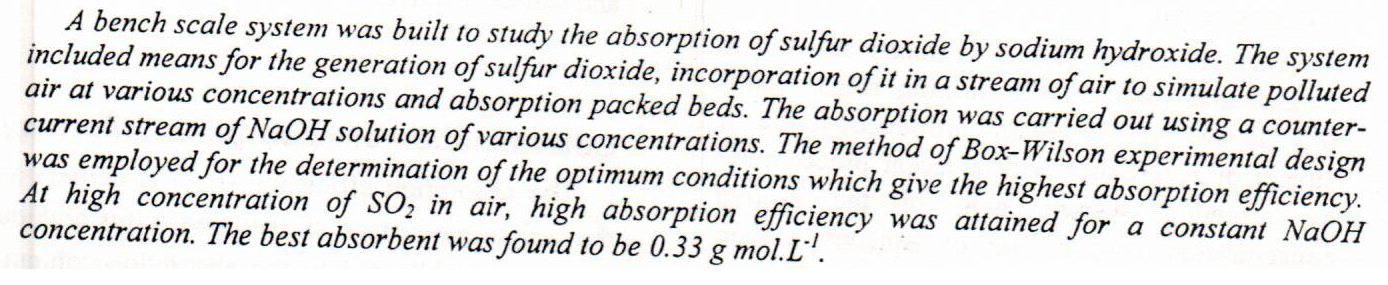
Removal of Sulfur Dioxide from Sulfuric Acid Plant Emissions

The possibility of predicting the mass transfer controlled CaCO3 scale removal rate has been investigated.
Experiments were carried out using chelating agents as a cleaning solution at different time and Reynolds’s number. The results of CaCO3 scale removal or (mass transfer rate) (as it is the controlling process) are compared with proposed model of prandtl’s and Taylor particularly based on the concept of analogy among momentum and mass transfer.
Correlation for the variation of Sherwood number ( or mass transfer rate ) with Reynolds’s number have been obtained .
Azo dyes like methyl orange (MO) are very toxic components due to their recalcitrant properties which makes their removal from wastewater of textile industries a significant issue. The present study aimed to study their removal by utilizing aluminum and Ni foam (NiF) as anodes besides Fe foam electrodes as cathodes in an electrocoagulation (EC) system. Primary experiments were conducted using two Al anodes, two NiF anodes, or Al-NiF anodes to predict their advantages and drawbacks. It was concluded that the Al-NiF anodes were very effective in removing MO dye without long time of treatment or Ni leaching at in the case of adopting the Al-Al or NiF-NiF anodes, respectively. The structure and surface morphology of the NiF electrode were inves
... Show More (2)
(2)


 (69)
(69)
 (66)
(11)
(12)
(18)
(66)
(11)
(12)
(18)
Data of multispectral satellite image (Landsat- 5 and Landsat-7) was used to monitoring the case of study area in the agricultural (extension and plant density), using ArcGIS program by the method of analysis (Soil adjusted vegetative Index). The data covers the selected area at west of Baghdad Government with a part of the Anbar and Karbala Government. Satellite image taken during the years 1990, 2001 and 2007. The scene of Satellite Image is consists of seven of spectral band for each satellite, Landsat-5(TM) thematic mapper for the year 1990, as well as satellite Landsat-7 (ETM+) Enhancement thematic mapper for the year 2001 and 2007. The results showed that in the period from 1990 to 2001 decreased land area exposed (bare) and increased
... Show MoreCancer stay to be one of the leading causes of death throughout the world due to a limited success to use treatments. The new synthesized metal complexes with formula: [Ni L2 (H2O)2]. 2.5 E t OH and [Cd L2]. ½ H2O Where L = Bis [ 5 – ( P – nitrophenyl ) - 4 – phenyl 1 , 2 , 4 – trazol – 3 – dithiocarbamato hydrazide ] and the aqueous extract of Teucrium polium L.(TP) plant (Ja,adahin Arabic) were examined against growth cells of hepatocellular Carcinoma cell Line ( HeP2 ). The cytotoxicity assay of cancer cell line was used for determination of inhibition rate with three concentrations; (62.5, 105 and 250 µg /200µl). The aqueous extract of TP plant induced death of cancer cells by significant elevation of the inhib
... Show More
(4)
Background: Pain and the usage of local anesthetic agents are still real problem in pediatric dentistry, for these reasons, the use of minimal invasive dentistry (MID) in regard to the patient comfort is important especially for children, anxious and uncooperative patients. Chemomechanical caries removal (CMCR) methods involve the selective removal of the carious dentine hence it avoided the painful removal of the sound dentine and the anxiety resulted due to the vibration of the hand piece which is also decreased thus it appears to be more acceptable and comfortable to the patient. Aims of this study: This study was conducted among group of children to assess and compare the anxiety rating scale (during and after treatment) between the
... Show More
(17)
(16)
Two new ligands Na2[ H3B (BDIA)].0.05H2O (L1)(BDIA = 1-Boranyl-2,3-
Dihydro-1H-Indol-3-yl)]Acetic Acid and Na3[H2B(BDIA)2].0.3H2O.0.3CH3Ph (L2)
were synthesized by reaction of NaBH4 with indole -3- acetic acid (IAA) . The
coordination properties of ligands were studied with Co(II) , Ni(II) , Cu(II) and
Pt(IV) ions. Characterization and structural aspects of the prepared compounds were
elucidated by 1HNMR, FTIR electronic spectra, magnetic susceptibility, elemental
and metal analysis, thermal analysis (TG & DTG) and conductivity measurements.
The obtained data for metal complexes suggested square planar geometry for
copper complexes, octahedral geometry for nickel and platinium complexes and
tetrahedral geom