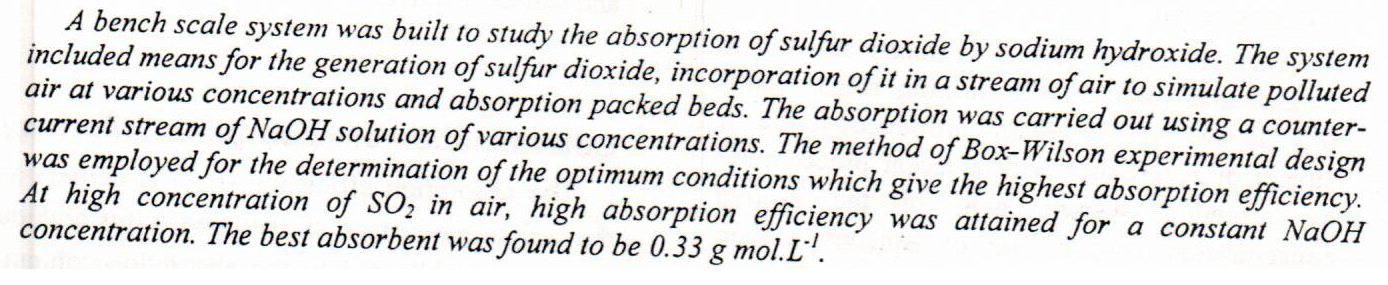
Removal of Sulfur Dioxide from Sulfuric Acid Plant Emissions

A new ligand 2,3-dihydrobenzo [d] thiazole-2-carboxylic acid (L) has been prepared from the reaction of ortho amino phenyl thiol with dichloroacetic acid in mole ratio (1:1). It has been characterized by elemental analysis (C.H.N.), IR, UV- Vis.spectraand 1H, 13C-NMR. A new series complexes of the bivalent ions (Co, Ni, Cu, Pd, Cd, Hg and Pb) and the trivalent (Cr) have been prepared and characterized too. The structural has been established by elemental analysis (C.H.N.), IR, UV-Vis. spectra, molar conductivity, atomic absorption and magnetic susceptibility measurements. The synthesized complexes were prepared in (1:2) ratio correspond to (Co(II), Ni(II), Cu(II), Pd(II), Cd(II), Hg(II) and Pb(II) complexes while in case Cr(III) complex is
... Show More
Coupling reaction of 4-amino antipyrene with 4-amino benzoic acid gave bidentate azo ligand. The prepared ligand was identified by Microelemental Analysis, 1HNMR, FT-IR and UV-Vis spectroscopic techniques. Treatment of the prepared ligand with the following metal ions (CoII, NiII, CuII and ZnII) in aqueous ethanol with a 1:2 M:L ratio and at optimum pH, yielded a series of neutral complexes of the general formula [M(L)2]Cl2 . The prepared complexes were characterized using flame atomic absorption, (C.H.N) Analysis, FT-IR and UV-Vis spectroscopic methods as well as magnetic susceptibility and conductivity measurements. Chloride ion content was also evaluated by (Mohr method). The nature of the complexes formed were studied following the mol
... Show MoreThe manganese doped zinc sulfide nanoparticles were synthesized by simple aqueous chemical reaction of manganese chloride, zinc acetate and thioacitamide in aqueous solution. Thioglycolic acid is used as capping agent for controlling the nanoparticle size. The main advantage of the ZnS:Mn nanoparticles of diameter ~ 2.73 nm is that the sample is prepared by using non-toxic precursors in a cost effective and eco-friendly way. The structural, morphological and chemical composition of the nanoparticles have been investigated by X-ray diffraction (XRD), Scanning Electron Microscopy (SEM) with energy dispersion spectroscopy (EDS) and Fourier transform infrared (FTIR) spectroscopy. The nanosize of the prepared nanoparticles was elucidated by Scan
... Show MoreBackground: Bone augmentation techniques are commonly employed in medical fields. This biomaterial system must be readily available, easily applicable by minimally-invasive technique and able to release an osteoinductive growth factor. Such a system will be able to engineer new bone formation locally at the site of injection. Hyaluronic acid has osteogenic potential that can be exploited not only for repairing bone defects but also for providing transplantable bone for the reconstruction of a variety of bone defects. The aims of this study were to evaluate the effects of Hyaluronic acid gel on bone healing by immunohistochemical estimation of transforming growth factor -beta 3 in experimental and control groups. Materials and methods: Thirt
... Show More (3)
(3)
 (1)
(1)

The esterification of oleic acid with 2-ethylhexanol in presence of sulfuric acid as homogeneous catalyst was investigated in this work to produce 2-ethylhexyl oleate (biodiesel) by using semi batch reactive distillation. The effect of reaction temperature (100 to 130°C), 2-ethylhexanol:oleic acid molar ratio (1:1 to 1:3) and catalysts concentration (0.2 to 1wt%) were studied. Higher conversion of 97% was achieved with operating conditions of reaction temperature of 130°C, molar ratio of free fatty acid to alcohol of 1:2 and catalyst concentration of 1wt%. A simulation was adopted from basic principles of the reactive distillation using MATLAB to describe the process. Good agreement was achieved.
Nanostructured Al2O3has been applied as a protective coating against corrosion of the carbon steel (C.S) in seawater environment (3.5% NaCl) at temperatures range (298-328)K. Aluminananoparticles were deposited on carbon steel substrates by cathodic electrophoretic deposition (EPD) with ethanol as suspension medium and poly(acrylic acid) (PAA) as polymeric charging agent. Meanwhile, thesurface morphology was examined using Atomic-force microscopy (AFM). The cross-section AFM showed that the particles sizes for the Al2O3 NPs is around 60-80 nm. The anticorrosion behaviour of coated C.S was investigated in 3.5% NaCl at temperature range 298-328 K by potentiodynamic polarization measurements. Results show that using PAA in suspension coat incr
... Show More
(13)
(51)
(44)
 (8)
(14)
(8)
(14)
Designing high-performance solid polymer electrolytes (SPEs) remains a key challenge, primarily due to their inherently low ionic conductivity, which hampers the advancement of all-solid-state lithium-ion batteries (ASSLiBs). In this work, we address this limitation by developing a green, crosslinked polymer blend comprising carboxymethyl cellulose (CMC) - extracted and functionalized from palm frond fibers - and poly (vinyl alcohol) (PVA). Citric acid (CA) was utilized as a crosslinking agent, while lithium perchlorate (LiClO4) was incorporated as a dopant to enhance ionic conductivity. The SPE membranes were fabricated via solution casting, with the optimized formulation - designated CP-15X-Li25 - containing 15 wt.-% CA and 25 wt.-% LiClO
... Show More
(5)
(5)