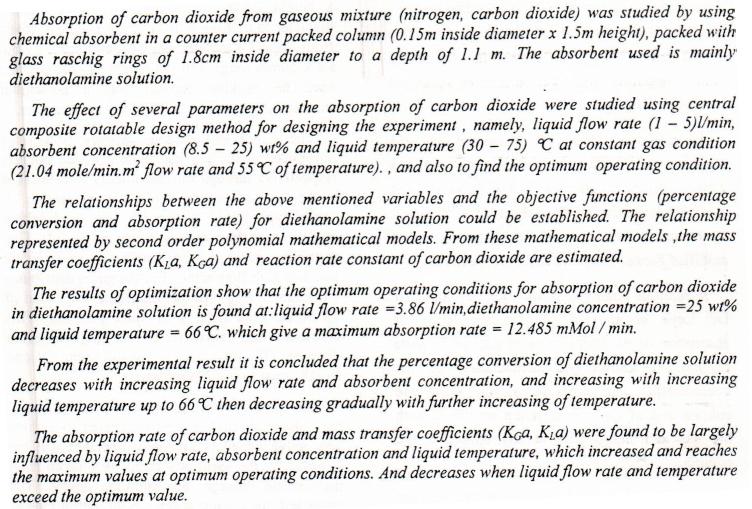
Characteristic of Absorption with Reaction in Packed Column

 (2)
(2)
 (1)
(1)


Genistein (GEN) is The major isoflavone found in soybeans, has a number of cardiovascular health benefits, Postmenopausal syndrome and osteoporosis. A direct flow injection analysis method for estimation of (GEN) in pure and supplements formulation . This system is based on diazotization coupling reactions between procaine penciline (PR) and genistein in basic medium, they formed yellow dyes have maximum absorption at 416 nm. Calibration curve were constructed over different GEN concentrations, linearity for GEN was 10-100 µg.mL-1 and detection limits of 1.51 ?g/mL. In the FIA technique, all analytical factors were analyzed and optimized. The established method was successfully used to determine GEN in the formulations of its supplement
... Show More
(6)
(1)
The CuInSe2 (CIS) nanocrystals are synthesized by arrested precipitation from molecular precursors are added to a hot solvent with organic cap- ping ligands to control nanocrystal formation and growth. CIS thin films deposited onto glass substrate by spray - coating, then selenized in Ar- atmosphere to form CIS thin films. PVs were made with power conversion efficiencies of 0.631% as -deposited and 0.846% after selenization, for Mo coated, under AM 1.5 illumination. X-ray diffraction (XRD) and energy dispersive spectroscopy (EDS) analysis it is evident that CIS have the chalcopyrite structure as the major phase with a preferred orientation along (112) direction and the atomic ratio of Cu : In : Se in the nanocrystals is nearly 1 : 1 : 2
This paper presents the first data for bremsstrahlung buildup factor (BBUF) produced by the complete absorption of Y-91 beta particles in different materials via the Monte Carlo simulation method. The bremsstrahlung buildup factors were computed for different thicknesses of water, concrete, aluminum, tin and lead. A single relation between the bremsstrahlung buildup factor BBUF with both the atomic number Z and thickness X of the shielding material has been suggested.
Air pollution is one of the important problems facing Iraq. Air pollution is the result of uncontrolled emissions from factories, car exhaust electric generators, and oil refineries and often reaches unacceptable limits by international standards. These pollutants can greatly affect human health and regular population activities. For this reason, there is an urgent need for effective devices to monitor the molecular concentration of air pollutants in cities and urban areas. In this research, an optical system has been built consisting of aHelium-Neonlaser,5mWand at 632.8 nm, a glass cell with a defined size, and a power meter(Gentec-E-model: uno) where a scattering of the laser beam occurs due to air pollution. Two pollutants were examin
... Show More
(8)
(1)
Fourier Transform-Infrared (FT-IR) spectroscopy was used to analyze gasoline engine oil (SAE 5W20) samples that were exposed to seven different oxidation times (0 h, 24 h, 48 h, 72 h, 96 h, 120 h, and 144 h) to determine the best wavenumbers and wavenumber ranges for the discrimination of the oxidation times. The thermal oxidation process generated oil samples with varying total base number (TBN) levels. Each wavenumber (400–3900 cm−1) and wavenumber ranges identified from the literature and this study were statistically analyzed to determine which wavenumbers and wavenumber ranges could discriminate among all oxidation times. Linear regression was used with the best wavenumbers and wavenumber ranges to predict oxidation time.
... Show More
(22)
(21)

Activation of farnesoid X receptor (FXR) markedly attenuates development of atherosclerosis in animal models. However, the underlying mechanism is not well elucidated. Here, we show that the FXR agonist, obeticholic acid (OCA), increases fecal cholesterol excretion and macrophage reverse cholesterol transport (RCT) dependent on activation of hepatic FXR. OCA does not increase biliary cholesterol secretion, but inhibits intestinal cholesterol absorption. OCA markedly inhibits hepatic cholesterol 7α‐hydroxylase (
(162)
(162)
