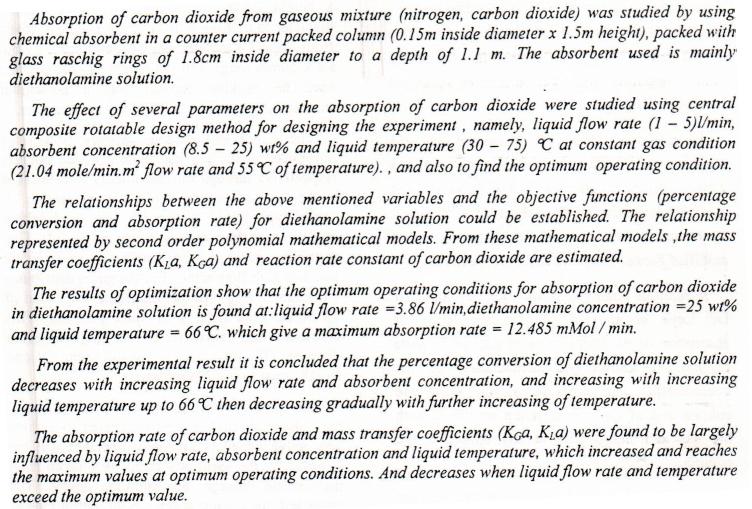
Characteristic of Absorption with Reaction in Packed Column

The development of a meaningful dissolution procedure for drug products with limited water solubility has been a challenge to both the pharmaceutical industry and the agencies that regulate them. Natural surfactants aid in the dissolution and subsequent absorption of drugs with limited aqueous solubility. In vitro, various techniques have been used to achieve adequate dissolution of the sparingly water – soluble or water insoluble drug products such as the use of mechanical methods (i.e., increased agitation and the disintegration method) or hydro alcoholic medium or large volumes of medium. The necessity of assuring the quality of drugs , especially those with low aqueous solubility and in vivo absorption , has led to the development and
... Show More
AlPO4 solid acid catalyst was prepared in order to use it in transesterification reaction of edible oil after supporting it with tungsten oxide. The maximum conversion of edible oil was obtained 78.78% at catalyst concentration (5gm.), temperature 70°Ϲ, 30/1 methanol/edible oil molar ratio, and time 5hr. The study of kinetics of the transesterification reaction of edible oil indicates that the reaction has an order of 3/2, while the value of activation energy for transesterification reaction is 51.367 kJ/mole and frequency factor equal 26219.13(L/ mol.minute).
 (1)
(1)
AlPO4 solid acid catalyst was prepared in order to use it in transesterification reaction of edible oil after supporting it with tungsten oxide. The maximum conversion of edible oil was obtained 78.78% at catalyst concentration (5gm.), temperature 70°Ϲ, 30/1 methanol/edible oil molar ratio, and time 5hr. The study of kinetics of the transesterification reaction of edible oil indicates that the reaction has an order of 3/2, while the value of activation energy for transesterification reaction is 51.367 kJ/mole and frequency factor equal 26219.13(L/ mol.minute).
(1)
This study investigates consecutive reaction assisted by pervaporation for the first time. It studies the saponification of diethyladipate DA with sodium hydroxide NaOH solution synchronous with separating ethanol from the reaction mixture through an aqueous – organic membrane. The effect of time on some variables such as: permeated ethanol concentration EtOH wt%, separation factor (α), concentration of NaOH solution CB in the reaction medium and the conversion of DA to monoethyladipate (the intermediate product) was studied. It was shown that EtOH wt% and the conversion increased with increasing time unlike CB but (α) showed the existence of maximum value during the time of experiment. The process of reaction assisted by pervaporation
... Show More
 (5)
(3)
(5)
(3)

The aim of this work is to study the influence of the type of fiber glass –mat on fatigue behavior of composite material which is manufactured from polyester and E-glass (woven roving, chopped strand mat (CSM)) as a laminate with a constant fiber volume fraction (VF) of 33%. The results showed that the laminates reinforced with E-glass (woven roving) [0/90, ±45.0/90] and [0/90, CSM, 0/90] have lower fatigue strength than the laminates reinforced with E-glass [0/90]3,[CSM]3 and [CSM, 0/90, CSM] although they had different tensile strength; the best laminate was [0/90]3 .
This work describes, selenium (Se) films were deposited on clean glass substrates by dc planar magnetron sputtering technique.The dependence of sputtering deposition rate of Se film deposited on pressure and DC power has been studied. The optimum argon pressure has range (4x10⁻¹ -8x10⁻² )mbar. The optical properties such as absorption coefficient (α) was determined using the absorbance and transmission measurement from UnicoUV-2102 PC spectrophotometer, at normal incidence of light in the wavelength range of 200-850 nm. And also we calculated optical constants(refractive index (n), dielectric constant (εi,r), and Extinction coefficient (κ) for selenium films.
(1)
Premature degradation is the problem of maxillofacial silicones, significantly affected by ultraviolet exposure, contributing to silicones photodegradation. Degradation necessitates frequent replacement of prostheses that increase the total cost of rehabilitation.
This study evaluated the effect of bisoctrizole on the ultraviolet absorption properties of silicone material and the stability of this absorption over time. Also, the bisoctrizole effect on the surface roughness of silicone was evaluated.
(1)
(1)