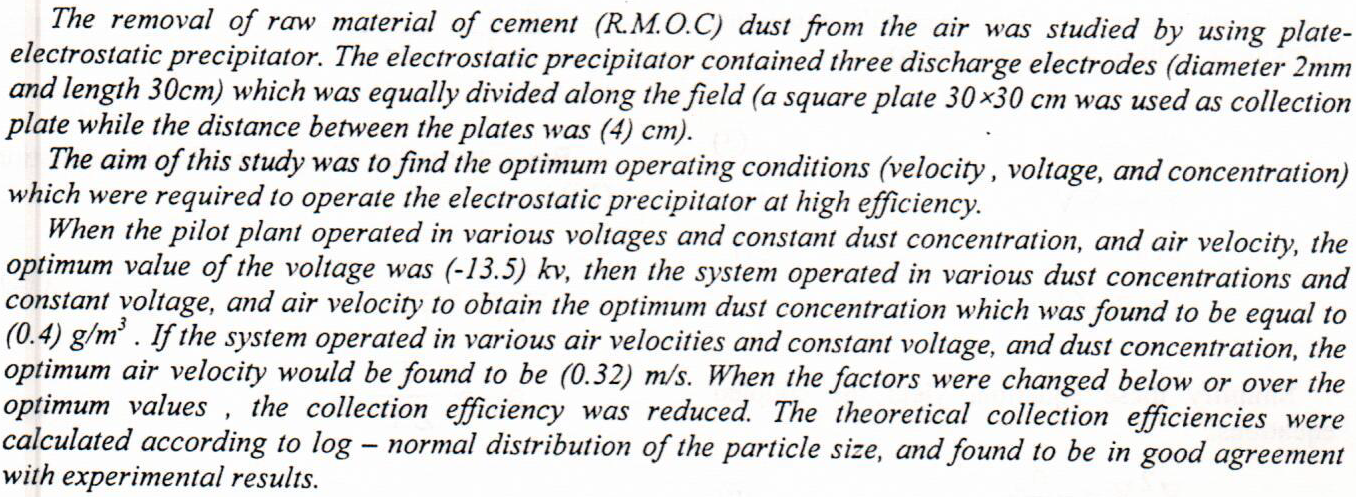
Performance of Plate-Electrostatic Precipitator for Removal of R.M.O.C. Dust

 (31)
(31)
 (29)
(29)



Purpose: To determine the effect of information technology governance (ITG) under the control objectives for information and related technologies (COBIT) on financial performance is the objective of this study. Additionally, the article seeks to look into the relationships between the factors under consideration. Theoretical framework: Information technology and operational processes are evaluated and ensure their compliance with the instructions of the Central Bank of Iraq. Therefore, the research dealt with a conceptual framework by reviewing the literature on the importance of the COBIT framework in assessing financial performance. Design/methodology/approach: To investigate the effect of information technology; we the valu
... Show More
(27)
(7)
Water pollution is widely regarded as one of the most pressing global challenges, exacerbated by human progress in industrial, agricultural, and technological sectors. Wastewater often contains non-biodegradable heavy metals that accumulate in living organisms. This accumulation poses significant risks to both environmental ecosystems and human health. The structures and surface morphology were characterized by FTIR, UV-vis measurements, XRD, SEM, and AFM. TiO2 nanoparticles could remove heavy metal ions (Pb2+, Cd2+, and Cr3+) from two samples (laboratory samples and real samples from Babylon battery factory in Al-Waziriya, Baghdad/Iraq) and measured by AAS. The results indicated that the removal percentages of heavy metal ions by T
... Show More
(3)
(1)
Background: Pain and the usage of local anesthetic agents are still real problem in pediatric dentistry, for these reasons, the use of minimal invasive dentistry (MID) in regard to the patient comfort is important especially for children, anxious and uncooperative patients. Chemomechanical caries removal (CMCR) methods involve the selective removal of the carious dentine hence it avoided the painful removal of the sound dentine and the anxiety resulted due to the vibration of the hand piece which is also decreased thus it appears to be more acceptable and comfortable to the patient. Aims of this study: This study was conducted among group of children to assess and compare the anxiety rating scale (during and after treatment) between the
... Show More
(17)
(16)
In this work, a novel single-slope solar distillator of floating perforated absorber inserted with wicks (cotton ribbons), and a stepped distillator are designed and manufactured with the aim of developing the conventional distillator. They are examined experimentally at Baghdad, Iraq (33.3°N Latitude, 44.4°E Longitude) in order to enhance the freshwater productivity and the efficiency of the conventional distillator. Results showed that the daily productivity and efficiency of the stepped distillator are higher than that for conventional solar distillator by 30% and 36.19% respectively. The daily productivity and thermal efficiency for the distillator with the floating absorber are higher than that for the conventional distillator by 16%
... Show More
(11)
(1)
(1)
(2)
(2)
Abstract
The research aims to study the role of e-government in enhancing institutional performance. The dimensions of e-government are: (support and commitment of senior management, technical structures, organization and human resources, knowledge and information, work procedures, attention to citizens' satisfaction, and client parties),while the dimensions of institutional performance are: (Service improvement, innovation, efficiency and effectiveness).
The research used electronic questionnaire as a main tool for data collection, The questionnaire included all the employees in the e-government project in Department of Government Coordinate and Citizen Affairs at the General Secretariat of the C
... Show More
(1)
This research aimed at studying the role of calculated knowledge an its efficiency in improving the performance especially most of the organizations are living within knowledge era which concentrate on new technology investment in different fields of modern live . Under the scientific trends towards the economy of calculated knowledge which depend basically on new computer program in order to utilize the knowledge to raise the level of work performance exploiting different resources in the best way that helps the organizations to achieve their objectives because the information technology and computer programs became a means of survival and indispensible instrument within the developed world which depend on prosperity . progress
... Show More