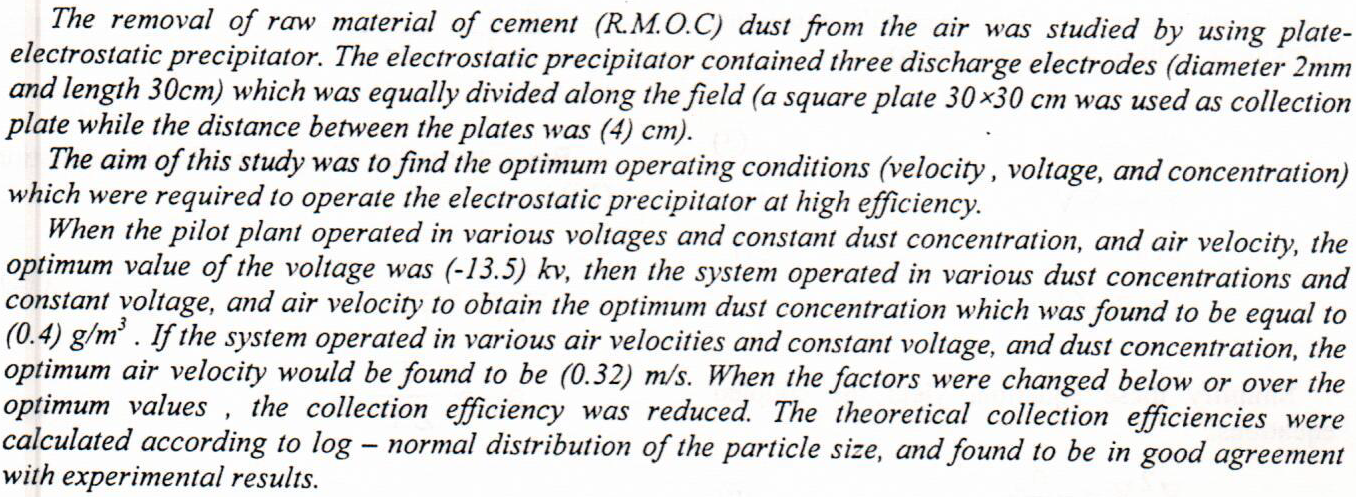
Performance of Plate-Electrostatic Precipitator for Removal of R.M.O.C. Dust

The goal of this experimental study is to determine the effects of different parameters (Flow rate, cuttings density, cuttings size, and hole inclination degree) on hole cleaning efficiency. Freshwater was used as a drilling fluid in this experiment. The experiments were conducted by using flow loop consist of approximately 14 m (46 ft) long with transparent glass test section of 3m (9.84 ft.) long with 4 inches (101.6 mm) ID, the inner metal drill pipe with 2 inches (50.8 mm) OD settled with eccentric position positive 0.5. The results obtained from this study show that the hole cleanings efficiency become better with high flow rate (21 m3/hr) and it increase as the hole inclination angles increased from 60 to 90 degree due to dominated
... Show More (3)
(3)

In this study, the preparation and characterization of hyacinth plant /chitosan composite, as a heavy metal removal, were done. Water hyacinth plant (Eichhorniacrasspes) was collected from Tigris river in Baghdad. The root and shoot parts of plant were ground to powder. Composite materials were prepared at different ratios of plant part (from 2.9% to 30.3%, wt /wt) which corresponds to (30-500mg) of hyacinth plant (root and shoot) and chitosan. The results showed that all examined ratios of plant parts have an excellent absorption to copper (Cu (II)). Moreover, it was observed that 2.9% corresponds (30mg) of plant root revealed highest removal (82.7%) of Pb (II), while 20.23% of shoot removed 61% of Cd (II) within 24 hr
... Show More (10)
(6)
(10)
(6)


Adsorption techniques are widely used to remove certain classes of pollutants from wastewater. Phenolic compounds represent one of the problematic groups. Na-Y zeolite has been synthesized from locally available Iraqi kaolin clay. Characterization of the prepared zeolite was made by XRD and surface area measurement using N2 adsorption. Both synthetic Na-Y zeolite and kaolin clay have been tested for adsorption of 4-Nitro-phenol in batch mode experiments. Maximum removal efficiencies of 90% and 80% were obtained using the prepared zeolite and kaolin clay, respectively. Kinetics and equilibrium adsorption isotherms were investigated. Investigations showed that both Langmuir and Freundlich isotherms fit the experimental data quite well. On the
... Show More
(24)
(19)
In this study involves removing of Brilliant Dyes, were which (Brilliant Green {BG} and Brilliant Cresyl Blue {BCB}) by using Iraqi Siliceous Rocks Powder (SRP). Adsorption isotherms were studied and the factors which prefer it, like temperature and salt effect, Adsorption isotherms of dyes, Brilliant Cresyl Blue {BCB} was found to be comparable to Langmuir equation according to Giles classification, isotherms dye Brilliant Green {BG} was found to be comparable to Freundlich equation more than dye Brilliant Blue {BCB} according to Giles classification. The adsorption process on this surface (SRP) studied at different temperatures, the results showed that the adsorption of dyes (BCB, BG) on the surface increased with increased temperature (E
... Show MoreIn this research, the removal of cadmium (Cd) from simulated wastewater was investigated by using a fixed bed bio-electrochemical reactor. The effects of the main controlling factors on the performance of the removal process such as applied cell voltage, initial Cd concentration, pH of the catholyte, and the mesh number of the cathode were investigated. The results showed that the applied cell voltage had the main impact on the removal efficiency of cadmium where increasing the applied voltage led to higher removal efficiency. Meanwhile increasing the applied voltage was found to be given lower current efficiency and higher energy consumption. No significant effect of initial Cd concentration on the removal efficiency of cadmium b
... Show More
(8)
In the present study, 1-ethyl -3-methyllimidazolium acetate ionic liquid is introduced for extractive desulfurization of Iraqi kerosene (1622ppm) and compared with 1-ethyl -3- methyllimidazolium tetrafloroborate. The effect of ionic liquid/ fuel ratio (1/9, 1/4, 1/2), temperature (25, 30,40oC), stirring speed (300,450rpm) and time (10, 30, 90, 180, 360 min) were studied. Sulfur compound analysis was performed using X-Ray fluorescence. The ionic liquid with acetate anion (OAc) showed better performance than tetrafloborate (BF4). The maximum extraction efficiency was 32% achieved at 1/2 IL/Fuel and 40oC after 90min. The oxidation step using hydrogen peroxide (8ml/200ml), catalyzed by acetic acid (2ml) and followed by ionic liquid extraction h
... Show MoreBiosorption is an effective method to remove toxic metals from wastewaters. In this study biosorption of lead and chromium ions from solution was studied using Citrobacter freundii and Citrobacter kosari isolated from industrial wastewater. The experimental results showed that optimum grwoth temperature for both bacteria is 30oC and the optimum pH is 7 &6 for C. freundii and C. kosari respectively. While the optimum incubation period to remove Pb and Cr for C. freundii and C. kosari is 4 days and 3days respectively. Also the biosorption of Pb and Cr in mixed culture of bacteria and mixed culture of Pb and Cr was investigated. Result indicate that uptake of Cr and Pb for C.freundii, C. kosari and in mixes culture of both bacteria is 58%, 53%
... Show MoreIn this research, the removal of cadmium (Cd) from simulated wastewater was investigated by using a fixed bed bio-electrochemical reactor. The effects of the main controlling factors on the performance of the removal process such as applied cell voltage, initial Cd concentration, pH of the catholyte, and the mesh number of the cathode were investigated. The results showed that the applied cell voltage had the main impact on the removal efficiency of cadmium where increasing the applied voltage led to higher removal efficiency. Meanwhile increasing the applied voltage was found to be given lower current efficiency and higher energy consumption. No significant effect of initial Cd concentration on the removal efficie
... Show More
(8)
The use of biopolymer material Chitosan impregnated granular activated carbon CHGAC as adsorbent in the removal of lead ions pb.2+ from aqueous solution was studied using batch adsorption mode. The prepared CHGAC was characterized by Scanning Electronic Microscopy (SEM) and atomic-absorption pectrophotometer. The adsorption of lead ions onto Chitosan-impregnated granular activated carbon was examined as a function of adsorbent weight, pH and
contact time in Batch system. Langmuir and Freundlich models were employed to analyze the resulting experimental data demonstrated that better fitted by Langmuir isotherm model than Freundlich model, with good correlation coefficient. The maximum adsorption capacity calculated f
