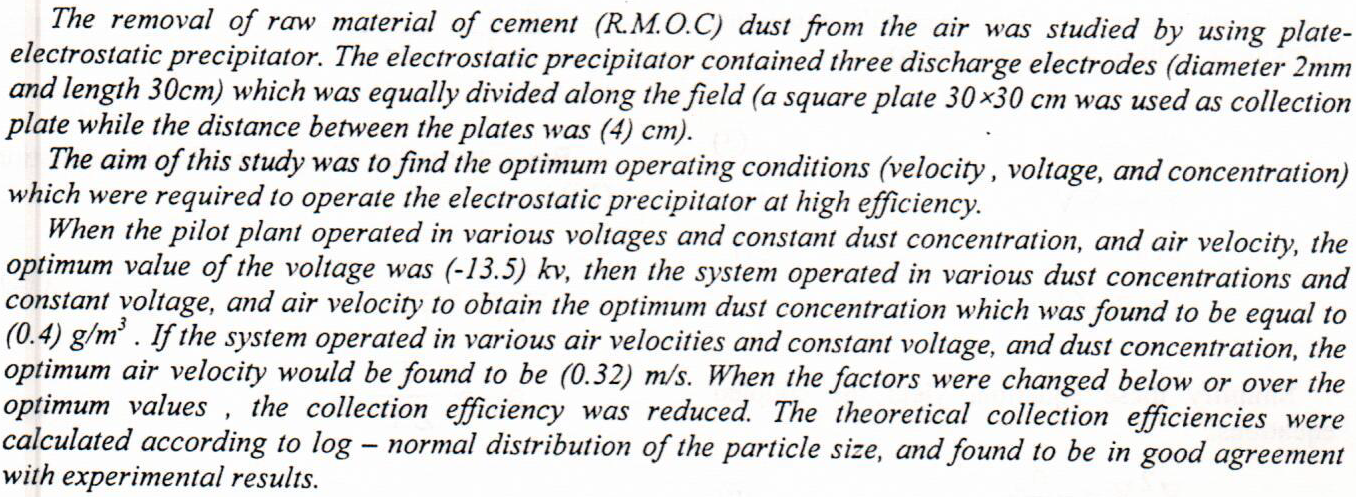
Performance of Plate-Electrostatic Precipitator for Removal of R.M.O.C. Dust

Electromyogram (EMG)-based Pattern Recognition (PR) systems for upper-limb prosthesis control provide promising ways to enable an intuitive control of the prostheses with multiple degrees of freedom and fast reaction times. However, the lack of robustness of the PR systems may limit their usability. In this paper, a novel adaptive time windowing framework is proposed to enhance the performance of the PR systems by focusing on their windowing and classification steps. The proposed framework estimates the output probabilities of each class and outputs a movement only if a decision with a probability above a certain threshold is achieved. Otherwise (i.e., all probability values are below the threshold), the window size of the EMG signa
... Show More (26)
(26)


A batch adsorption system was applied to study the adsorption of methylene blue from aqueous solution by Iraqi bentonite and treated bentonite with different amount of zinc oxide (ZnO). The adsorption capacities of methylene blue onto bentonite were evaluated. The equilibrium between liquid and solid phase was described by Langmuir model better than the Freundlich model. Langmuir and Freundlich constants have been determined. The separation factor or equilibrium parameter, RL which is used to predict if an adsorption system is favourable or unfavourable was calculated for all cases.

 (1)
(1)
(1)
(1)
The study aimed to prepare quick response codes to learn some of the technical skills of the second graders in the Faculty of Physical Education and Sports Sciences. The experimental method was used in the design of the experimental and control experimental and control groups. The research sample was represented by second-graders in the College of Physical Education and Sports Sciences / University of Baghdad, and by lot, the second division (a) was chosen to represent the experimental group that applied the inverse method using the QR code, and the second division (g) to represent the control group and applied the traditional method. (10) Students per group. After the tribal tests, his main experiment was carried out for 10 weeks with one
... Show More
Objective: To determine the effectiveness of hypothermia on renal functions for patients undergoing
coronary artery bypass graft CABG surgery.
Methodology: A purposive (non-probability) sample of (50) patients undergoing Isolated coronary artery
bypass graft surgery consecutively admitted to the surgical ward, and they were followed up in the
intraoperative, Intensive Care Unit (ICU) and in the postoperative (surgical ward). Post-operative renal function
test (glumeruler filteration rate (GFR) by using the Crockroft-Gault formula and serum creatinine level) was
determined first week post operative and post operative renal function was classified on the base of peak of
the serum creatinine level and decline of glomeru
The ground charge density distributions (CDD), elastic charge form factors and proton, charge, neutron, and matter root mean square (rms) radii for stable 40Ca and 48Ca have been calculated using single-particle radial wave functions of Woods-Saxon (WS) and harmonic-oscillator (HO) potentials. Different central potential depths are used for each subshell which is adjusted so as to reproduce the experimental single-nucleon binding energies. An excellent agreement between the calculated rms charge radii and experimental data are found for both nuclei using WS and HO potentials. The calculated proton rms radii for 40Ca are found to be in good agreement with experiment data using both WS and HO potentials while the results for 48Ca showed an ov
... Show More
(3)
(3)
Shumblan (SH) is one of the most undesirable aquatic plants widespread in the irrigation channels and water bodies. This work focuses on boosting the biogas potential of shumblan by co-digesting it with other types of wastes without employing any chemical or thermal pretreatments as done in previous studies. A maximum biogas recovery of 378 ml/g VS was reached using shumblan with cow manure as inoculum in a ratio of 1:1. The methane content of the biogas was 55%. Based on volatile solid (VS) and C/N ratios, biogas productions of 518, 434, and 580 ml/g VS were obtained when the shumblan was co-digested with food wastes (SH:F), paper wastes (SH:P), and green wastes (SH:G) respectively. No significant changes of methane contents were observ
... Show More
(2)