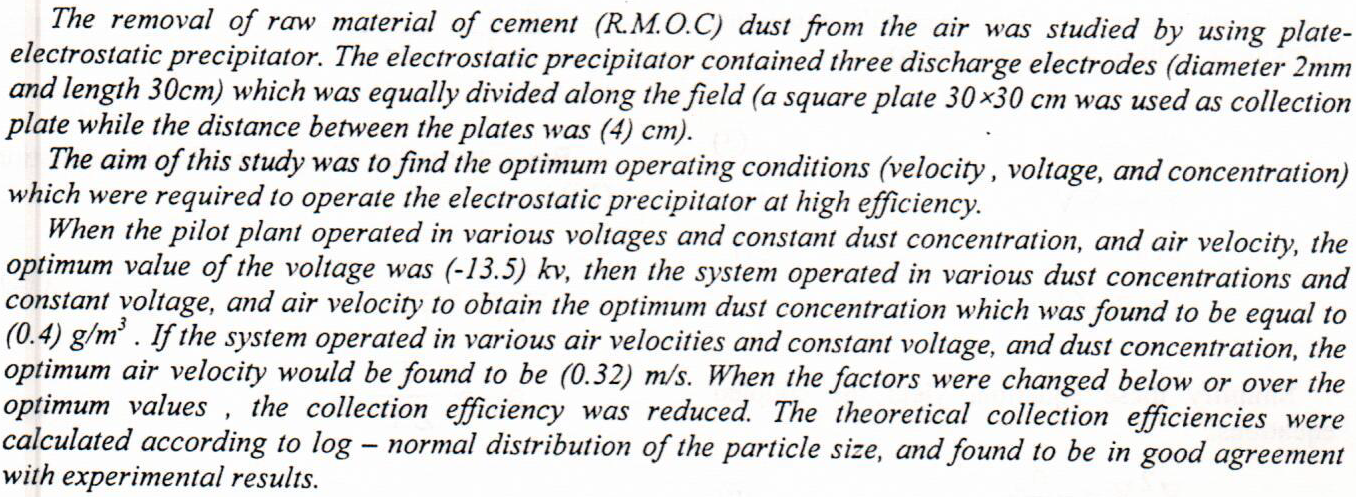
Performance of Plate-Electrostatic Precipitator for Removal of R.M.O.C. Dust

This paper numerically and theoretically investigates the optical and thermal performance of a parabolic trough collector PTC system. Many numerical simulations and theoretical analyses are conducted to demonstrate the influence of the receiver geometry and shifting from the focal position on the optical performance. The examined receiver geometries are circular, square, triangular, elliptical, and the new circular–square combined geometry is named as channel receiver. The thermal performance of PTC is examined for different volume flow rates theoretically in the range of (0.36 to 2.4 lpm). The results show that the best optical design is the channel receiver with an intercept factor of 84%, while the worst is the elliptical receiver with
... Show More (21)
(21)
 (12)
(12)


Moisture-induced damage is one of the primary causes of premature distress in asphalt pavements, leading to reduced service life and increased maintenance costs. Although nanomaterials have shown potential in enhancing asphalt performance, the underlying composite interaction mechanisms among nanomaterials, asphalt binder, and aggregate phases under moisture exposure are still not fully understood. In addition, comparative evaluations under consistent experimental conditions remain limited. This study investigates the influence of five nanomaterials: nano-silica (NS), nano-alumina (NA), nano-titanium dioxide (NT), nano-zinc oxide (NZ), and carbon nanotubes (CNT) on the physical and mechanical properties of asphalt binders and mixtur
... Show More
This paper proposes a novel finite-time generalized proportional integral observer (FTGPIO) based a sliding mode control (SMC) scheme for the tracking control problem of high order uncertain systems subject to fast time-varying disturbances. For this purpose, the construction of the controller consists of two consecutive steps. First, the novel FTGPIO is designed to observe unmeasurable plant dynamics states and disturbance with its higher time derivatives in finite time rather than infinite time as in the standard GPIO. In the FTGPO estimator, the finite time convergence rate of estimations is well achieved, whereas the convergence rate of estimations by classical GPIO is asymptotic and slow. Secondly, on the basis of the finite and fast e
... Show More
(12)
(10)
Shadow detection and removal is an important task when dealing with color outdoor images. Shadows are generated by a local and relative absence of light. Shadows are, first of all, a local decrease in the amount of light that reaches a surface. Secondly, they are a local change in the amount of light rejected by a surface toward the observer. Most shadow detection and segmentation methods are based on image analysis. However, some factors will affect the detection result due to the complexity of the circumstances. In this paper a method of segmentation test present to detect shadows from an image and a function concept is used to remove the shadow from an image.
Silver-bismuth iodide (ABI) ternary semiconductors, such as AgBi2I7, AgBiI4, Ag2BiI5, and Ag3BiI6, have emerged as promising lead-free light absorbers for photovoltaic applications due to their favorable optoelectronic properties. Despite recent advances that have improved power conversion efficiencies from ∼1% to over 5%, ABI-based solar cells still show substantial open-circuit voltage (VOC) losses of up to ∼1 V, which significantly hinder the device performance. These losses have been experimentally attributed to the non-radiative recombination originating from intrinsic defects, however, theoretical understanding of these defect mechanisms remains limited. Here, using density functional theory calculations, we systematical
... Show More
(2)
(2)
The Adaptive Optics technique has been developed to obtain the correction of atmospheric seeing. The purpose of this study is to use the MATLAB program to investigate the performance of an AO system with the most recent AO simulation tools, Objected-Oriented Matlab Adaptive Optics (OOMAO). This was achieved by studying the variables that impact image quality correction, such as observation wavelength bands, atmospheric parameters, telescope parameters, deformable mirror parameters, wavefront sensor parameters, and noise parameters. The results presented a detailed analysis of the factors that influence the image correction process as well as the impact of the AO components on that process
(7)
(1)
(14)
Composite materials are widely used in the engineered assets as aerospace structures, marine and air navigation owing to their high strength/weight ratios. Detection and identification of damage in the composite structures are considered as an important part of monitoring and repairing of structural systems during the service to avoid instantaneous failure. Effective cost and reliability are essential during the process of detecting. The Lamb wave method is an effective and sensitive technique to tiny damage and can be applied for structural health monitoring using low energy sensors; it can provide good information about the condition of the structure during its operation by analyzing the propagation of the wave in the
... Show More
(1)