Preparation, Characterization, and Properties of Barium Titanate
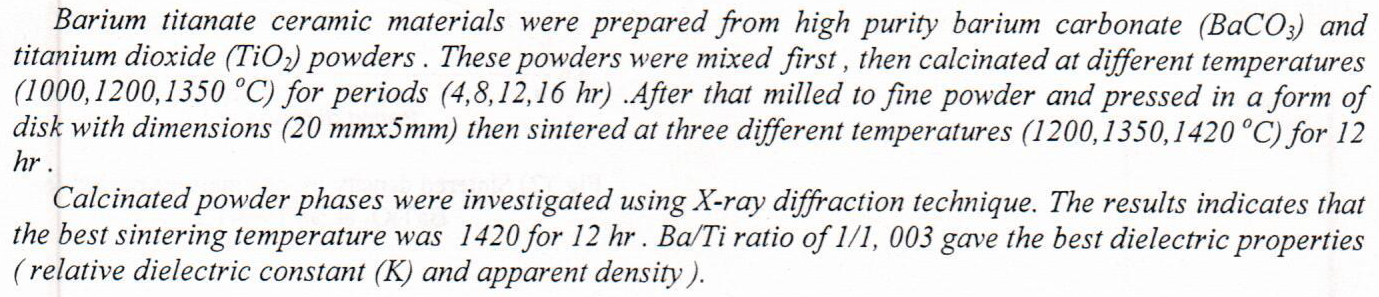

During the last quarter century, many changes have taken place in the tanks industry and also in the materials that used in its production، while concrete is the most suitable material where concrete tanks has the benefits of strength, long service life and cost effectiveness. So, it is necessary improvement the
conventional concrete in order to adapt the severe environment requirements and as a result high
performance concrete (HPC) was used. It is not fundamentally different from the concrete used in the past, although it usually contains fly ash, ground granulated blast furnace slag and silica fume, as well as
superplasticizer. So, the content of cementitious material is high and the water/cement ratio is low. In this
stu
 (2)
(2)

Tin Oxide (SnO2) films have been deposited by spray pyrolysis technique at different substrate temperatures. The effects of substrate temperature on the structural, optical and electrical properties of SnO2 films have been investigated. The XRD result shows a polycrystalline structure for SnO2 films at substrate temperature of 673K. The thickness of the deposited film was of the order of 200 nm measured by Toulansky method. The energy gap increases from 2.58eV to 3.59 eV when substrate temperature increases from 473K to 673K .Electrical conductivity is 4.8*10-7(.cm)-1 for sample deposited at 473K while it increases to 8.7*10-3 when the film is deposited at 673K
A developed model has been put for the hypothesis of capturing moons in explaining the origin of Jupiter moons, and study the change of the orbital properties of these satellites as well as the distance from the planet. Jupiter moons were divided into two types according to their physical and orbital properties, they are the moons , which are formed from the same material as the planet, so it was named the original moons ,while the moons that have been captured from the surrounding space was renamed exotic moons . And the moons of exotic origin asteroid belt and the Kuiper belt in the region which is behind Neptune, the origin of each clique of moons is an asteroid fragmented after colliding previously with another body and
... Show More
Two grades of paving asphalt with penetration of 46 and 65 are studied for determining changes in their physical and chemical properties caused by ageing.
The ageing process has been conducted on two petroleum paving asphalt cement using thin film oven test at 150, 163 and 175 C, and ageing time 5, 10,15, 20, 25 and 30 hours. The effect of ageing time and temperature on penetration, kinematic viscosity, softening point, solubility in trichloroethylene, heat loss and changes in chemical composition are investigated. The results of thin film oven test process indicte that the asphaltenes concentration of all aged asphalt increases with increasing ageing time, while the opposite was observed for polar-aromatic and naphthene-aromatic. The
 (2)
(3)
(2)
(3)


In this work, Pure and Cu: doped titanium dioxide nano-powder was prepared through a solid-state method. the dopant concentration [Cu/TiO2 in atomic percentage (wt%)] is derived from 0 to 7 wt.%. structural properties of the samples performed with XRD revealed all nanopowders are of titanium dioxide having polycrystalline nature. Physical and Morphological studies were conducted using a scanning electronic microscope SEM test instrument to confirm the grain size and texture. The other properties of samples were examined using an optical microscope, Lee's Disc, Shore D hardness instrument, Fourier-transform infrared spectroscopy (FTIR), and Energy-dispersive X-ray spectroscopy (EDX). Results showed that the thermal conductivity
... Show More
(4)
4-((2-hydroxy-3,5-dinitrophenyl)diazenyl)-1,5-dimethyl-2-phenyl-1H-pyrazol-3(2H)-one was produced through the reaction of diazonium salt from 4-amino antipyrine with 2,4-dinitrophenol. This ligand is examined by (UV-Vis, FTIR,1H,13CNMR, and LC-Mass) spectral techniques and micro elemental analysis (C.H.N.O). Co(II), Ni(II), Cu(II), and Zn(II) complexes were also performed and depicted. Metal chelates were distinguished by utilizing flame atomic absorption, infrared analysis, and elemental, visible, as well as ultraviolet spectroscopy, in addition to conductivity and magnetic quantification. Methods of mole ratio and continuous contrast have been studied to determine the nature of the compounds. Beer's law was followed throughout a co
... Show MoreIn this work involved prepared of several new 1-cyclopentene-1,2-dicarboxylimide linked to oxadiazole and benzothiazole moiety were synthesized by two steps: The first step 2-amino-substituted-1,3,4-oxadiazoles and substituted-2-aminobenzothiazole were reaction with 1-cyclopentene-1,2-dicarboxyl anhydride producing N-( 5- substituted-1,3,4-oxadiazole-2-yl)-1-cyclopentene-1,2-dicarboxyl amic acids and N-(Substitutedbenzothiazole-2-yl)-1-cyclopentene-1,2-dicarboxyl amic acids which in turn were dehydrated in the second step via fusion method to afford he desirable N-(5-substituted-1,3,4-oxadiazole-2-yl)-1-cyclopentene-1,2-dicarboxylimides and N-(Substituted benzothiazole-2-yl)1-cyclopentene-1,2-dicarboxylimides respectively. Struct
... Show More
The synthesis of new benzodiazepine, imidazole, isatin, maleimide, pyrimidine and 1,2,4-triazole derived from 2-amino-4-hydroxy-1,3,5-triazine, via its cyclocondensation reaction with different organic reagents, is described. FT-IR, 1H-NMR and as well as 13C-NMR spectra disclosed the structures of the precursors and heterocyclic derivatives formed.
The study of biopolymers and their derivative materials had received a considerable degree of attention from researchers in the preparation of novel material. Biopolymers and their derivatives have a wide range of applications as a result of their bio-compatibility, bio-degradability and non-toxicity. In this paper, chitosan reacted with different aldehydes(2,4 –dichloro- benzaldehyde or 2-methyl benzaldehyde), different ketones (4-bromoacetophenone or 3-aminoacetophenone) to produce chitosan schiff base (1-4) . Chitosan schiff base (1-4) reacted with glutaric acid or adipic acid in acidic media in distilled water according to the steps of Fischer and Speier to produce compounds (5-12)
... Show More
(13)