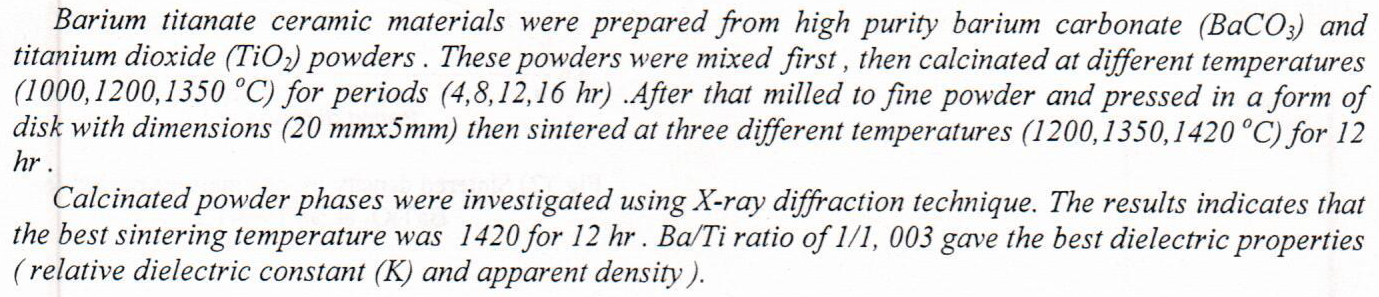
Preparation, Characterization, and Properties of Barium Titanate


Date stones were used as precursor for the preparation of activated carbons by chemical
activation with ferric chloride and zinc chloride. The effects of operating conditions represented
by the activation time, activation temperature, and impregnation ratio on the yield and adsorption
capacity towards methylene blue (MB) of prepared activated carbon by ferric chloride activation
(FAC) and zinc chloride activation (ZAC) were studied. For FAC, an optimum conditions of 1.25
h activation time, 700 °C activation temperature, and 1.5 impregnation ratio gave 185.15 mg/g
MB uptake and 47.08 % yield, while for ZAC, 240.77 mg/g MB uptake and 40.46 % yield were
obtained at the optimum conditions of 1.25 h activation time, 500
 (8)
(8)
The aim of this study was to compare the effect of conventional implant site preparation technique and a combination of conventional/piezosurgery preparation on implant stability measured at different time intervals, insertion torque, and preparation time. A randomized controlled study was designed, it included 26 patients who received 54 dental implants randomly assigned to 2 groups; in the control group, implants were installed after conventional preparation with drills whereas the study group received implants after mixed conventional/piezosurgery preparation. The outcome variables included: implant stability measured immediately after implant insertion, at 8 weeks and 16 weeks postoperatively, insertion torque and preparation time. All
... Show More (11)
(10)
(11)
(10)


Gallium arsenide diamondoids structural and vibrational properties are investigated using density functional theory at the PBE/6-31(d) level and basis including polarization functions. Variation of energy gap as these diamondoids increase in size is seen to follow confinement theory for diamondoids having nearly equiaxed dimensions. Density of energy states transforms from nearly single levels to band structure as we reach larger diamondoids. Bonds of surface hydrogen with As atoms are relatively localized and shorter than that bonded to Ga atoms. Ga-As bonds have a distribution range of values due to surface reconstruction and effect of bonding to hydrogen atoms. Experimental bulk Ga-As bond length (2.45 Å) is within this distribu
... Show More
(10)
(9)
In this work, the role of s ubs trate temperature in the range (293-423)K on the structure and microstructure of CuInSTe thin films was investigated. The results showed that the structure was amorphous for films prepared at ambient temperature Ts=293Kwhile it was polycrys talline for films prepared at high temperature. The grain s ize and roughness increased with increasing substrate temperature. The frequency and temperature dependencies upon AC conductivity were investigated in the frequency range 100Hz-10MHz and temperature of heat treatment in the range of 303-453K. The AC activation energy was found to increase from 0.1132 to 0.1258 eV with increas ing s ubs trate temperature from 293 to 423K and decreas e to 0.0962 eV with inc
... Show More
(6)
(1)
In this work, (ZnO)1-x(MnO2)x compounds were synthesized with composition (x=0, 0.1, 0.2, 0.3, 0.4, and 0.5) of manganese oxide content using solid state reaction. Thin films were prepared from these compounds on glass substrates at room temperature using pulsed laser deposition method. The structure of the prepared compounds and thin films were analyzed using x-ray diffraction while the optical properties was measured using UV-visible spectrophotometry. It was found that the synthesized composites declared many peaks in the diffraction pattern which indicate polycrystalline structure with hexagonal wurtzite hexagonal structure of ZnO, and MnO2 and Mn2O3 secondary phases. A narrowing in the optical energy gap was found as Mn content increas
... Show More
(6)
Results of a study of alloys and films with various Pb content have been reported and discussed. Films of of thickness 1.5
(1)
(2)
In this work, the preparation of some new oxazolidine and thiazolidine derivatives has been conducted. This was done over two steps; the first step included the synthesis of Schiff bases A1-A5 in 72-88% yields by the condensation of isonicotinic acid hydrazide and aldehydes. The second step includes the cyclization of derivatives A1-A5 with glycolic acid and thioglycolic acid to obtain the desired products, oxazolidine derivatives B1-B5 (44-60% yields) and thiazolidine derivatives C1-C5 (41-61% yields), respectively. The structure of the prepared compounds was characterized using FT-IR, 1H NMR, and 13C NMR spectroscopy. Some of the produced compounds were tested for antioxidant properties.
(4)
(4)
In this study, zinc oxide was prepared by pulsed laser ablation method (PLAL), which is an easy-to-use and inexpensive physical method. The optical properties were studied using UV-Vis spectrometers, structure properties by (XRD) to calculate the crystalline size, and particle size determination by Field emission scanning electron microscopy (FE-SEM) and (EDS), transmission electron microscopy (TEM) assays and it was proved that they are within the ideal nanoscale for biological application. These ZnO NPs were employed on the inhibitory activity of different types of Gram-positive and Gram-negative bacteria, as well as on fungi, and it was noted their ability to penetrate the bacterial cell wall and inhibit its action.
(19)
(12)