Preparation, Characterization, and Properties of Barium Titanate
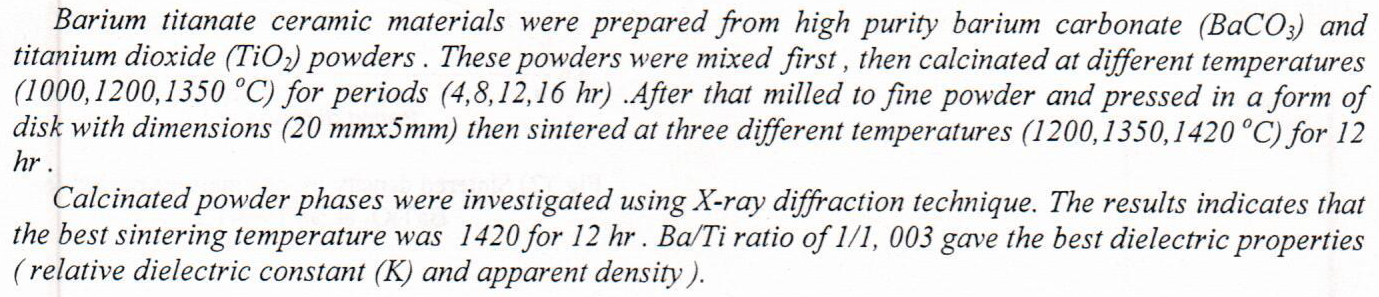

 (1)
(1)


Objective(s): In the present study, glycerin is used as a substitute for tin-foil and cold mold seal (Alginate mould seal)
in the process of curing heat and cold-cure acrylic resin denture base against stone and plaster.
Methodology: 60 specimens were prepared from heat-cure acrylic resin and cold-cure acrylic resin denture base. The
study includes 12 groups of specimens depending on the type of processing, investment material and type of
separating medium that are used in curing process. Each group of them contains 5 specimens for each test.
Some of physical properties of the processed acrylic denture base that (water sorption and solubility) have been
compared with those processed using tin-foil and tin-foil substitut
(26)
 (26)
(26)
 (4)
(4)
(4)
(4)
The purpose of the current work was to evaluate the effect of Radiation of Gamma on the superconducting characteristics of the compound PbBr2Ca1.9Sb0.1Cu3O8+δ utilizing a 137Cs source at doses of 10, 15, and 20MRad. Solid state reaction technology was used to prepare the samples. Before and after irradiation, X-ray diffraction (XRD) and superconductor properties were examined. Results indicated that the tetragonal structure of our chemical corresponds to the Pb-1223 phase with an increase in the ratio c/a as a result of gamma irradiation. (Tc (onset) ) and on set temperature Tc (offset)) were also dropping from 113 to the 85.6 K and 129.5 to 97 K, respectively, for a transition temperatu
(15)
(9)
(2)
Abstract: The M(II) complexes [M2(phen)2(L)(H2O)2Cl2] in (2:1:2 (M:L:phen) molar ratio, (where M(II) =Mn(II), Co(II), Cu(II), Ni(II) and Hg(II), phen = 1,10-phenanthroline; L = 2,2'-(1Z,1'Z)-(biphenyl-4,4'-diylbis(azan-1-yl-1-ylidene))bis(methan-1-yl-1- ylidene)diphenol] were synthesized. The mixed complexes have been prepared and characterized using 1H and13C NMR, UV/Visible, FTIR spectra methods and elemental microanalysis, as well as magnetic susceptibility and conductivity measurements. The metal complexes were tested in vitro against three types of pathogenic bacteria microorganisms: Staphylococcus aurous, Escherichia coli, Bacillussubtilis and Pseudomonasaeroginosa to assess their antimicrobial properties. From this study shows that a
... Show More