Preparation, Characterization, and Properties of Barium Titanate
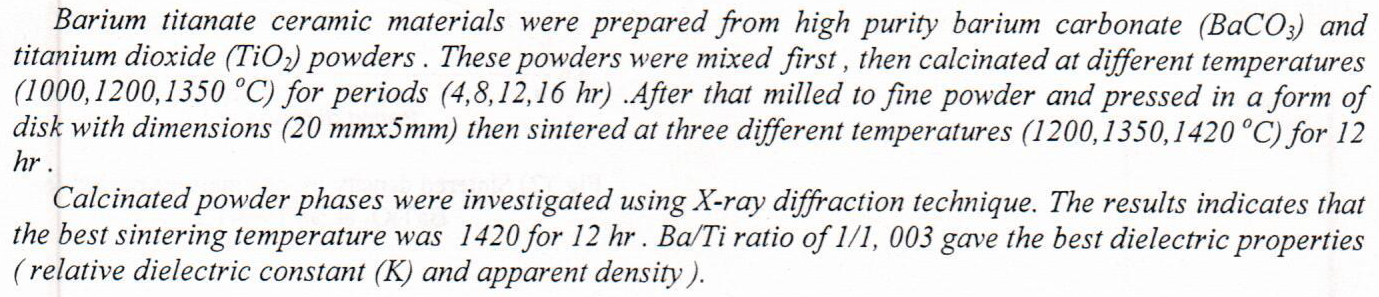

 (11)
(11)
 (11)
(11)


 (11)
(11)
(11)
(11)
This article reviews the construction of organic solar cell (OSC) and characterized their optical and electrical properties, where indium tin oxide (ITO) used as a transparent electrode, “Poly (3-hexylthiophene- 2,5-diyl) P3HT / Poly (9,9-dioctylfluorene-alt-benzothiadiazole) F8BT” as an active layer and “Poly(3,4-ethylenedioxythiophene)-poly (styrene sulfonate)” PEDOT: PSS which is referred to the hole transport layer. Spin coating technique was used to prepared polymers thin film layers under ambient atmosphere to make OSC. The prepared samples were characterized after annealing process at (80 ͦ C) for (30 min) under non-isolated circumference. The results show a value of filling factor (FF) of (2.888), (0.233) and (0.28
... Show More
(1)
by in situ polymerization of aniline monomer, conducting polyaniline (PANI) nanocomposites containing various concentrations of carboxylic acid functionalized multi-walled carbon nanotubes (f-MWCNT) were synthesized. The morphological and electrical properties of pure PANI and PANI /MWCNT nanocomposites were examined by using Fourier transform- infrared spectroscopy (FTIR), X-ray diffraction (XRD) and Atomic Force Microscopy (AFM) respectively. FTIR spectra shows that the carboxylic acid groups formed at the both ends of the sidewalls of the MWCNTs. The aniline monomers were polymerized on the surface of MWCNTs, depending on the -* electron interaction between aniline monomers and MWCNTs and hydrogen bonding into interaction between t
... Show MorePolymers, being one of the most important materials in dentistry, offer great physical and mechanical qualities, as well as good biocompatibility. Aim of this study was done to evaluate the Polyetherketoneketone and Polyetherketoneketone polymer composite material used as dental implant through tensile strength, Fourier Transform Infrared analysis FTIR, and wettability). Polyetherketoneketone composites (Polyetherketoneketone and Strontium-containing hydroxyapatite) with selected weight percentage ratios of (0, 10%, 20%, 30%), were fabricated using a compression molding technique”, The study involved Samples preparation (sheets) shaped and form into the desired shape according to standard for tests which included tensile strength,
... Show More
(8)
(8)
Objective: The objective of the present study was to design and optimize oral fast dissolving film (OFDF) of practically insoluble drug lafutidine in order to enhance bioavailability and patient compliance especially for a geriatric and unconscious patient who are suffering from difficulty in swallowing.Methods: The films were prepared by a solvent casting method using low-grade hydroxyl propyl methyl cellulose (HPMC E5), polyvinyl alcohol (PVA), and sodium carboxymethyl cellulose (SCMC) as film forming polymers. Polyethylene glycol 400 (PEG400), propylene glycol (PG) and glycerin were used as a plasticizer to enhance the film forming properties of the polymer. Tween 80 (1% solution) and poloxamer407 were used as a surfactant, citri
... Show More
(15)
(7)
The purpose of this research was to prepare, characterize, and evaluate the new antimicrobial peptide KSL peptide encapsulated in poly(D,L-lactide-co-glycolide) (PLGA)composite microspheres. KSL was loaded in poly(acryloyl hydroxyethyl) starch (acHES) micropar-ticles, and then the peptide-containing microparticles were encapsulated in the PLGA matrix by a solvent extraction /evaporation method.
KSL-loaded PLGA microspheres were also prepared without the starch hydrogel microparticle microspheres for comparison study. KSL peptide microspheres were characterized for drug content, surface morphology, microspheres size determination, polymers stability , in vitro microspheres degradation and in vitro release. KSL peptide
... Show More
Abstract:
In this study a type of polymeric composites from melting poly propylene as a basic substance with Palm fronds powder were prepared. Evaluation of polymeric composites was done by studying some of it is mechanical properties, which included:Yong modulus (E), Impact Strength (I.S), Brinell hardness (B.H) and Compression Strength (C.S). The polymeric composites were studied before and after reinforcment by comparing between them. There was an increase in resistance of Yong modulus (E), Impact Strength (I.S), Brinell hardness (B.H) and compression Strength (C.S). Also, the effect of some acids were studied such as (HCl, H2
(2)
(1)
(15)
(11)
Nanomaterials, including nanoparticles such as iron oxide nanoparticles, have received great attention from researchers due to their unique properties and applications. There are several diverse methods, including chemical, physical, and green biological methods, to prepare iron oxide nanoparticles. The green method was chosen because it is safer, purer, and less toxic compared to other methods. Therefore, the green method is a promising and environmentally friendly method in the near future. The aqueous extract of Iraqi orange leaves was used to prepare nano iron oxide, it was examined structurally and spectrally by several techniques (X-ray diffraction- XRD, Fourier transform infrared - FT-IR, field emission scanning electron micr
... Show More
(2)
(1)