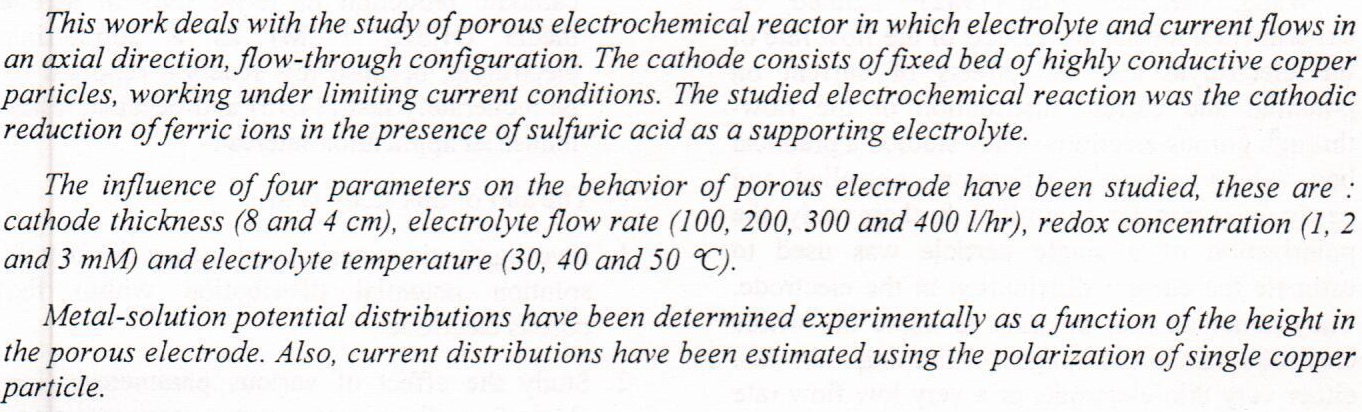
Potential and Current Distribution in Flow Through Porous Electrochemical Reactor Working under Limiting Current Conditions

 (15)
 (3)


Background: Cluster of differentiation 14 (CD14) is a serum/cell surface glycoprotein; and it is a pattern recognition receptor. CD14 expressed on the surface of various cells, or it found soluble in saliva and other body fluids. It has been proposed that soluble CD14 (sCD14) may play a protective role by controlling Gram negative bacterial infections through its capacity to bind lipopolysaccharide. This study was conducted to assess the level of soluble CD14 in saliva of patients with different periodontal diseases and healthy subjects and determine its correlation with clinical periodontal parameters. Materials & Methods: A total of 80 subjects, age ranged (25-50) years old, divided into three main groups, group ? consisted of 45 chronic
... Show MoreThis paper deals with an up to date problem for oil and gas industry- separation of the gas -fluid fogs. Here is described the worked out physical model of the gas movement process in the sections of the inertial filtering (IF) gas separators. One can find the mathematical model for research of the fields of velocities and pressures in the inertial curvilinear channel. The main simplifications and assumptions are explained. This mathematical model has been made using mathematical program Maple and it is received the 3-d graphic of the distribution componential speed parts in the channel and also 2-d graphics at the channel sectional view when the flow is flat. The new method for gas - fluid systems separation is suggested.
Experimental and numerical studies have been conducted for the effect of injected air bubbles on the heat transfer coefficient through the water flow in a vertical pipe under the influence of uniform heat flux. The investigated parameters were water flow rate of (10, 14 and 18) lit/min, air flow rate of (1.5, 3 and 4) lit/min for subjected heat fluxes of (27264, 36316 and 45398) W/m2. The energy, momentum and continuity equations were solved numerically to describe the motion of flow. Turbulence models k-ε was implemented. The mathematical model is using a CFD code Fluent (Ansys15). The water was used as continuous phase while the air was represented as dispersed. phase. The experimental work includes design, build and instrument a test
... Show MoreThe electrochemical behavior of carbon steel in water sweetening station in Libya has been studied in the range of ( 293–333 oC) using weight loss technique. Measurements were carried out over a range of Reynolds number (5000 – 25000).An apparatus was designed for studying the corrosion process in the turbulent regime, which is of industrial significance. It was found that The corrosion rate of carbon steel in water sweetening station is under diffusion control and increases with increasing Reynolds number. On the other hand the variation of corrosion rate with temperature in the range of (293–333 oC) was found to follow Arrhenius equation and the activation energy approximately the same except at low Reynolds
... Show MoreThe field of autonomous robotic systems has advanced tremendously in the last few years, allowing them to perform complicated tasks in various contexts. One of the most important and useful applications of guide robots is the support of the blind. The successful implementation of this study requires a more accurate and powerful self-localization system for guide robots in indoor environments. This paper proposes a self-localization system for guide robots. To successfully implement this study, images were collected from the perspective of a robot inside a room, and a deep learning system such as a convolutional neural network (CNN) was used. An image-based self-localization guide robot image-classification system delivers a more accura
... Show More
(4)
(2)
We explore the transform coefficients of fractal and exploit new method to improve the compression capabilities of these schemes. In most of the standard encoder/ decoder systems the quantization/ de-quantization managed as a separate step, here we introduce new way (method) to work (managed) simultaneously. Additional compression is achieved by this method with high image quality as you will see later.
The sol-gel route using an agar gel with calcium nitrate and phosphate solution as starting materials for producing hydroxyapatite (HAP). The product formed were needle like, zigzag and straight fibres. The fibrous products on sintering transformed into stoichiometric HAP with a biological Ca/P ratio of 1.67. The influences of pH, temperature, nature of base and phosphate solution on the growth of fibrous HAP were studied. The pH of the solution was found to greatly influence the growth rate and morphology of the resultant product. The optimum gel temperature was found to be 60oC and sintering temperature of 900oC for 1 hour. The crystalline, thermal, functional and morphological characteristics of the fibrous HAP were investigated.