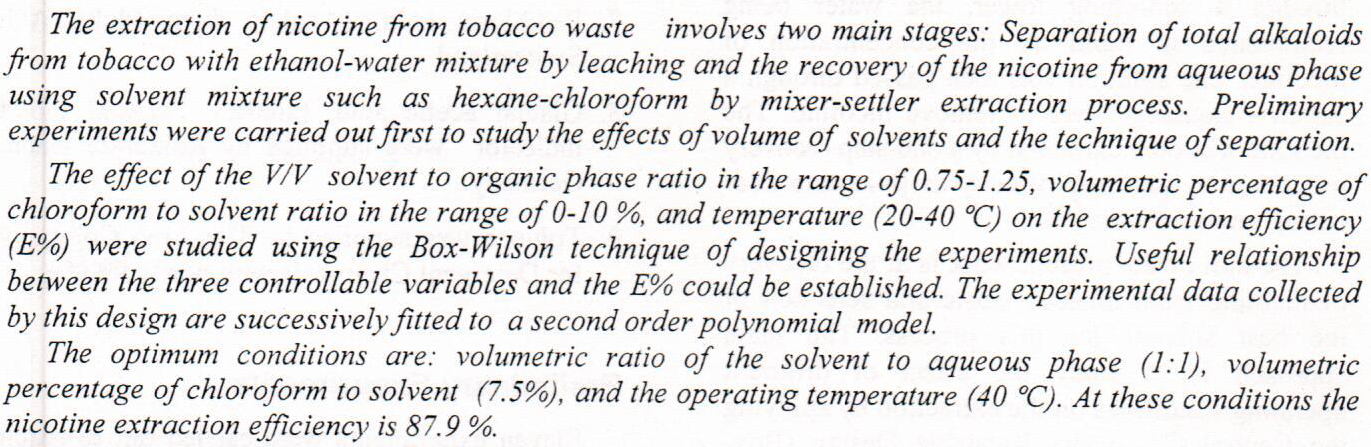
The Nicotine Extraction from Tobacco Wastes

 (33)
(33)
 (21)
(21)



Steps were taken to obtain the Kojic acid crystals from local fungal isolation A. flavus WJF81 by separating the fermentation products from the fungus mycelium from the production plant at the centrifuge at a speed of 5000 cycles for 10 minutes. The extraction was followed by ethyl acetate then supernatant concentrate by using rotary evaporator, and dried with heat oven 37ºC. Long, yellowish, pristine acid crystals were obtained that examined the optical microscope with a magnification force of 10x and 40x. The melting point of kojic acid was determined between 152.9-153.5 °C Results of the diagnosis of Kojic acid by applying High pressure liquid chromatography HPLC technique showed that the acid was at one peak, which was close to the
... Show MoreThe study aimed at identifying the role of the Faculty of Education in the community service in light of vision of the Kingdom 2030 from the faculty members’ point of view at the University of Jeddah. The study used a descriptive method through a questionnaire administered to a sample of the faculty members.It concluded that the role of the College in serving the community is the development of the right habits in the family and the importance of establishing bridges of cooperation between the Faculty of Education and the surrounding environment and teaching special education teachers how to apply some methods of measurement to determine the needs of students with disabilities. The results also pointed out that there are no statistical
... Show MorePraise be to God who created the soul, perfected it, and inspired it with its immorality and piety. He says in His Noble Book: ﭤ Fajr: 27-30 Glory be to You, O God! O Lord, on whom I have chosen for You as a beloved from myself and the soul of the two worlds, may our master Muhammad be sacrificed for him, who enlightened the horizons with his introduction to enlightenment. It soon ends with the end of pleasure, which is the opposite of the pleasure of thought and meaning, as it is permanent and continuous, and from here we see that the Messenger of God, may God’s prayers and peace be upon him, urges us in various places to seek knowledge and fortify the soul and thought in a way that raises one’s status and protects him from the st
... Show MoreThe environment and the placesthat prince Faisal Bin AL-Husein influenced his childhood ,
behaviourand future . his expereence in his early life in leading the battles and
arabRevoluionenriched him . inspite of his short periedand harsh experience of leadersmp.
he gained an experienencein ruling iraqadter 1921 . The Syrian experiencetaught him how to
deal with the strong and establish the government as he beliered in the slogan: independence
is taken not given. He established the consititution and the election . he made a solid
basefeconomy of in his time, Iraq , Iraq be came the country number ( 53) as an
independency country on the third of November 1932 . he died peacefuliy after Iraq's
indepence.
The university press is an essential pillar in building an academic community to achieve its objectives in the service of society. Since the university press is a means of university media, which is issued by the departments or units of media in Iraqi universities as academic governmental-institutions, so it highlights the activities of the university and link them to its internal society in the first place as the university press is a mirror of the university and its voice is sincerely expressed. This research comes to know the extent of interest of the university press in various student issues.
In order to identify the problem of the research, the method of content analysis was adopted within the survey method
... Show More
هدف البحث التعرف الى اسباب سلوك التنمر لدى طلاب الصف الاول المتوسط من وجهة نظر المدرسين والمدرسات واساليب تعديله، واستعمل الباحثان المنهج الوصفي واختيار عينة عشوائية من المدرسين والمدرسات في متوسطة أرض الرافدين ومتوسطة الرحمن للبنين وكان عددهم (46) مدرساً ومدرسة بواقع (32) مدرساً و(14) مدرسة، واعتمد الباحثان الاستبانة أداة للتعرف الى اسباب سلوك التنمر واساليب تعديله، واشارت نتائج البحث الى تنوع اسباب التن
... Show MoreOil pollution of the soil due to a leakage in oil tubes, transportation of products, or during oil excavations can change the soil physical and mechanical, chemical, and biological properties. Consequently, the soil may or may not be eligible for engineering construction projects and it may need a significant treatment. Therefore, it is required to have a better understanding of the general behavior and the corresponding geotechnical properties upon pollution particularly for those areas associated with oil explorations and industry like Thi-Qar Governorate. Fine and coarse soils from two sites at the University of Thi-Qar are artificially contaminated with oil products ranging from 0% to 10% of their dry weight. Testing programs have been
... Show Morehe effect of different cultural conditions on production of bioemulsifier from Serratia marcescens S10 was determined; different carbon and nitrogen sources were used such as: different oils include: edible (vegetable) oils (olive oil, sesame oil, sun flower oil and corn oil) and heavy oils (oil 150, oil 60, oil 40) as carbon sources and (NH4Cl, casein, (NH4)2SO4, peptone, tryptone, gelatin and yeast extract) as nitrogen sources were added to production media. Bioemulsifier was estimated by measuring the surface tension (S.T), emulsification activity (E.A) and emulsification index (E24%). The best results of bioemulsifier production from Serratia marcescens S10 were obtained at pH8 and incubated at 37ºC for 5days, using sesame oil
... Show More
(1)
The current study aims to identify the level of adaptation of the curriculum for visually handicapped pupils from the point of view of their teachers as well as to identify the level of adaptation of the educational programs offered to visually handicapped pupils from the point of view of their teachers. In order to achieve the goals of the research, the researcher developed two tools to measure the adaptation of curricula and educational programs for pupils with visual handicapped from the point of view of teachers. The sample included (60) teachers from Al Noor Institute for Blinders in Baghdad, the two tools were applied to them, and then the Reliability and Validity coefficients were extracted. The results sh
... Show More