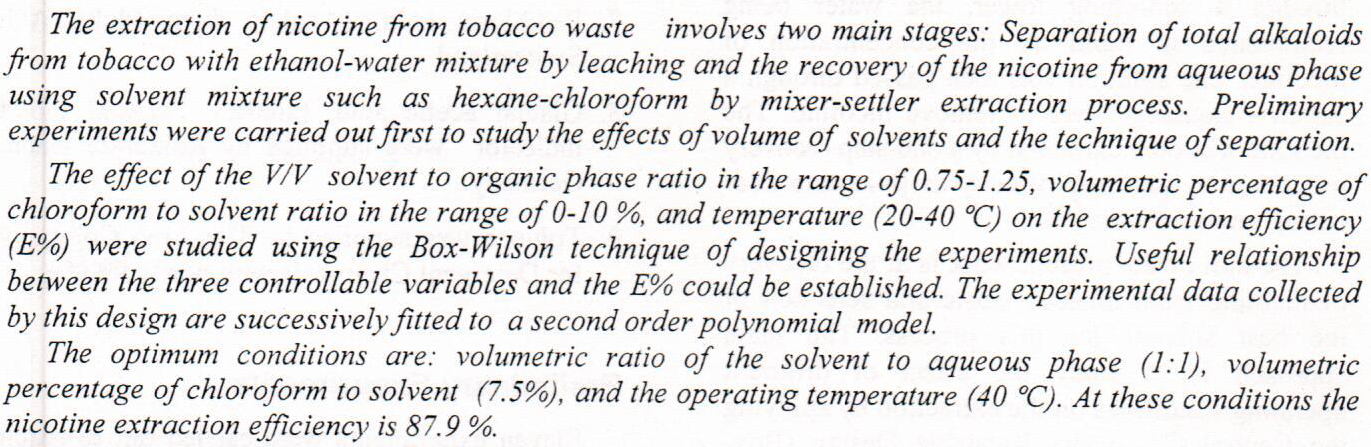
The Nicotine Extraction from Tobacco Wastes

The research seeks to find out the extent of the coverage of the Mosul press to the issues of psychological and social effects of the organization "IS" on the community of Mosul, by analyzing the content of the newspapers “Economic City” and “Mosul News”. As well as to stand at the types of psychological and social effects and their repercussions on the Mosul community including figures, statistics and evidence that were covered in the theoretical study of these topics.
This study is the first scientific diagnosis to reveal the size and types of psychological and social effects of the “ISIS” organization through what was monitored by the Mosul press. The study seeks to draw the attention of officials, decision-m
... Show More
Six isolates of A. pullulans were collected from many sources including Hibiscus sabdariffa (Roselle), old Roofs of houses and bathroom surface that referred as Ap ros1, Ap or2, 3, 4 and Ap bs5, 6 respectively, all these isolates were identified based on morphological characteristics and nutritional physiology profiles, all were able to utilize various carbon and nitrogen sources such as glucose, xylose, sucrose, maltose, ammonium sulfate, ammonium nitrate and ammonium chloride, also they showed positive test for starch and amylase, while α-cellulose, ethanol, and methanol were could not be ass
... Show MoreThe aim of the present study was to isolated the Enterococcus spp. from milk samples of cow and vaginal swabs from aborted women and patient women in Baghdad during September 2016 to april 2017. All 100 milk sample collecting was carried out on California Mastitis Test (CMT) and the positive Percentage of CMT reactions was 5% and the percentage of Enterococcus isolates from mastitic milk was 60% and 30% from nonmasitic milk. The prevalence of Enterococcus spp was 31% of milk samples and the prevalence of Enterococcus spp. Isolates were 67.74% of the isolates of cow milk samples were Enterococcus faecalis, 25.80% was Group D and 6.45% was non groupable while Enterococcus spp. isolates from aborted women samples were 20% and all isolated was
... Show MoreA many risk challenge in (settings hospital) are multi- bacteria are antibiotic-resistant. Some type strains that ability adhesion surface-attached bio-film census. Fifteen MRSA isolates were considered as high biofilm producers Moreover all MRSA isolates; M3, M5, M7 and M11 produced biofilms but the thickest biofilm seen M7strain. The MIC values of N. sativa oil against clinical isolates of MRSA were between (0.25, 0.5, 0.75, 1.0) μg/ml While MRSAcin (50, 75, 100, 125) µg\ ml. All biofilms treated with MRSAcin and Nigella sativa developed a presence of live cells after cultured on plate agar with inhibition zone between MIC (18 – 15) and (14- 11)mm respectively.Yet, results showed that MRSA supernatant developed a inhibitory ef
... Show More (8)
(8)
 (8)
(8)

Biological activity of the carotenoids which are produced fromchemically-mutaed local isolate of Rhodotorula mucilaginosawas studied. The results showed variation of inhibition activity of caritenoids against different types of pathogenic bacteria include, Staph aureus, E. coli, B. subtilis and Salmo. typh., the number declined from 2×10⁷cell/ml to 2×10⁴, 5×10⁴, 2×10⁵, 9×10⁵ cell/ml respectively after 24hour. The produced carotenoids from alocal mutant Rhodotorula mucilaginosa revealed an antioxidant activity as free radical removal of 85.6%. Carotinoides revealed a highest stability in petroleum ether solvent for 30 days at room temperature. It found that the pigment was more stability in sesame oil compared with sun flower and coc
... Show MoreThis study investigates the stomach morphology and histochemistry of Clarias gariepinus. Grossly, the stomach is a J-shaped organ with three distinct regions: cardiac, fundic, and pyloric. Histologically, its wall comprises four layers: mucosa, submucosa, muscularis externa, and serosa. The mucosa exhibits broad longitudinal folds lined by high columnar cells with basal oval nuclei. These cells contain apical mucosubstances that react positively with Periodic Acid Schiff (PAS) stain and negatively with Alcian Blue (AB). Gastric pits result from mucosal invaginations. Glands are present in the fundic and cardiac regions but absent in the pyloric. Oxynticopeptic cells exclusively line the fundic glands. Enteroendocrine cells are distr
... Show More
This study aimed to reveal the degree possession of secondary teachers for effective teaching skills from the perspective of the teachers themselves in the Mafraq governorate .To achieve the objective of the study(45) teachers were chosen randomly, also a questionnaire composed of 17 was prepared spread over three skill areas (planning, implementation, evaluation).
After application of the tool on the sample results of the study showed that the degree of ownership ranged between medium and high.
The results showed no differences in the degree of ownership due to the variables of sex in favor of females and variable qualification for the benefit of people with qualified Master higher, while differences are attributed to the experien
At the beginning of 1935 theMinistry of (Yasin AL-Hashimi) was formed which was the result of the (Sulayikh)Conference .The new ministys policy was towards the authority of the one party and the exclusivity of power.The policy of (Yasin AL-Hashemi)has faced severe campaigns from the AL-Ekhaa and AL-Ahaly newspapers.The new ministry like its predecessor ministries . When it faces criticism from opposition newspapers .its shutting down newspapers and not accepting requests for them. Some opposition newspapers named Yassin AL-Hashemi (the dictator).Iraqi opposition newspapers have been neglected and deprived of press freedom although they were the main factor in educating the community and representing the public opinion of people . Lt appe
... Show MoreThe research aims to identify intelligence spiritual among a sample of students Baghdad University as well as to identify the differences between students in intelligence spiritual according to variable type (male - female), and variable area of study (Science - a human) and variable (First grade - fourth grade), The research sample consisted of (300) students, were applied scale search - a spiritual Intelligence Scale (prepared by the researcher), has resulted in the search results for: -
The students of the University of Baghdad (sample) enjoyed a high level of spiritual intelligence.
- There are no differences between males and females in the spiritual intelligence.
- There
This study investigates the stomach morphology and histochemistry of Clarias gariepinus. Grossly, the stomach is a J-shaped organ with three distinct regions: cardiac, fundic, and pyloric. Histologically, its wall comprises four layers: mucosa, submucosa, muscularis externa, and serosa. The mucosa exhibits broad longitudinal folds lined by high columnar cells with basal oval nuclei. These cells contain apical mucosubstances that react positively with Periodic Acid Schiff (PAS) stain and negatively with Alcian Blue (AB). Gastric pits result from mucosal invaginations. Glands are present in the fundic and cardiac regions but absent in the pyloric. Oxynticopeptic cells exclusively line the fundic glands. Enteroendocrine cells are distr
... Show More